Chan Connie V, Kaufman David R
Biomedical Informatics, Columbia University, New York, NY 10032, USA.
J Med Internet Res. 2011 Nov 17;13(4):e94. doi: 10.2196/jmir.1750.
Consumer eHealth interventions are of a growing importance in the individual management of health and health behaviors. However, a range of access, resources, and skills barriers prevent health care consumers from fully engaging in and benefiting from the spectrum of eHealth interventions. Consumers may engage in a range of eHealth tasks, such as participating in health discussion forums and entering information into a personal health record. eHealth literacy names a set of skills and knowledge that are essential for productive interactions with technology-based health tools, such as proficiency in information retrieval strategies, and communicating health concepts effectively.
We propose a theoretical and methodological framework for characterizing complexity of eHealth tasks, which can be used to diagnose and describe literacy barriers and inform the development of solution strategies.
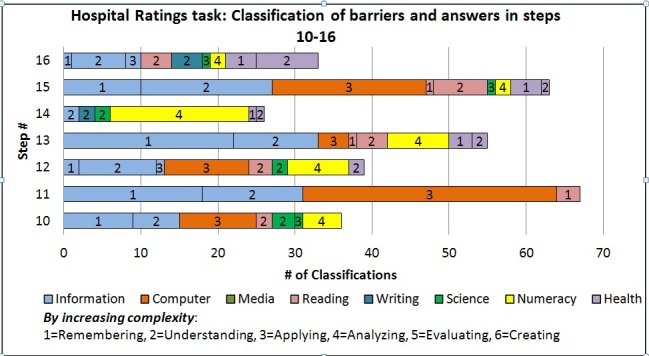
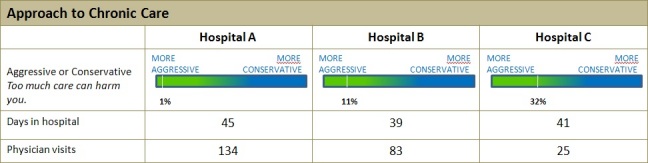
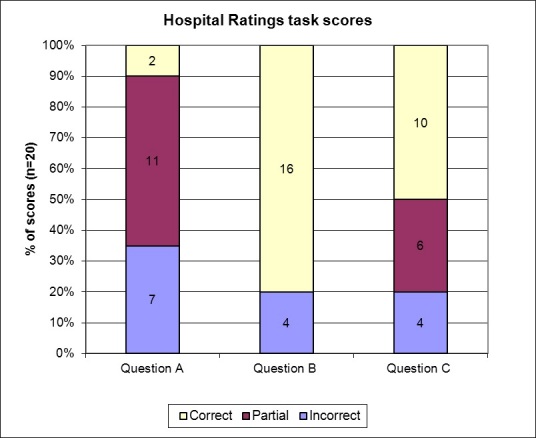
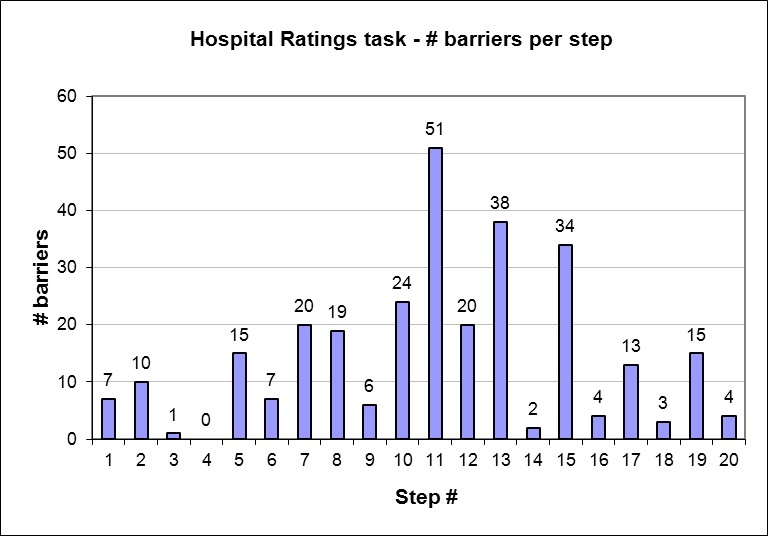
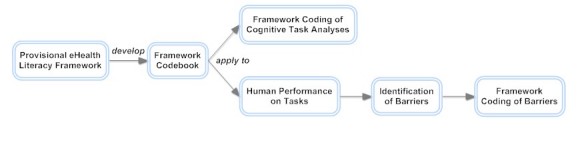
We adapted and integrated two existing theoretical models relevant to the analysis of eHealth literacy into a single framework to systematically categorize and describe task demands and user performance on tasks needed by health care consumers in the information age. The method derived from the framework is applied to (1) code task demands using a cognitive task analysis, and (2) code user performance on tasks. The framework and method are applied to the analysis of a Web-based consumer eHealth task with information-seeking and decision-making demands. We present the results from the in-depth analysis of the task performance of a single user as well as of 20 users on the same task to illustrate both the detailed analysis and the aggregate measures obtained and potential analyses that can be performed using this method.
The analysis shows that the framework can be used to classify task demands as well as the barriers encountered in user performance of the tasks. Our approach can be used to (1) characterize the challenges confronted by participants in performing the tasks, (2) determine the extent to which application of the framework to the cognitive task analysis can predict and explain the problems encountered by participants, and (3) inform revisions to the framework to increase accuracy of predictions.
The results of this illustrative application suggest that the framework is useful for characterizing task complexity and for diagnosing and explaining barriers encountered in task completion. The framework and analytic approach can be a potentially powerful generative research platform to inform development of rigorous eHealth examination and design instruments, such as to assess eHealth competence, to design and evaluate consumer eHealth tools, and to develop an eHealth curriculum.
消费者电子健康干预在个人健康及健康行为管理中日益重要。然而,一系列获取途径、资源和技能障碍阻碍了医疗保健消费者充分参与电子健康干预并从中受益。消费者可能会参与一系列电子健康任务,例如参加健康讨论论坛以及将信息录入个人健康记录。电子健康素养指的是与基于技术的健康工具进行有效互动所必需的一系列技能和知识,比如信息检索策略的熟练程度以及有效传达健康概念的能力。
我们提出一个用于描述电子健康任务复杂性的理论和方法框架,该框架可用于诊断和描述素养障碍,并为解决方案策略的制定提供依据。
我们对与电子健康素养分析相关的两个现有理论模型进行了改编和整合,形成一个单一框架,以系统地分类和描述信息时代医疗保健消费者所需任务的任务要求和用户表现。从该框架衍生出的方法应用于:(1)使用认知任务分析对任务要求进行编码,(2)对任务的用户表现进行编码。该框架和方法应用于对一项具有信息搜索和决策要求的基于网络的消费者电子健康任务的分析。我们展示了对单个用户以及20名用户在同一任务上的任务表现进行深入分析的结果,以说明详细分析以及所获得的汇总测量结果,以及使用此方法可进行的潜在分析。
分析表明,该框架可用于对任务要求以及任务用户表现中遇到的障碍进行分类。我们的方法可用于:(1)描述参与者在执行任务时面临的挑战,(2)确定将该框架应用于认知任务分析能够预测和解释参与者遇到的问题的程度,(3)为框架的修订提供依据以提高预测的准确性。
这个示例应用的结果表明,该框架对于描述任务复杂性以及诊断和解释任务完成过程中遇到的障碍很有用。该框架和分析方法可能是一个强大的生成性研究平台,可为严格的电子健康检查和设计工具的开发提供依据,例如评估电子健康能力、设计和评估消费者电子健康工具以及开发电子健康课程。