Department of Rheumatology, Felix-Platter-Spital, University of Basel, Basel, Switzerland.
J Inflamm Res. 2011;4:21-7. doi: 10.2147/JIR.S10602. Epub 2011 Feb 4.
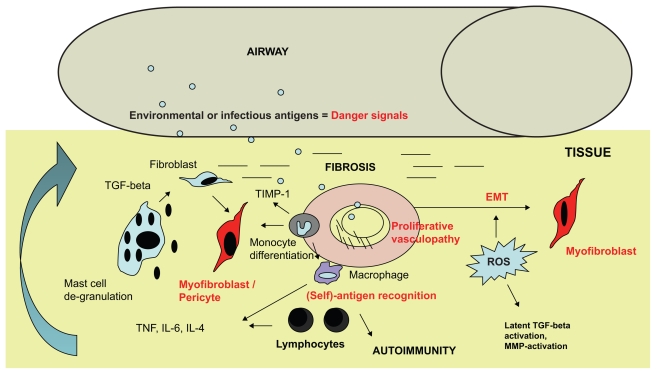
Interstitial lung disease (ILD) and lung fibrosis are characterized by different grades of fibrosis and inflammation. Persistent low-grade inflammation is believed to play a major pathogenic role, leading to an imbalance of cytokines, growth factors, and tissue proteinases. Recruited monocytes and macrophages play a pivotal role through their cytokine expression and possibly differentiation into fibrocytes, pericytes, or myofibroblasts. Atypical bacterial infections can cause ILD, although not usually in the form of usual interstitial pneumonia. On the other hand, bacterial colonization is frequently encountered in patients with chronic fibrotic lung disorders, and patients regularly undergo antibacterial treatment. As demonstrated in patients with diffuse panbronchiolitis and other chronic respiratory disorders, treatment with macrolides can be beneficial. This is partly explained by their antimicrobial effects but, for macrolides, immunomodulatory properties have been identified which might also be beneficial in patients with ILD or lung fibrosis. This article reviews the immunology of lung fibrogenesis and putative implications of macrolides for reinstallation of tolerance.
间质性肺病(ILD)和肺纤维化的特征是不同程度的纤维化和炎症。持续的低度炎症被认为在发病机制中起主要作用,导致细胞因子、生长因子和组织蛋白酶失衡。募集的单核细胞和巨噬细胞通过细胞因子表达并可能分化为成纤维细胞、周细胞或肌成纤维细胞发挥关键作用。非典型细菌感染可引起ILD,但通常不以间质性肺炎的形式出现。另一方面,慢性纤维性肺疾病患者经常发生细菌定植,并且患者经常接受抗菌治疗。如弥漫性泛细支气管炎和其他慢性呼吸道疾病患者所证明的那样,大环内酯类药物治疗可能是有益的。这部分是由于它们的抗菌作用,但对于大环内酯类药物,已经确定了其免疫调节特性,这在ILD 或肺纤维化患者中也可能有益。本文综述了肺纤维化发生的免疫学以及大环内酯类药物重新建立耐受的潜在意义。