Neuroimaging Group, Department of Psychiatry and Psychotherapy, University Hospital Cologne, Cologne, Germany.
PLoS One. 2011;6(11):e27591. doi: 10.1371/journal.pone.0027591. Epub 2011 Nov 9.
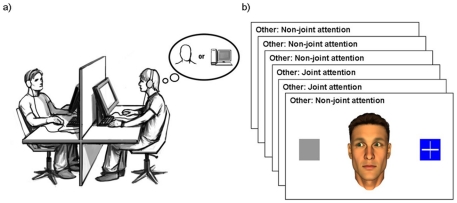
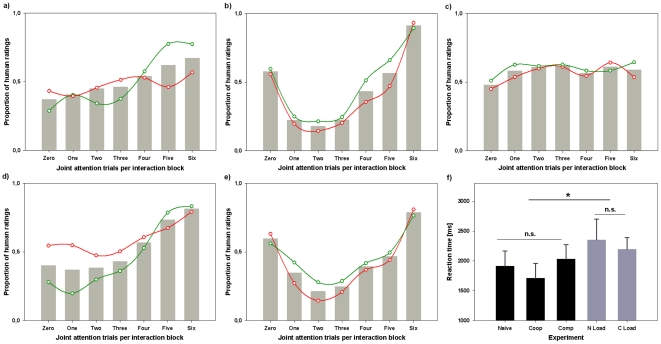
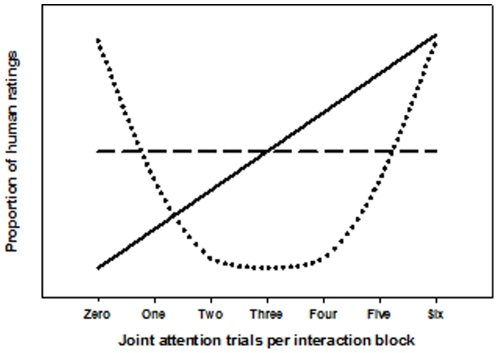
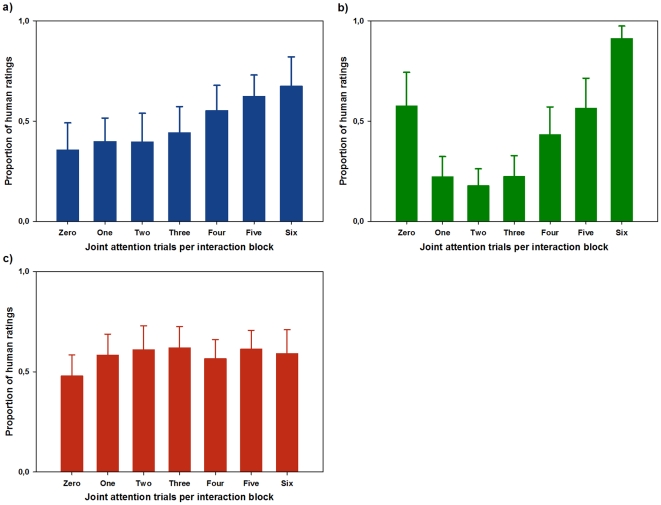
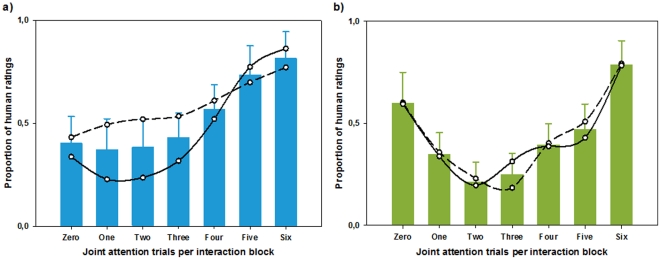
In social interaction, gaze behavior provides important signals that have a significant impact on our perception of others. Previous investigations, however, have relied on paradigms in which participants are passive observers of other persons' gazes and do not adjust their gaze behavior as is the case in real-life social encounters. We used an interactive eye-tracking paradigm that allows participants to interact with an anthropomorphic virtual character whose gaze behavior is responsive to where the participant looks on the stimulus screen in real time. The character's gaze reactions were systematically varied along a continuum from a maximal probability of gaze aversion to a maximal probability of gaze-following during brief interactions, thereby varying contingency and congruency of the reactions. We investigated how these variations influenced whether participants believed that the character was controlled by another person (i.e., a confederate) or a computer program. In a series of experiments, the human confederate was either introduced as naïve to the task, cooperative, or competitive. Results demonstrate that the ascription of humanness increases with higher congruency of gaze reactions when participants are interacting with a naïve partner. In contrast, humanness ascription is driven by the degree of contingency irrespective of congruency when the confederate was introduced as cooperative. Conversely, during interaction with a competitive confederate, judgments were neither based on congruency nor on contingency. These results offer important insights into what renders the experience of an interaction truly social: Humans appear to have a default expectation of reciprocation that can be influenced drastically by the presumed disposition of the interactor to either cooperate or compete.
在社交互动中,目光行为提供了重要的信号,对我们对他人的感知有重大影响。然而,之前的研究依赖于这样的范式,即参与者是他人目光的被动观察者,而不是像现实社交互动中那样调整自己的目光行为。我们使用了一种交互式眼动追踪范式,允许参与者与一个拟人化的虚拟角色互动,该角色的目光行为会实时响应参与者在刺激屏幕上的注视位置。角色的目光反应沿着从最大回避概率到最大跟随概率的连续体系统地变化,从而改变反应的偶然性和一致性。我们研究了这些变化如何影响参与者是否认为角色是由另一个人(即共谋者)或计算机程序控制的。在一系列实验中,人类共谋者要么对任务一无所知,要么合作,要么竞争。结果表明,当参与者与天真的伙伴互动时,目光反应的一致性越高,赋予人类的程度就越高。相比之下,当共谋者被介绍为合作时,人类的归因则取决于偶然性,而不取决于一致性。这些结果为理解什么使互动体验真正具有社交性提供了重要的见解:人类似乎有一种默认的互惠期望,这种期望可以被互动者合作或竞争的假定倾向极大地影响。