Department of Health Services Research and Policy, London School of Hygiene and Tropical Medicine, London, UK.
BMC Pregnancy Childbirth. 2011 Nov 21;11:95. doi: 10.1186/1471-2393-11-95.
To compare the risk of placenta previa at second birth among women who had a cesarean section (CS) at first birth with women who delivered vaginally.
Retrospective cohort study of 399,674 women who gave birth to a singleton first and second baby between April 2000 and February 2009 in England. Multiple logistic regression was used to adjust the estimates for maternal age, ethnicity, deprivation, placenta previa at first birth, inter-birth interval and pregnancy complications. In addition, we conducted a meta-analysis of the reported results in peer-reviewed articles since 1980.
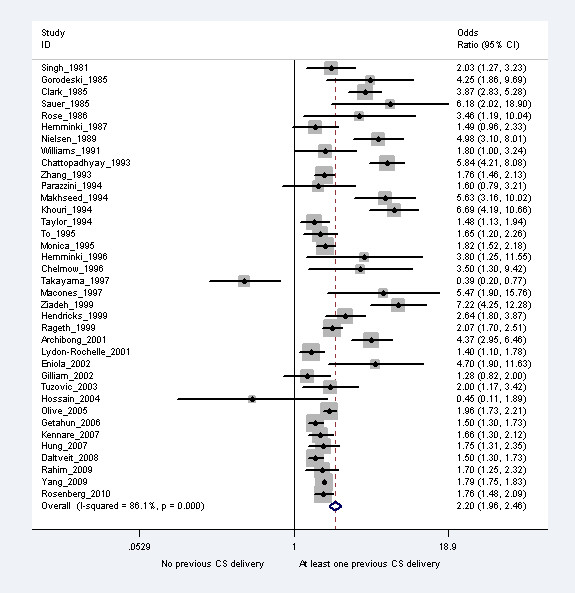
The rate of placenta previa at second birth for women with vaginal first births was 4.4 per 1000 births, compared to 8.7 per 1000 births for women with CS at first birth. After adjustment, CS at first birth remained associated with an increased risk of placenta previa (odds ratio = 1.60; 95% CI 1.44 to 1.76). In the meta-analysis of 37 previously published studies from 21 countries, the overall pooled random effects odds ratio was 2.20 (95% CI 1.96-2.46). Our results from the current study is consistent with those of the meta-analysis as the pooled odds ratio for the six population-based cohort studies that analyzed second births only was 1.51 (95% CI 1.39-1.65).
There is an increased risk of placenta previa in the subsequent pregnancy after CS delivery at first birth, but the risk is lower than previously estimated. Given the placenta previa rate in England and the adjusted effect of previous CS, 359 deliveries by CS at first birth would result in one additional case of placenta previa in the next pregnancy.
比较首次剖宫产(CS)分娩与阴道分娩的女性在第二次分娩时前置胎盘的风险。
这是一项回顾性队列研究,纳入了 2000 年 4 月至 2009 年 2 月期间在英格兰首次分娩单胎的 399674 名女性。采用多因素逻辑回归校正了母亲年龄、种族、贫困程度、首次分娩时前置胎盘、分娩间隔和妊娠并发症等因素的影响。此外,我们还对 1980 年以来已发表的同行评议文章中报告的结果进行了荟萃分析。
阴道分娩的女性第二次分娩时前置胎盘的发生率为每 1000 例 4.4 例,而 CS 分娩的女性为每 1000 例 8.7 例。校正后,首次 CS 分娩与前置胎盘的风险增加相关(比值比=1.60;95%可信区间 1.44-1.76)。在来自 21 个国家的 37 项已发表研究的荟萃分析中,总体随机效应比值比为 2.20(95%可信区间 1.96-2.46)。我们当前研究的结果与荟萃分析一致,因为仅分析第二次分娩的 6 项基于人群的队列研究的汇总比值比为 1.51(95%可信区间 1.39-1.65)。
首次 CS 分娩后再次妊娠发生前置胎盘的风险增加,但风险低于之前的估计。考虑到英国的前置胎盘发生率和之前 CS 的调整效果,首次 CS 分娩会导致下一次妊娠中增加 359 例前置胎盘。