Umeh Uchenna Anthony, Eleje George Uchenna, Onuh Justus Uchenna, Nwankwo Ogochukwu Theophilus, Ezeome Ijeoma Victoria, Ajah Leonard Ogbonna, Dim Ngozi Regina, Obi Samuel Nnamdi, Anikwe Chidebe Christian, Ikechebelu Joseph Ifeanyichukwu
Department of Obstetrics and Gynecology, College of Medicine, University of Nigeria, Enugu Campus, Enugu, Nigeria.
Effective Care Research Unit, Department of Obstetrics and Gynecology, Faculty of Medicine, Nnamdi Azikiwe University, Awka, Nigeria.
Obstet Gynecol Int. 2022 Aug 3;2022:8028639. doi: 10.1155/2022/8028639. eCollection 2022.
The aim of this study is to determine the effect of interpregnancy interval (IPI) on the incidence of placenta previa and placenta accreta spectrum disorders in women with a previous cesarean section.
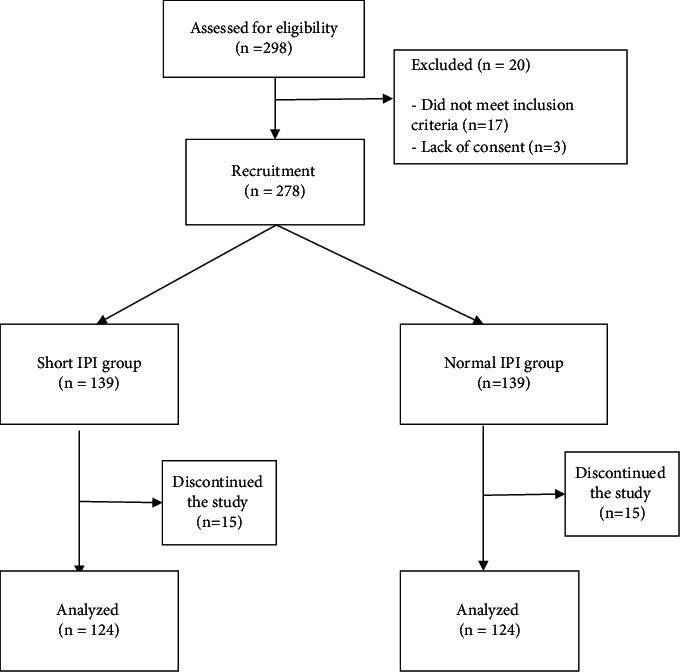
A prospective cohort three-center study involving parturients who had previous cesarean section was conducted. Participants were included if pregnancy has lasted up to 34 weeks. Parturients with co-existing uterine fibroids, multiple gestations, premature rupture of membranes, and those with prior postcesarean delivery wound infection were excluded. The eligible women recruited were distributed into two groups, namely, short (<18 months) and normal (18-36 months) IPI. The outcome measures were incidences of placenta previa and placenta accreta spectrum disorder and factors associated with the occurrence of placenta previa. A univariate analysis was performed using the chi-square test or Mann-Whitney test, wherever appropriate, to examine the significance of the differences in clinical variables.
A total of 248 women met the inclusion criteria. The incidence of placenta previa by ultrasound was 8.9% and 4.0% for short and normal IPI (odds ratios = 2.32; 95% confidence intervals = 0.78-6.88; = 0.13), respectively. The incidence of placenta accreta spectrum disorder was 1.6% and 0.8% for short and normal IPI (odds ratios = 2.02; 95% confidence intervals = 0.18-22.13; = 0.57), respectively. The only observed significant difference between the clinical variables and placenta previa is the number of cesarean sections ( = 0.02) in women with short IPI.
A short interpregnancy interval does not significantly affect the incidence of placenta previa and placenta accreta spectrum disorder following a cesarean section. There is a need for further study with large numbers to corroborate these findings in low- and middle-income settings.
本研究旨在确定妊娠间隔(IPI)对有剖宫产史女性前置胎盘和胎盘植入谱系疾病发生率的影响。
开展一项涉及有剖宫产史产妇的前瞻性队列三中心研究。妊娠持续至34周的参与者被纳入研究。排除合并子宫肌瘤、多胎妊娠、胎膜早破以及既往剖宫产术后伤口感染的产妇。招募的符合条件的女性被分为两组,即短妊娠间隔组(<18个月)和正常妊娠间隔组(18 - 36个月)。观察指标为前置胎盘和胎盘植入谱系疾病的发生率以及与前置胎盘发生相关的因素。在适当情况下,使用卡方检验或曼 - 惠特尼检验进行单因素分析,以检验临床变量差异的显著性。
共有248名女性符合纳入标准。短妊娠间隔组和正常妊娠间隔组超声诊断前置胎盘的发生率分别为8.9%和4.0%(优势比 = 2.32;95%置信区间 = 0.78 - 6.88;P = 0.13)。短妊娠间隔组和正常妊娠间隔组胎盘植入谱系疾病的发生率分别为1.6%和0.8%(优势比 = 2.02;95%置信区间 = 0.18 - 22.13;P = 0.57)。在临床变量与前置胎盘之间观察到的唯一显著差异是短妊娠间隔女性的剖宫产次数(P = 0.02)。
短妊娠间隔对剖宫产后前置胎盘和胎盘植入谱系疾病的发生率无显著影响。需要在低收入和中等收入环境中进行更大规模的进一步研究以证实这些发现。