Diabetes Center, Tzanio General Hospital of Piraeus, and Department of Nursing, Faculty of Human Movement and Quality of Life Sciences, University of Peloponnese, Greece.
Cardiovasc Diabetol. 2011 Nov 21;10:101. doi: 10.1186/1475-2840-10-101.
Soluble ST2, a member of the of the Toll/IL-1 superfamily, is a novel biomarker with exceptional predictive value in heart failure and myocardial infarction- related mortality as well as in acute dyspneic states. Soluble ST2 is considered a decoy receptor of IL 33 that blocks the protective effects of the cytokine in atherosclerosis and cardiac remodeling. In the present study we investigated the differences in the levels of soluble ST2, BNP and hs-CRP between healthy controls and patients with type 2 diabetes with and without left ventricular diastolic dysfunction. A secondary aim was to investigate correlations between sST2 and other biomarkers of type 2 diabetes, such as HbA1c.
158 volunteers were recruited and underwent a complete Doppler-echocardiographic evaluation of both systolic & diastolic cardiac function. All subjects with ejection fraction<50% were excluded. The study population was divided in 4 groups as follows: A: 42 healthy controls, B: 18 subjects without diabetes with LVDD, C: 48 patients with type 2 diabetes without LVDD & D: 50 patients with type 2 diabetes & LVDD. ELISA technique was performed to measure sST2 levels. Statistical analysis was performed with Kruskal-Wallis & Mann-Whitney test (continuous variables), chi squared & Fischer exact test (discrete variables), Spearman coefficient (univariate analysis) and step-wise backward method (multivariate analysis).
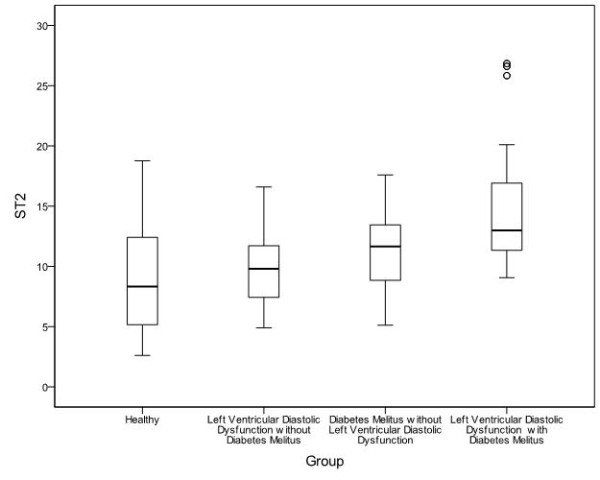
Patients with type 2 diabetes with (p<0.001) or without LVDD (p=0.007) had higher serum ST2 levels compared to healthy controls, state found also for hs-CRP levels but not for the corresponding BNP levels (p=0.213 & p=0.207 respectively). Patients with type 2 diabetes & LVDD had higher serum ST2 in relation to diabetic patients without LVDD (p=0.001). In multivariate analysis HbA1c positively and independently correlated with sST2 levels in both groups of patients with type 2 diabetes.
Patients with type 2 diabetes exhibit higher sST2 levels compared to healthy controls. The presence of LVDD in patients with type 2 diabetes is associated with even higher sST2 levels. A significant correlation between glycemic control and sST2 levels was also revealed.
可溶性 ST2 是 Toll/IL-1 超家族的成员,是心力衰竭和心肌梗死相关死亡率以及急性呼吸困难状态的新型生物标志物,具有出色的预测价值。可溶性 ST2 被认为是白细胞介素 33 的诱饵受体,可阻断细胞因子在动脉粥样硬化和心脏重构中的保护作用。在本研究中,我们研究了健康对照组与 2 型糖尿病患者(伴或不伴左心室舒张功能障碍)之间可溶性 ST2、BNP 和 hs-CRP 水平的差异。次要目的是研究 sST2 与 2 型糖尿病其他生物标志物(如 HbA1c)之间的相关性。
招募了 158 名志愿者,并对收缩期和舒张期心脏功能进行了完整的多普勒超声心动图评估。所有射血分数<50%的患者均被排除。研究人群分为以下 4 组:A:42 名健康对照者,B:18 名无糖尿病伴左心室舒张功能障碍者,C:48 名 2 型糖尿病无左心室舒张功能障碍者,D:50 名 2 型糖尿病伴左心室舒张功能障碍者。采用 ELISA 技术测量 sST2 水平。采用 Kruskal-Wallis 和 Mann-Whitney 检验(连续变量)、卡方和 Fischer 精确检验(离散变量)、Spearman 系数(单变量分析)和逐步向后法(多变量分析)进行统计学分析。
2 型糖尿病伴(p<0.001)或不伴(p=0.007)左心室舒张功能障碍的患者血清 ST2 水平高于健康对照组,hs-CRP 水平也升高,但 BNP 水平无差异(p=0.213 和 p=0.207)。2 型糖尿病伴左心室舒张功能障碍的患者血清 ST2 水平高于 2 型糖尿病不伴左心室舒张功能障碍的患者(p=0.001)。多元分析显示,HbA1c 与两组 2 型糖尿病患者的 sST2 水平呈正相关且独立相关。
与健康对照组相比,2 型糖尿病患者的 sST2 水平更高。2 型糖尿病患者伴左心室舒张功能障碍与更高的 sST2 水平相关。还揭示了血糖控制与 sST2 水平之间的显著相关性。