Key Laboratory of Nutrition and Metabolism, Institute for Nutritional Sciences, Shanghai Institutes for Biological Sciences, Graduate School of the Chinese Academy of Sciences, Shanghai, China.
PLoS One. 2011;6(11):e27515. doi: 10.1371/journal.pone.0027515. Epub 2011 Nov 16.
Chronic low-grade inflammation and adipokines dysregulation are linked to mechanisms underscoring the pathogenesis of obesity-related metabolic disorders. Little is known about roles of these cytokines on the association between snoring and metabolic syndrome (MetS). We aimed to investigate whether a cluster of cytokines are related to snoring frequency and its association with MetS in apparently healthy Chinese.
Current analyses used a population-based sample including 1059 Shanghai residents aged 35-54 years. Self-reported snoring frequency was classified as never, occasionally and regularly. Fasting plasma glucose, lipid profile, insulin, C-reactive protein, interleukin-6, interleukin-18, lipopolysaccharide binding protein, high-molecular-weight adiponectin and leptin were measured. MetS was defined by the updated National Cholesterol Education Program Adult Treatment Panel III criteria for Asian-Americans.
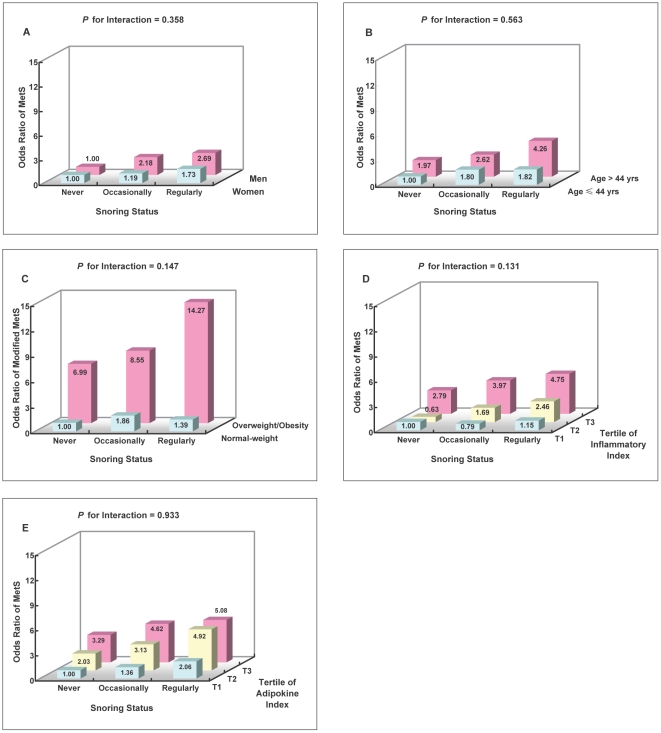
Overweight/obese subjects had significantly higher prevalence of regular snorers than their normal-weight counterparts (34.8% vs. 11.5%, P<0.001). Regular snoring was associated with unfavorable profile of inflammatory markers and adipokines. However, those associations were abolished after adjustment for body mass index (BMI) or waist circumference. The MetS risk (multivariate-adjusted odds ratio 5.41, 95% confidence interval 3.72-7.88) was substantially higher in regular snorers compared with non-snorers. Controlling for BMI remarkably attenuated the association (2.03, 1.26-3.26), while adjusting for inflammatory markers and adipokines showed little effects.
Frequent snoring was associated with an elevated MetS risk independent of lifestyle factors, adiposity, inflammatory markers and adipokines in apparently healthy Chinese. Whether snoring pattern is an economic and no-invasive indicator for screening high-risk persons needs to be addressed prospectively.
慢性低度炎症和脂肪因子失调与肥胖相关代谢紊乱发病机制有关。对于这些细胞因子在打鼾与代谢综合征(MetS)之间的关联中的作用知之甚少。我们旨在研究一组细胞因子是否与中国健康人群中的打鼾频率及其与 MetS 的相关性有关。
目前的分析使用了一项基于人群的样本,包括 1059 名年龄在 35-54 岁的上海居民。打鼾频率自评分为从不、偶尔和经常。测量空腹血糖、血脂、胰岛素、C 反应蛋白、白细胞介素-6、白细胞介素-18、脂多糖结合蛋白、高分子量脂联素和瘦素。MetS 根据亚太裔美国人的美国国家胆固醇教育计划成人治疗小组 III 标准的最新标准定义。
超重/肥胖受试者中经常打鼾者的比例明显高于体重正常者(34.8% vs. 11.5%,P<0.001)。经常打鼾与炎症标志物和脂肪因子的不良特征有关。然而,这些关联在调整体重指数(BMI)或腰围后消失。与不打鼾者相比,经常打鼾者患 MetS 的风险(多变量调整后的优势比 5.41,95%置信区间 3.72-7.88)显着更高。控制 BMI 后,该关联明显减弱(2.03,1.26-3.26),而调整炎症标志物和脂肪因子几乎没有影响。
在中国健康人群中,频繁打鼾与 MetS 风险增加独立于生活方式因素、肥胖、炎症标志物和脂肪因子有关。打鼾模式是否是筛查高危人群的经济且无创指标,需要前瞻性研究。