Department of Public Health, Ghent University, Watersportlaan 2, 9000 Ghent, Belgium.
BMC Public Health. 2011 Nov 23;11:881. doi: 10.1186/1471-2458-11-881.
Overweight and obesity in youth has increased dramatically. Therefore, overweight prevention initiatives should start early in life and target modifiable energy balance-related behaviours. Parental participation is often advocated as important for school-based interventions, however, getting parents involved in school-based interventions appears to be challenging based on earlier intervention experiences. The purpose of this study was to get insight into the determinants of and perspectives on parental participation in school-interventions on energy balance-related behaviours (physical activity, healthy eating, sedentary behaviours) in parents of ten- to twelve-year olds in order to develop an effective parental module for school-based interventions concerning energy balance-related behaviours.
Four countries (Belgium, Hungary, Norway and Spain) conducted the focus group research based on a standardised protocol and a semi-structured questioning route. A variation in parental socio-economic status (SES) and parental school involvement was taken into account when recruiting the parents. The audio taped interviews were transcribed, and a qualitative content analysis of the transcripts was conducted in each country.
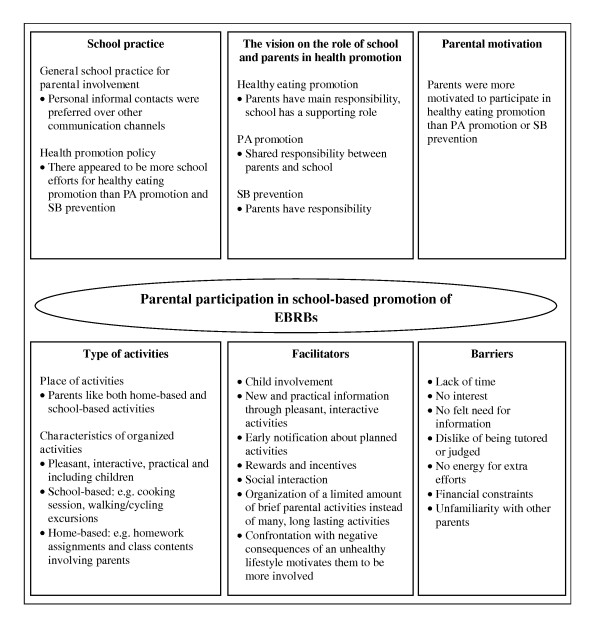
Seventeen focus group interviews were conducted with a total of 92 parents (12 men, 80 women). Physical activity was considered to be a joint responsibility of school and parents, nutrition as parent's responsibility but supported by the school, and prevention of sedentary behaviours as parent's sole responsibility. Parents proposed interactive and practical activities together with their child as the best way to involve them such as cooking, food tasting, nutrition workshops, walking or cycling tours, sport initiations together with their child. Activities should be cheap, on a convenient moment, focused on their children and not on themselves, not tutoring, not theoretical, and school-or home-based.
Parents want to be involved in activities related to energy balance-related behaviours if this implies 'doing things together' with their child at school or at home.
青少年超重和肥胖问题急剧增加。因此,超重预防措施应尽早开始,并针对可改变的与能量平衡相关的行为。家长参与通常被认为对基于学校的干预措施很重要,但是,根据早期的干预经验,让家长参与基于学校的干预措施似乎具有挑战性。本研究的目的是深入了解父母参与十至十二岁儿童父母的与能量平衡相关行为(身体活动、健康饮食、久坐行为)的学校干预措施的决定因素和观点,以便为基于学校的干预措施开发有关能量平衡相关行为的有效的家长模块。
四个国家(比利时、匈牙利、挪威和西班牙)根据标准化协议和半结构化问题路线进行了焦点小组研究。在招募父母时,考虑了父母社会经济地位(SES)和父母学校参与的差异。对录音采访进行了转录,并对每个国家的转录本进行了定性内容分析。
共进行了 17 次焦点小组访谈,共有 92 位家长(12 位男性,80 位女性)参加。身体活动被认为是学校和家长的共同责任,营养是家长的责任,但得到了学校的支持,预防久坐行为是家长的唯一责任。家长提出互动和实用的活动,与孩子一起参与,例如烹饪、品尝食物、营养研讨会、步行或骑自行车旅行、与孩子一起开展运动启蒙活动,是让他们参与的最佳方式。活动应该便宜、方便、以孩子为中心而不是以自己为中心、不辅导、不理论化,并且在学校或家庭中进行。
如果家长参与与能量平衡相关的行为活动意味着与孩子在学校或家里“一起做事”,他们就希望参与其中。