Department of Animal Science, Iowa State University, Ames, IA 50011, USA.
Genet Sel Evol. 2011 Nov 28;43(1):40. doi: 10.1186/1297-9686-43-40.
Genomic selection is a recently developed technology that is beginning to revolutionize animal breeding. The objective of this study was to estimate marker effects to derive prediction equations for direct genomic values for 16 routinely recorded traits of American Angus beef cattle and quantify corresponding accuracies of prediction.
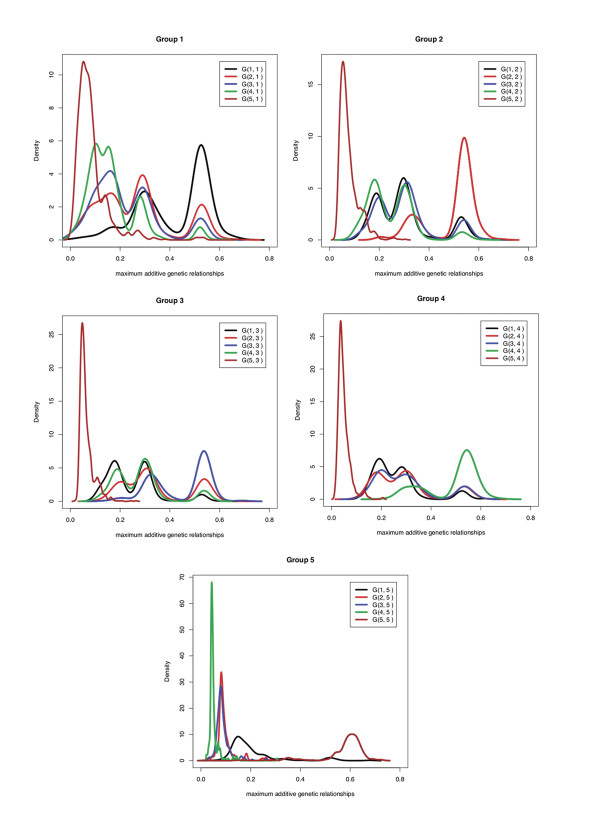
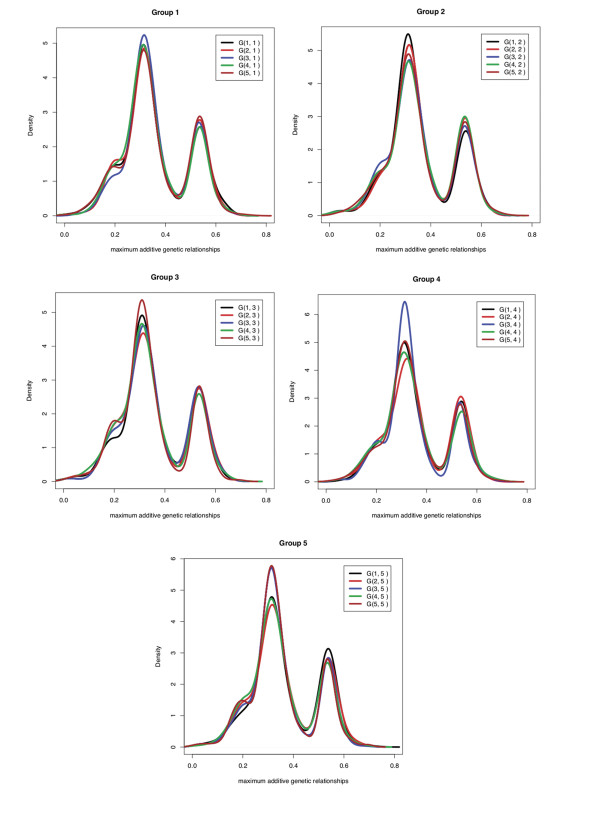
Deregressed estimated breeding values were used as observations in a weighted analysis to derive direct genomic values for 3570 sires genotyped using the Illumina BovineSNP50 BeadChip. These bulls were clustered into five groups using K-means clustering on pedigree estimates of additive genetic relationships between animals, with the aim of increasing within-group and decreasing between-group relationships. All five combinations of four groups were used for model training, with cross-validation performed in the group not used in training. Bivariate animal models were used for each trait to estimate the genetic correlation between deregressed estimated breeding values and direct genomic values.
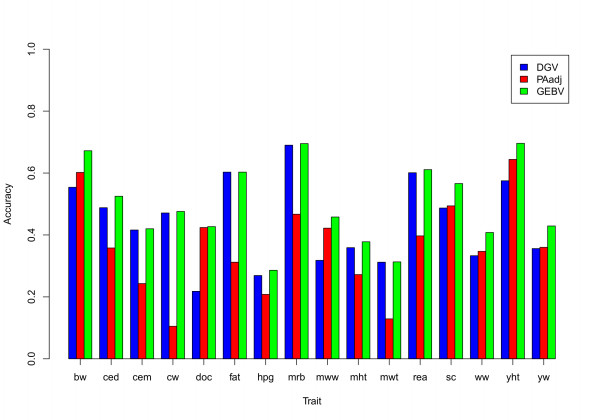
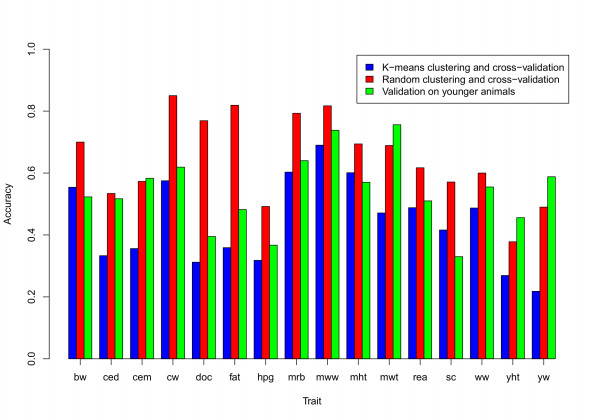
Accuracies of direct genomic values ranged from 0.22 to 0.69 for the studied traits, with an average of 0.44. Predictions were more accurate when animals within the validation group were more closely related to animals in the training set. When training and validation sets were formed by random allocation, the accuracies of direct genomic values ranged from 0.38 to 0.85, with an average of 0.65, reflecting the greater relationship between animals in training and validation. The accuracies of direct genomic values obtained from training on older animals and validating in younger animals were intermediate to the accuracies obtained from K-means clustering and random clustering for most traits. The genetic correlation between deregressed estimated breeding values and direct genomic values ranged from 0.15 to 0.80 for the traits studied.
These results suggest that genomic estimates of genetic merit can be produced in beef cattle at a young age but the recurrent inclusion of genotyped sires in retraining analyses will be necessary to routinely produce for the industry the direct genomic values with the highest accuracy.
基因组选择是一种新兴的技术,正在引发动物育种的革命。本研究的目的是估计标记效应,为美国安格斯肉牛的 16 个常规记录性状推导直接基因组值预测方程,并量化相应的预测准确性。
使用去回归估计育种值作为观测值,在加权分析中为 3570 头使用 Illumina BovineSNP50 BeadChip 进行基因分型的公牛推导直接基因组值。这些公牛使用动物加性遗传关系的系谱估计值通过 K-均值聚类分为五组,目的是增加组内关系并减少组间关系。使用五组中任意四组的组合进行模型训练,在未用于训练的组中进行交叉验证。使用双变量动物模型为每个性状估计去回归估计育种值和直接基因组值之间的遗传相关性。
所研究性状的直接基因组值的准确性范围为 0.22 至 0.69,平均为 0.44。当验证组中的动物与训练集中的动物更密切相关时,预测的准确性更高。当训练集和验证集通过随机分配形成时,直接基因组值的准确性范围为 0.38 至 0.85,平均为 0.65,反映了训练和验证动物之间的关系更大。从较年长的动物训练并在较年轻的动物中验证获得的直接基因组值的准确性介于 K-均值聚类和随机聚类获得的准确性之间。所研究性状的去回归估计育种值和直接基因组值之间的遗传相关性范围为 0.15 至 0.80。
这些结果表明,可以在肉牛年轻时产生基因组估计的遗传优势,但为了定期为行业提供最高准确性的直接基因组值,需要将基因分型公牛反复纳入再训练分析中。