Speech and Hearing Sciences, University of Illinois, Champaign, IL 61820, United States.
J Fluency Disord. 2011 Dec;36(4):302-7. doi: 10.1016/j.jfludis.2011.04.004. Epub 2011 Apr 22.
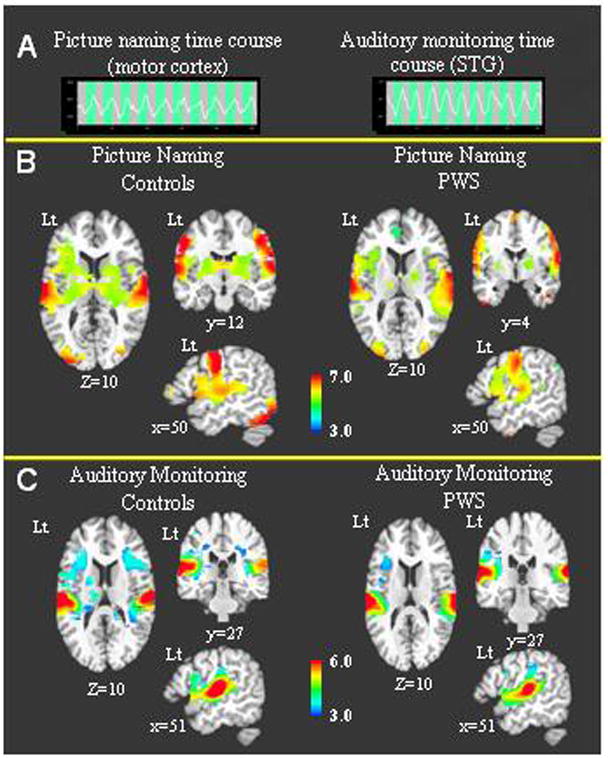
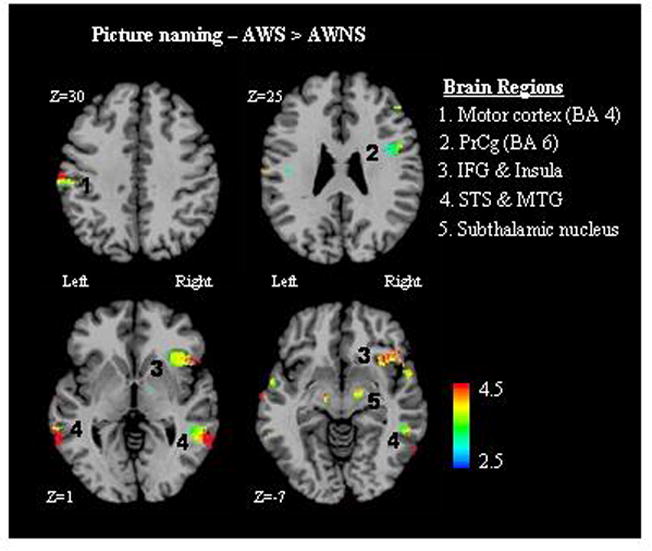
The purpose of this study was to investigate whether brain activity related to the presence of stuttering can be identified with rapid functional MRI (fMRI) sequences that involved overt and covert speech processing tasks. The long-term goal is to develop sensitive fMRI approaches with developmentally appropriate tasks to identify deviant speech motor and auditory brain activity in children who stutter closer to the age at which recovery from stuttering is documented. Rapid sequences may be preferred for individuals or populations who do not tolerate long scanning sessions. In this report, we document the application of a picture naming and phoneme monitoring task in 3 min fMRI sequences with adults who stutter (AWS). If relevant brain differences are found in AWS with these approaches that conform to previous reports, then these approaches can be extended to younger populations. Pairwise contrasts of brain BOLD activity between AWS and normally fluent adults indicated the AWS showed higher BOLD activity in the right inferior frontal gyrus (IFG), right temporal lobe and sensorimotor cortices during picture naming and higher activity in the right IFG during phoneme monitoring. The right lateralized pattern of BOLD activity together with higher activity in sensorimotor cortices is consistent with previous reports, which indicates rapid fMRI sequences can be considered for investigating stuttering in younger participants.
The reader will learn about and be able to describe the: (1) use of functional MRI to study persistent developmental stuttering; (2) differences in brain activation between persons who stutter and normally fluent speakers; and (3) potential benefit of time efficient fMRI sequences combined with a range of speech processing tasks for investigating stuttering in younger populations.
本研究旨在探讨是否可以通过涉及显性和隐性言语处理任务的快速功能磁共振成像 (fMRI) 序列来识别与口吃相关的大脑活动。长期目标是开发具有适当发展阶段的敏感 fMRI 方法,以识别口吃儿童在口吃恢复记录年龄附近的异常言语运动和听觉大脑活动。对于不能耐受长时间扫描的个体或人群,快速序列可能是首选。在本报告中,我们记录了口吃者(AWS)在 3 分钟 fMRI 序列中进行图片命名和音位监测任务的应用。如果这些方法在 AWS 中发现与之前报告相关的相关大脑差异,那么这些方法可以扩展到更年轻的人群。AWS 与正常流畅的成年人之间的大脑 BOLD 活动的成对对比表明,AWS 在图片命名时右侧额下回 (IFG)、右侧颞叶和感觉运动皮层的大脑 BOLD 活动较高,在音位监测时右侧 IFG 的活动较高。大脑 BOLD 活动的右侧偏侧化模式与感觉运动皮层的较高活动一致,与之前的报告一致,这表明可以考虑使用快速 fMRI 序列来研究年轻参与者的口吃。
读者将了解并能够描述:(1) 使用功能磁共振成像研究持续性发育性口吃;(2) 口吃者和正常流畅者之间大脑激活的差异;(3) 高效时间 fMRI 序列结合一系列言语处理任务对研究年轻人群口吃的潜在益处。