International Centre for Allied Health Evidence (iCAHE), City East Campus, University of South Australia, Adelaide, Australia.
J Multidiscip Healthc. 2011;4:383-92. doi: 10.2147/JMDH.S24595. Epub 2011 Oct 31.
There is research evidence which supports the effectiveness of exercise in reducing pain and increasing function in patients with patellofemoral pain syndrome. However, what is unclear are the parameters underpinning this intervention. This has led to uncertainty when operationalizing exercises for patients with patellofemoral pain syndrome in clinical practice. The aim of this review was to evaluate the parameters of exercise programs reported in primary research, to provide clinicians with evidence-based recommendations for exercise prescription for patellofemoral pain.
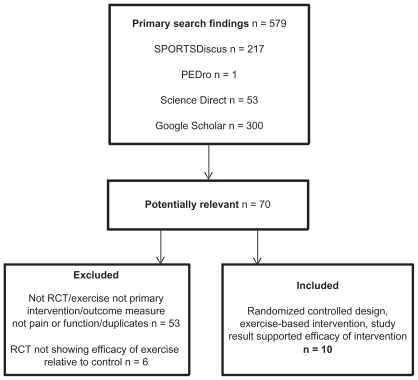
A systematic review of randomized controlled trials was undertaken. Only trials that identified exercise to be effective in treating patellofemoral pain were included. Appropriate databases and reference lists were searched using established keywords. Data relating to common exercise parameters such as the type of exercise, length, and frequency of intervention, intensity, repetitions, sets, and specific technique were extracted, along with details of co-interventions that may have been used.
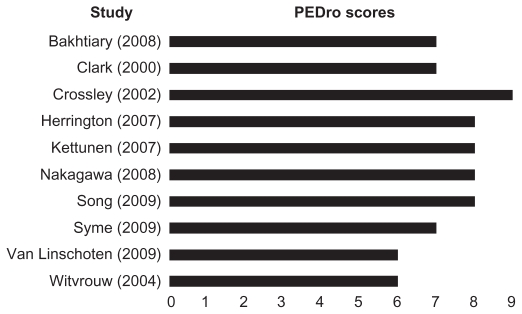
A total of ten randomized controlled trials were included in this review and from these trials 14 interventions arms were evaluated. All 14 interventions focused on active exercises, all but two of which also included a passive stretching component. The current body of evidence demonstrates positive results with exercise interventions such as knee extension, squats, stationary cycling, static quadriceps, active straight leg raise, leg press, and step-up and down exercises for patients with patellofemoral pain syndrome. A progressive regime of daily exercises of two to four sets of ten or more repetitions over an intervention period of 6 weeks or more, combined with exercises to address flexibility of the lower limb musculature was commonly used.
Currently, the primary research on this topic supports the use of closed kinetic chain, strengthening exercises for musculature of the lower limb, combined with flexibility options. The current evidence base supports a prescription of daily exercises of two-four sets of ten or more repetitions over a period of 6 weeks or more.
有研究证据支持运动在减轻髌股疼痛综合征患者疼痛和提高功能方面的有效性。然而,这种干预的具体参数尚不清楚。这导致了在临床实践中对髌股疼痛综合征患者进行运动操作时的不确定性。本综述的目的是评估主要研究中报告的运动方案的参数,为临床医生提供髌股疼痛综合征运动处方的循证建议。
进行了系统的随机对照试验综述。只有确定运动对治疗髌股疼痛有效的试验才被包括在内。使用既定的关键词搜索了适当的数据库和参考文献列表。提取了与常见运动参数相关的数据,如运动类型、干预的长度和频率、强度、重复次数、组数和特定技术,以及可能使用的联合干预的详细信息。
本综述共纳入了 10 项随机对照试验,从这些试验中评估了 14 个干预组。所有 14 个干预都集中在主动运动上,除了两个之外,其他的都包括被动伸展部分。目前的证据表明,髌股疼痛综合征患者的膝关节伸展、深蹲、固定自行车、静态四头肌、主动直腿抬高、腿举和上下台阶等运动干预措施都有积极的效果。通常使用的是每天进行两到四组、每组 10 次或更多重复的渐进式日常运动方案,结合针对下肢肌肉柔韧性的运动。
目前,关于这个主题的主要研究支持使用闭链、下肢肌肉强化运动,结合柔韧性选择。目前的证据基础支持在 6 周或更长时间内每天进行两到四组、每组 10 次或更多重复的运动处方。