Division of Diabetes, Department of Medicine, University of Texas Health Science Center, San Antonio, Texas, United States of America.
PLoS One. 2011;6(11):e28050. doi: 10.1371/journal.pone.0028050. Epub 2011 Nov 30.
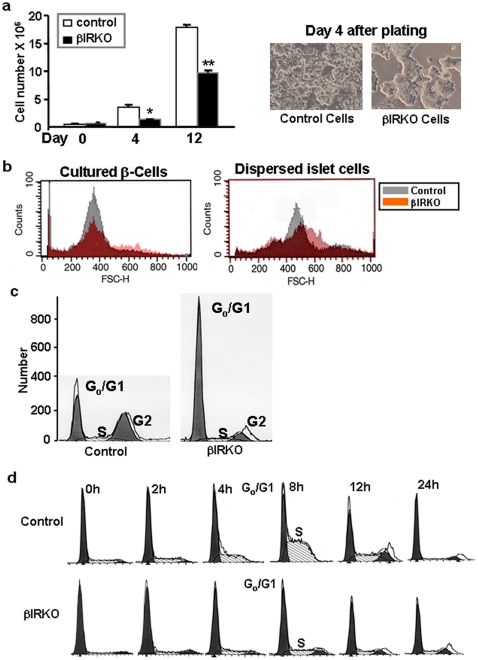
Insulin resistance, reduced β-cell mass, and hyperglucagonemia are consistent features in type 2 diabetes mellitus (T2DM). We used pancreas and islets from humans with T2DM to examine the regulation of insulin signaling and cell-cycle control of islet cells. We observed reduced β-cell mass and increased α-cell mass in the Type 2 diabetic pancreas. Confocal microscopy, real-time PCR and western blotting analyses revealed increased expression of PCNA and down-regulation of p27-Kip1 and altered expression of insulin receptors, insulin receptor substrate-2 and phosphorylated BAD. To investigate the mechanisms underlying these findings, we examined a mouse model of insulin resistance in β-cells--which also exhibits reduced β-cell mass, the β-cell-specific insulin receptor knockout (βIRKO). Freshly isolated islets and β-cell lines derived from βIRKO mice exhibited poor cell-cycle progression, nuclear restriction of FoxO1 and reduced expression of cell-cycle proteins favoring growth arrest. Re-expression of insulin receptors in βIRKO β-cells reversed the defects and promoted cell cycle progression and proliferation implying a role for insulin-signaling in β-cell growth. These data provide evidence that human β- and α-cells can enter the cell-cycle, but proliferation of β-cells in T2DM fails due to G1-to-S phase arrest secondary to defective insulin signaling. Activation of insulin signaling, FoxO1 and proteins in β-cell-cycle progression are attractive therapeutic targets to enhance β-cell regeneration in the treatment of T2DM.
胰岛素抵抗、β细胞减少和胰高血糖素血症是 2 型糖尿病(T2DM)的共同特征。我们使用 T2DM 患者的胰腺和胰岛来研究胰岛细胞胰岛素信号和细胞周期调控。我们观察到 2 型糖尿病患者的β细胞减少和α细胞增加。共聚焦显微镜、实时 PCR 和 Western blot 分析显示 PCNA 表达增加,p27-Kip1 下调,胰岛素受体、胰岛素受体底物-2 和磷酸化 BAD 的表达改变。为了研究这些发现的机制,我们研究了一种β细胞胰岛素抵抗的小鼠模型——β细胞特异性胰岛素受体敲除(βIRKO),其也表现出β细胞减少。从βIRKO 小鼠分离的新鲜胰岛和β细胞系显示出较差的细胞周期进程、FoxO1 的核限制和有利于生长停滞的细胞周期蛋白表达减少。在βIRKOβ细胞中重新表达胰岛素受体可逆转这些缺陷并促进细胞周期进程和增殖,表明胰岛素信号在β细胞生长中起作用。这些数据提供了证据,表明人类β-和α-细胞可以进入细胞周期,但由于胰岛素信号缺陷导致 G1 到 S 期阻滞,T2DM 中的β细胞增殖失败。激活胰岛素信号、FoxO1 和β细胞周期进程中的蛋白是增强 T2DM 中β细胞再生的有吸引力的治疗靶点。