Division of Human Nutrition, Wageningen University, Netherlands.
Am J Clin Nutr. 2012 Jan;95(1):32-8. doi: 10.3945/ajcn.111.020503. Epub 2011 Dec 7.
Protein is an indispensable component within the human diet. It is unclear, however, whether behavioral strategies exist to avoid shortages.
The objective was to investigate the effect of a low protein status compared with a high protein status on food intake and food preferences.
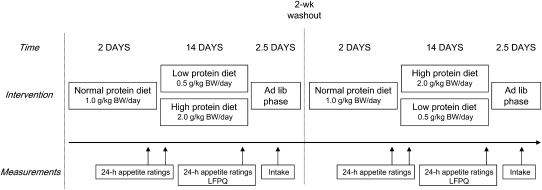
We used a randomized crossover design that consisted of a 14-d fully controlled dietary intervention involving 37 subjects [mean ± SD age: 21 ± 2 y; BMI (in kg/m(2)): 21.9 ± 1.5] who consumed individualized, isoenergetic diets that were either low in protein [0.5 g protein · kg body weight (BW)(-1) · d(-1)] or high in protein (2.0 g protein · kg BW(-1) · d(-1)). The diets were followed by an ad libitum phase of 2.5 d, during which a large array of food items was available, and protein and energy intakes were measured.
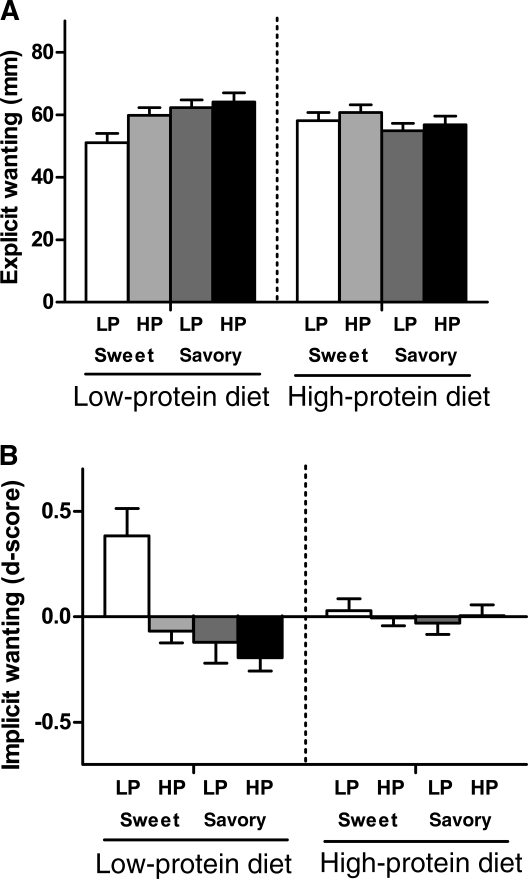
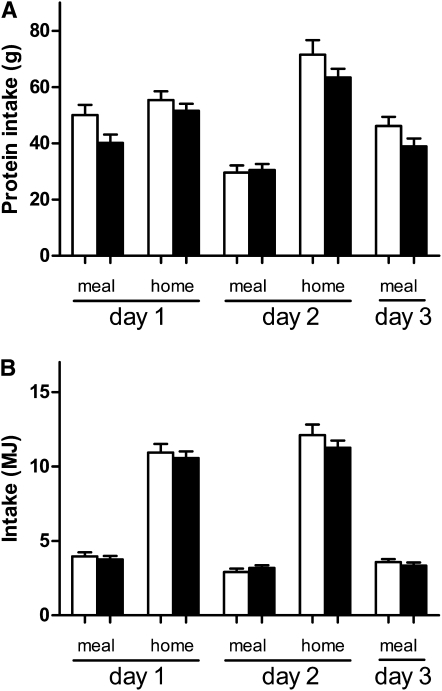
We showed that in the ad libitum phase protein intake was 13% higher after the low-protein diet than after the high-protein diet (253 ± 70 compared with 225 ± 63 g, P < 0.001), whereas total energy intake was not different. The higher intake of protein was evident throughout the ad libitum phase of 2.5 d. In addition, after the low-protein diet, food preferences for savory high-protein foods were enhanced.
After a protein deficit, food intake and food preferences show adaptive changes that suggest that compensatory mechanisms are induced to restore adequate protein status. This indicates that there are human behavioral strategies present to avoid protein shortage and that these involve selection of savory high-protein foods. This trial was registered with the Dutch Trial register at http://www.trialregister.nl as NTR2491.
蛋白质是人类饮食中不可或缺的组成部分。然而,目前尚不清楚是否存在避免蛋白质缺乏的行为策略。
本研究旨在探究低蛋白状态与高蛋白状态相比对食物摄入和食物偏好的影响。
我们采用了随机交叉设计,该设计包括 14 天的完全控制饮食干预,共有 37 名受试者(平均年龄 ± 标准差:21 ± 2 岁;BMI(kg/m²):21.9 ± 1.5)参与,他们摄入了个体化的、等能量的饮食,这些饮食要么蛋白质含量低(0.5 g 蛋白质·kg 体重(BW)(-1)·d(-1)),要么蛋白质含量高(2.0 g 蛋白质·kg BW(-1)·d(-1))。在随后的 2.5 天的自由进食阶段,提供了大量的食物,测量了蛋白质和能量的摄入量。
我们发现,在自由进食阶段,低蛋白饮食后蛋白质的摄入量比高蛋白饮食后高 13%(253 ± 70 对比 225 ± 63 g,P < 0.001),而总能量摄入没有差异。这种高蛋白的摄入在 2.5 天的自由进食阶段都很明显。此外,在低蛋白饮食后,人们更喜欢食用咸味高蛋白食物。
在经历蛋白质缺乏后,食物摄入和食物偏好会发生适应性变化,这表明会诱导补偿机制来恢复足够的蛋白质状态。这表明人类存在避免蛋白质缺乏的行为策略,并且这些策略涉及选择咸味高蛋白食物。本试验已在荷兰临床试验注册中心(http://www.trialregister.nl)注册,注册号为 NTR2491。