Department of Pediatrics, Chang Gung Memorial Hospital, College of Medicine, Chang Gung University, Taoyuan, Taiwan.
PLoS One. 2011;6(12):e28102. doi: 10.1371/journal.pone.0028102. Epub 2011 Dec 2.
The clinical diagnosis of influenza is difficult because it shares nonspecific symptoms with a variety of diseases. Emergency departments and clinics were overwhelmed by a surge of anxious patients during the 2009 influenza A virus (H1N1) outbreak. Our objective was to identify symptomatic predictors of influenza virus infection for patients with a negative rapid diagnostic test.
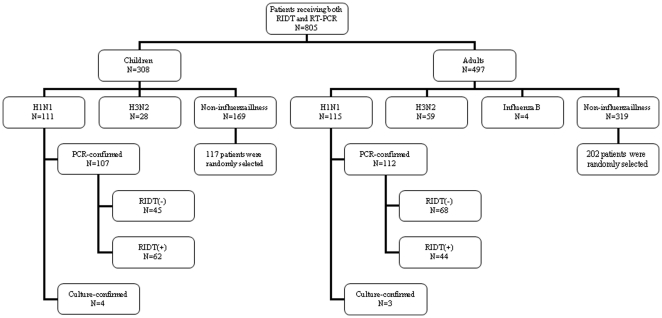
METHODOLOGY/PRINCIPAL FINDINGS: We conducted a retrospective review of 805 patients who presented at Chang Gung Memorial Hospital, from August 1, 2009, to September 30, 2009. Respiratory specimens from these patients were subjected to rapid influenza tests and reverse-transcription polymerase chain reactions. In total, 36% of 308 children and 23% of 497 adults were positive for 2009 influenza A virus (H1N1) infection by polymerase chain reaction or virus culture. For pediatric patients, sore throat and influenza-like illness significantly increased the odds of having 2009 influenza A virus (H1N1) infection, by more than 3-fold (95% confidence interval (CI): 1.9-7.3) and 7-fold (95% CI: 4.00-14.2), respectively. For adult patients, cough and constitutional symptoms increased the odds of having 2009 influenza A virus (H1N1) by greater than 5-fold (95% CI: 3.1-10.2) and 3-fold (95% CI: 2.1-6.7), respectively. The negative likelihood ratio of the combination of fever and cough was 0.096 (95% CI: 0.01-0.69) for children with negative results of rapid influenza diagnostic tests.
CONCLUSION/SIGNIFICANCE: In influenza epidemic settings, clinicians should be aware that rapid influenza diagnostic tests are relatively insensitive for the diagnosis of influenza virus infection. For patients with negative rapid influenza diagnostic tests, those lacking fever and cough have a low probability of influenza virus infection. The management strategy should be made individually and depend on the severity of illness.
由于流感的临床诊断具有挑战性,因为它与多种疾病具有非特异性症状。在 2009 年甲型 H1N1 流感病毒爆发期间,急诊室和诊所被大批焦虑的患者淹没。我们的目的是为快速诊断检测呈阴性的流感病毒感染患者确定症状预测因子。
方法/主要发现:我们对 2009 年 8 月 1 日至 9 月 30 日期间在长庚纪念医院就诊的 805 例患者进行了回顾性研究。对这些患者的呼吸道标本进行了快速流感检测和逆转录聚合酶链反应。共有 308 例儿童中有 36%,497 例成人中有 23%通过聚合酶链反应或病毒培养对 2009 年甲型 H1N1 流感病毒呈阳性。对于儿科患者,喉咙痛和流感样疾病使 2009 年甲型 H1N1 流感病毒感染的几率增加了 3 倍以上(95%置信区间 (CI):1.9-7.3)和 7 倍(95%CI:4.00-14.2)。对于成年患者,咳嗽和全身症状使 2009 年甲型 H1N1 流感病毒感染的几率增加了 5 倍以上(95%CI:3.1-10.2)和 3 倍(95%CI:2.1-6.7)。对于快速流感诊断检测呈阴性的儿童,发热和咳嗽的阴性似然比为 0.096(95%CI:0.01-0.69)。
结论/意义:在流感流行期间,临床医生应该意识到快速流感诊断检测对流感病毒感染的诊断相对不敏感。对于快速流感诊断检测呈阴性的患者,如果没有发热和咳嗽,则流感病毒感染的可能性较低。管理策略应根据病情的严重程度个体化制定。