Centre for Ecological and Evolutionary Synthesis, Department of Biology, University of Oslo, P, O, Box 1066 Blindern, NO-0316 Oslo, Norway.
BMC Evol Biol. 2011 Dec 13;11:360. doi: 10.1186/1471-2148-11-360.
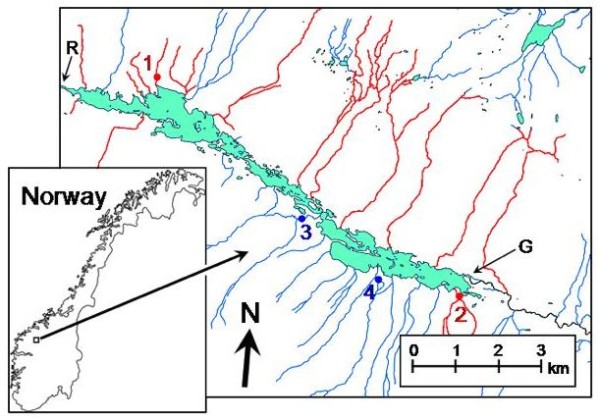
Following colonization of new habitats and subsequent selection, adaptation to environmental conditions might be expected to be rapid. In a mountain lake in Norway, Lesjaskogsvatnet, more than 20 distinct spawning demes of grayling have been established since the lake was colonized, some 20-25 generations ago. The demes spawn in tributaries consistently exhibiting either colder or warmer temperature conditions during spawning in spring and subsequent early development during early summer. In order to explore the degree of temperature-related divergence in early development, a multi-temperature common-garden experiment was performed on embryos from four different demes experiencing different spring temperatures.
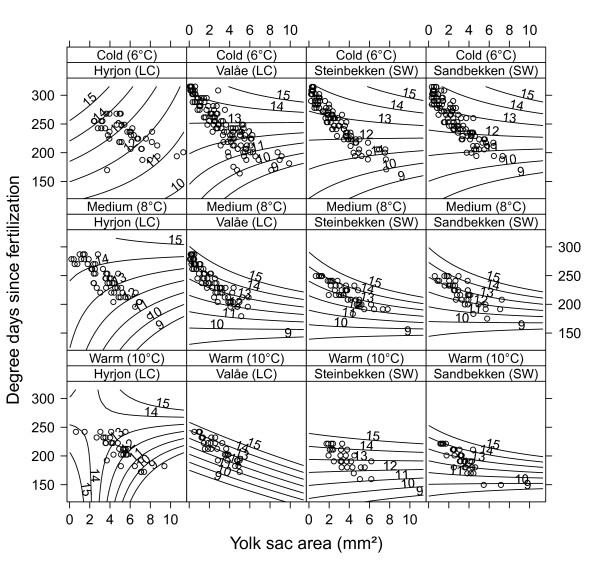
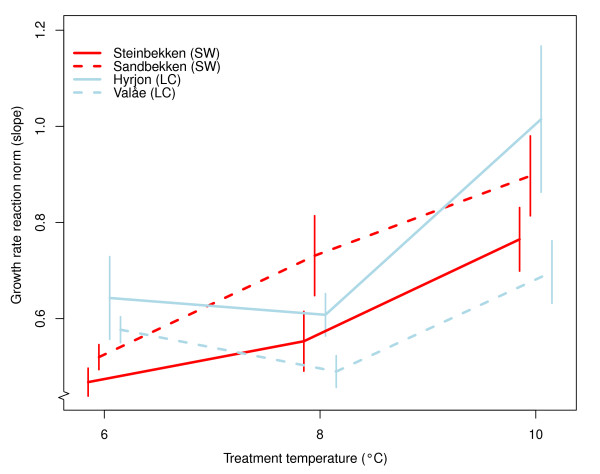
Early developmental characters were measured to test if individuals from the four demes respond differently to the treatment temperatures. There was clear evidence of among-deme differences (genotype - environment interactions) in larval growth and yolk-to-body-size conversion efficiency. Under the cold treatment regime, larval growth rates were highest for individuals belonging to cold streams. Individuals from warm streams had the highest yolk-consumption rate under cold conditions. As a consequence, yolk-to-body-mass conversion efficiency was highest for cold-deme individuals under cold conditions. As we observed response parallelism between individuals from demes belonging to similar thermal groups for these traits, some of the differentiation seems likely to result from local adaptation
The observed differences in length at age during early larval development most likely have a genetic component, even though both directional and random processes are likely to have influenced evolutionary change in the demes under study.
在新栖息地的殖民化和随后的选择之后,适应环境条件应该是迅速的。在挪威的一座山湖 Lesjaskogsvatnet 中,自大约 20-25 代前该湖被殖民以来,已经建立了 20 多个不同的产卵生殖群。这些生殖群在春季产卵时栖息在支流中,温度条件要么更冷要么更暖,随后在初夏早期发育。为了探索早期发育过程中与温度相关的分歧程度,对来自四个经历不同春季温度的不同生殖群的胚胎进行了多温度共同养殖实验。
测量了早期发育特征,以测试来自四个生殖群的个体对处理温度的反应是否不同。在幼虫生长和蛋黄-身体大小转换效率方面,存在明显的群体间差异(基因型-环境相互作用)。在寒冷处理条件下,属于冷水溪流的个体的幼虫生长速度最高。在寒冷条件下,来自温暖溪流的个体的蛋黄消耗率最高。因此,在寒冷条件下,冷生殖群个体的蛋黄-体质量转换效率最高。由于我们观察到属于类似热群的生殖群个体在这些特征上具有平行反应,因此一些分化可能是由于局部适应造成的。
在早期幼虫发育过程中观察到的年龄长度差异很可能具有遗传成分,尽管定向和随机过程都可能影响研究中生殖群的进化变化。