Utah Center for Advanced Imaging Research, Department of Radiology, University of Utah, 729 Arapeen Drive, Salt Lake City, UT 84108, USA.
BMC Bioinformatics. 2011 Oct 18;12 Suppl 10(Suppl 10):S15. doi: 10.1186/1471-2105-12-S10-S15.
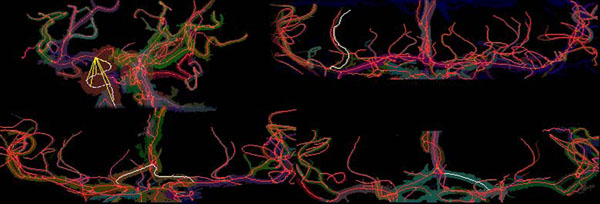
Hypertension may increase tortuosity or twistedness of arteries. We applied a centerline extraction algorithm and tortuosity metric to magnetic resonance angiography (MRA) brain images to quantitatively measure the tortuosity of arterial vessel centerlines. The most commonly used arterial tortuosity measure is the distance factor metric (DFM). This study tested a DFM based measurement's ability to detect increases in arterial tortuosity of hypertensives using existing images. Existing images presented challenges such as different resolutions which may affect the tortuosity measurement, different depths of the area imaged, and different artifacts of imaging that require filtering.
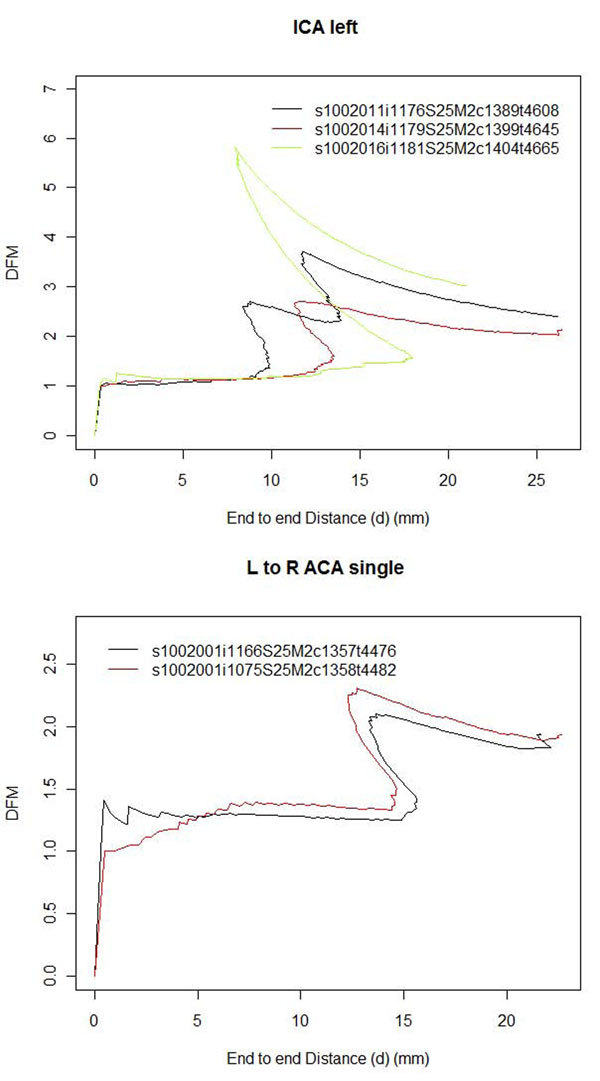
The stability and accuracy of alternative centerline algorithms was validated in numerically generated models and test brain MRA data. Existing images were gathered from previous studies and clinical medical systems by manually reading electronic medical records to identify hypertensives and negatives. Images of different resolutions were interpolated to similar resolutions. Arterial tortuosity in MRA images was measured from a DFM curve and tested on numerically generated models as well as MRA images from two hypertensive and three negative control populations. Comparisons were made between different resolutions, different filters, hypertensives versus negatives, and different negative controls.
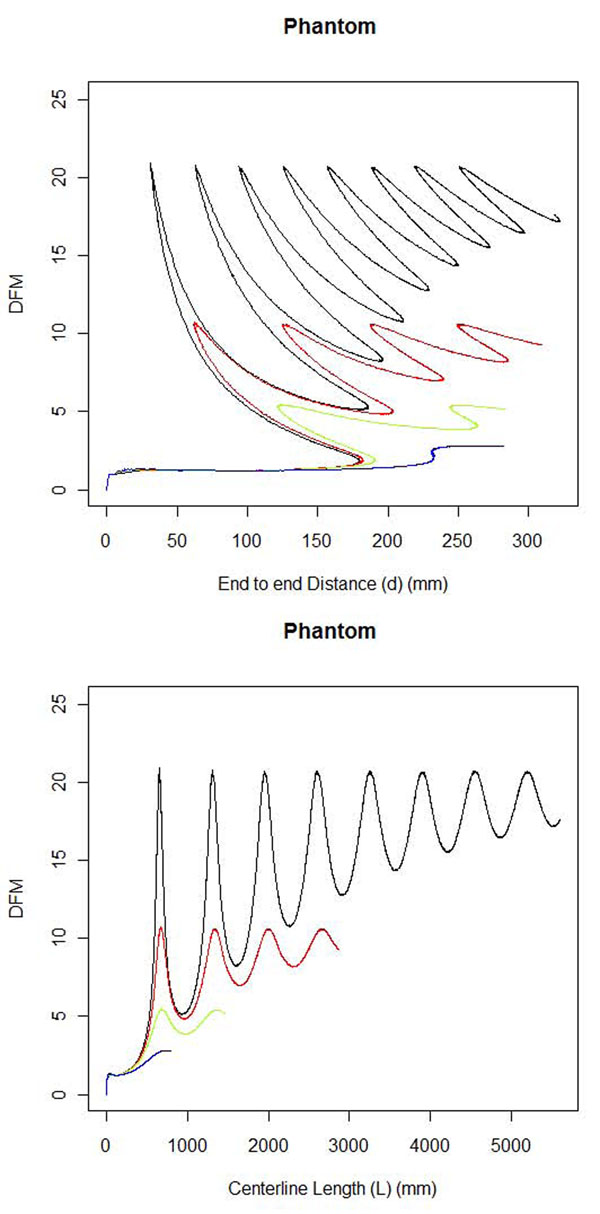
In tests using numerical models of a simple helix, the measured tortuosity increased as expected with more tightly coiled helices. Interpolation reduced resolution-dependent differences in measured tortuosity. The Korean hypertensive population had significantly higher arterial tortuosity than its corresponding negative control population across multiple arteries. In addition one negative control population of different ethnicity had significantly less arterial tortuosity than the other two.
Tortuosity can be compared between images of different resolutions by interpolating from lower to higher resolutions. Use of a universal negative control was not possible in this study. The method described here detected elevated arterial tortuosity in a hypertensive population compared to the negative control population and can be used to study this relation in other populations.
高血压可能会增加动脉的迂曲或扭曲程度。我们应用中心线提取算法和迂曲度度量标准对磁共振血管造影(MRA)脑图像进行分析,以定量测量动脉中心线的迂曲程度。最常用的动脉迂曲度度量标准是距离因子度量(DFM)。本研究使用现有的图像来测试一种基于 DFM 的测量方法,以检测高血压患者动脉迂曲度的增加。现有的图像存在一些挑战,例如分辨率不同可能会影响迂曲度的测量,成像区域的深度不同,以及需要过滤的成像伪影不同。
在数值生成的模型和测试脑 MRA 数据中验证了替代中心线算法的稳定性和准确性。通过手动阅读电子病历,从先前的研究和临床医疗系统中收集现有的图像,以识别高血压患者和非高血压患者。对不同分辨率的图像进行插值,以达到相似的分辨率。使用 DFM 曲线测量 MRA 图像中的动脉迂曲度,并在数值生成的模型以及来自两个高血压和三个阴性对照组的 MRA 图像上进行测试。比较了不同分辨率、不同滤波器、高血压患者与非高血压患者以及不同阴性对照组之间的差异。
在使用简单螺旋的数值模型进行的测试中,随着螺旋的紧密程度增加,测量的迂曲度按预期增加。插值减少了分辨率依赖性测量迂曲度的差异。与相应的阴性对照组相比,韩国高血压患者的多个动脉迂曲度明显更高。此外,与其他两个对照组相比,一个不同种族的阴性对照组的动脉迂曲度明显较低。
通过从低分辨率插值到高分辨率,可以比较不同分辨率的图像之间的迂曲度。在本研究中,使用通用的阴性对照组是不可能的。这里描述的方法检测到高血压患者与阴性对照组相比,动脉迂曲度升高,并可用于研究其他人群中的这种关系。