University of Puerto Rico Comprehensive Cancer Center, PMB #315 PO Box 70344, San Juan, PR.
Prev Chronic Dis. 2012;9:E15. Epub 2011 Dec 15.
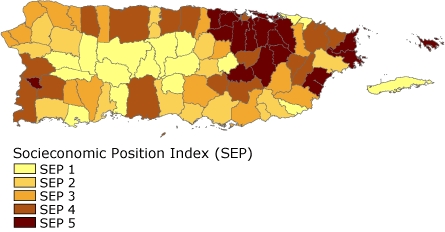
Evaluation of the extent of socioeconomic inequalities in cancer incidence and mortality is essential to generate hypotheses in population health research and provides evidence for population-based strategies for comprehensive cancer control. The objective of this study was to create an area-based socioeconomic position (SEP) index to assess possible socioeconomic disparities in incidence and mortality of selected cancers in Puerto Rico.
Data for cancer incidence and mortality from 1995 to 2004 were obtained from the Puerto Rico Central Cancer Registry and the Puerto Rico Department of Health, and Puerto Rico socioeconomic data were obtained from the US Census 2000. We used principal component and factor analysis methods to construct the SEP index at the municipality level. We calculated age-adjusted incidence and mortality for each SEP area and used rate ratios to evaluate the differences by SEP.
Incidence and mortality of cancer in Puerto Rico varied by SEP area. In general, the incidence and mortality for cancers of the esophagus and stomach were higher for municipalities with the lowest SEP; in contrast, rates for breast, colorectal, kidney, pancreas, prostate, and thyroid were higher for areas with the highest SEP.
These results highlight cancer disparities in Puerto Rico by SEP level that warrant further research.
评估癌症发病率和死亡率的社会经济不平等程度对于开展人群健康研究中的假设至关重要,并且为基于人群的综合癌症控制策略提供了证据。本研究的目的是创建一个基于地区的社会经济地位(SEP)指数,以评估波多黎各特定癌症发病率和死亡率方面可能存在的社会经济差异。
从 1995 年到 2004 年,癌症发病率和死亡率的数据来源于波多黎各中央癌症登记处和波多黎各卫生部,波多黎各社会经济数据来源于美国 2000 年人口普查。我们使用主成分和因子分析方法在市级水平构建 SEP 指数。我们计算了每个 SEP 地区的年龄调整发病率和死亡率,并使用率比来评估 SEP 的差异。
波多黎各的癌症发病率和死亡率因 SEP 地区而异。一般来说,社会经济地位最低的城市中食管癌和胃癌的发病率和死亡率较高;相比之下,社会经济地位最高的地区乳腺癌、结直肠癌、肾癌、胰腺癌、前列腺癌和甲状腺癌的发病率较高。
这些结果强调了波多黎各按社会经济地位划分的癌症差异,需要进一步研究。