Zoologisches Institut, Evolutionsbiologie, University of Basel, Basel, Switzerland.
PLoS One. 2011;6(12):e27947. doi: 10.1371/journal.pone.0027947. Epub 2011 Dec 12.
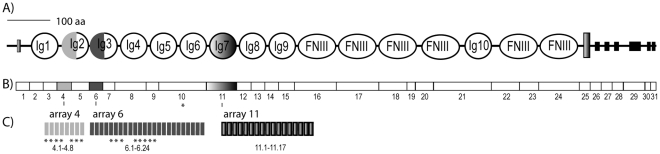
In insects and crustaceans, the Down syndrome cell adhesion molecule (Dscam) occurs in many different isoforms. These are produced by mutually exclusive alternative splicing of dozens of tandem duplicated exons coding for parts or whole immunoglobulin (Ig) domains of the Dscam protein. This diversity plays a role in the development of the nervous system and also in the immune system. Structural analysis of the protein suggested candidate epitopes where binding to pathogens could occur. These epitopes are coded by regions of the duplicated exons and are therefore diverse within individuals. Here we apply molecular population genetics and molecular evolution analyses using Daphnia magna and several Drosophila species to investigate the potential role of natural selection in the divergence between orthologs of these duplicated exons among species, as well as between paralogous exons within species. We found no evidence for a role of positive selection in the divergence of these paralogous exons. However, the power of this test was low, and the fact that no signs of gene conversion between paralogous exons were found suggests that paralog diversity may nonetheless be maintained by selection. The analysis of orthologous exons in Drosophila and in Daphnia revealed an excess of non-synonymous polymorphisms in the epitopes putatively involved in pathogen binding. This may be a sign of balancing selection. Indeed, in Dr. melanogaster the same derived non-synonymous alleles segregate in several populations around the world. Yet other hallmarks of balancing selection were not found. Hence, we cannot rule out that the excess of non-synonymous polymorphisms is caused by segregating slightly deleterious alleles, thus potentially indicating reduced selective constraints in the putative pathogen binding epitopes of Dscam.
在昆虫和甲壳类动物中,唐氏综合征细胞黏附分子(Dscam)存在许多不同的同工型。这些同工型是通过数十个串联重复外显子的相互排斥的选择性剪接产生的,这些外显子编码 Dscam 蛋白的部分或完整免疫球蛋白(Ig)结构域。这种多样性在神经系统的发育中起作用,也在免疫系统中起作用。对蛋白质的结构分析表明了候选表位,这些表位可能与病原体结合。这些表位由重复外显子的区域编码,因此在个体内部是多样化的。在这里,我们使用大弹涂鱼和几种果蝇物种应用分子群体遗传学和分子进化分析,研究自然选择在物种间这些重复外显子的直系同源物之间以及物种内的旁系同源外显子之间的分歧中的潜在作用。我们没有发现正选择在这些旁系同源外显子的分歧中起作用的证据。然而,这种测试的功效很低,并且没有发现旁系同源外显子之间基因转换的迹象表明,旁系同源多样性可能仍然受到选择的维持。在果蝇和大弹涂鱼中的直系同源外显子的分析表明,在假定参与病原体结合的表位中,非同义多态性的过剩。这可能是平衡选择的一个标志。事实上,在 Dr. melanogaster 中,相同的衍生非同义等位基因在世界各地的几个种群中分离。然而,没有发现其他平衡选择的特征。因此,我们不能排除非同义多态性过剩是由分离的轻微有害等位基因引起的,从而可能表明 Dscam 中假定的病原体结合表位的选择压力降低。