Unit of Nutritional Epidemiology, Institute of Environmental Medicine, Karolinska Institutet, Stockholm, Sweden.
Environ Health. 2011 Dec 16;10:105. doi: 10.1186/1476-069X-10-105.
Cadmium is a widespread environmental pollutant with adverse effects on kidneys and bone, but with insufficiently elucidated public health consequences such as risk of end-stage renal diseases, fractures and cancer. Urinary cadmium is considered a valid biomarker of lifetime kidney accumulation from overall cadmium exposure and thus used in the assessment of cadmium-induced health effects. We aimed to assess the relationship between dietary cadmium intake assessed by analyses of duplicate food portions and cadmium concentrations in urine and blood, taking the toxicokinetics of cadmium into consideration.
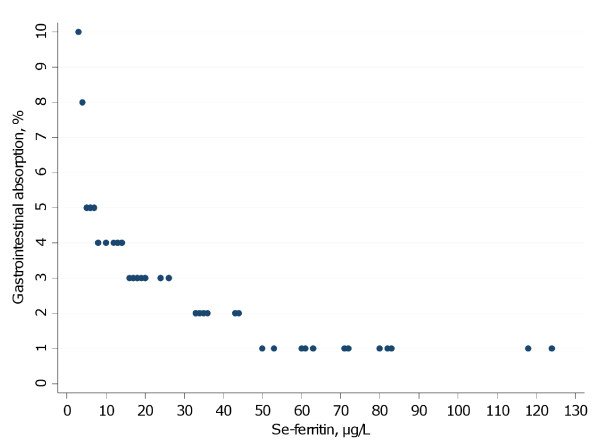
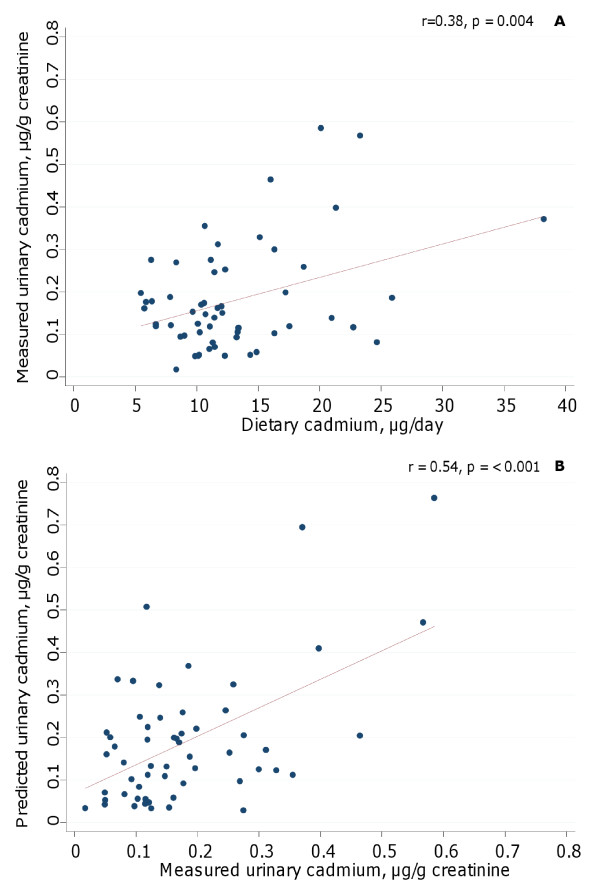
In a sample of 57 non-smoking Swedish women aged 20-50 years, we assessed Pearson's correlation coefficients between: 1) Dietary intake of cadmium assessed by analyses of cadmium in duplicate food portions collected during four consecutive days and cadmium concentrations in urine, 2) Partial correlations between the duplicate food portions and urinary and blood cadmium concentrations, respectively, and 3) Model-predicted urinary cadmium concentration predicted from the dietary intake using a one-compartment toxicokinetic model (with individual data on age, weight and gastrointestinal cadmium absorption) and urinary cadmium concentration.
The mean concentration of cadmium in urine was 0.18 (+/- s.d.0.12) μg/g creatinine and the model-predicted urinary cadmium concentration was 0.19 (+/- s.d.0.15) μg/g creatinine. The partial Pearson correlations between analyzed dietary cadmium intake and urinary cadmium or blood concentrations were r = 0.43 and 0.42, respectively. The correlation between diet and urinary cadmium increased to r = 0.54 when using a one-compartment model with individual gastrointestinal cadmium absorption coefficients based on the women's iron status.
Our results indicate that measured dietary cadmium intake can reasonably well predict biomarkers of both long-term kidney accumulation (urine) and short-term exposure (blood). The predictions are improved when taking data on the iron status into account.
镉是一种广泛存在的环境污染物,对肾脏和骨骼有不良影响,但对其公共健康影响(如终末期肾病、骨折和癌症的风险)的了解还不够充分。尿镉被认为是衡量一生中因整体镉暴露而导致肾脏中镉蓄积的有效生物标志物,因此用于评估镉引起的健康影响。我们旨在评估通过分析连续四天采集的两份食物样本中镉的含量来评估膳食镉摄入量与尿镉和血镉浓度之间的关系,并考虑到镉的毒代动力学。
在 57 名年龄在 20-50 岁之间的非吸烟瑞典女性中,我们评估了以下各项之间的皮尔逊相关系数:1)通过分析连续四天采集的两份食物样本中镉的含量来评估膳食镉摄入量与尿镉浓度之间的关系;2)分别对两份食物样本与尿镉和血镉浓度之间的偏相关;3)使用包含个体年龄、体重和胃肠道镉吸收率数据的单室毒代动力学模型,从膳食摄入量预测尿镉浓度的模型预测值与尿镉浓度之间的关系。
尿镉的平均浓度为 0.18(+/-s.d.0.12)μg/g 肌酐,模型预测的尿镉浓度为 0.19(+/-s.d.0.15)μg/g 肌酐。分析的膳食镉摄入量与尿镉或血浓度之间的偏皮尔逊相关系数分别为 r = 0.43 和 0.42。当使用包含个体胃肠道镉吸收率系数的单室模型,并基于女性的铁状态时,饮食与尿镉之间的相关性增加至 r = 0.54。
我们的研究结果表明,测量的膳食镉摄入量可以很好地预测长期肾脏蓄积(尿液)和短期暴露(血液)的生物标志物。当考虑铁状态数据时,预测结果会得到改善。