• 文献检索
  • 文档翻译
  • 深度研究
  • 学术资讯
  • Suppr Zotero 插件Zotero 插件
  • 邀请有礼
  • 套餐&价格
  • 历史记录
应用&插件
Suppr Zotero 插件Zotero 插件浏览器插件Mac 客户端Windows 客户端微信小程序
定价
高级版会员购买积分包购买API积分包
服务
文献检索文档翻译深度研究API 文档MCP 服务
关于我们
关于 Suppr公司介绍联系我们用户协议隐私条款
关注我们

Suppr 超能文献

核心技术专利:CN118964589B侵权必究
粤ICP备2023148730 号-1Suppr @ 2026

文献检索

告别复杂PubMed语法,用中文像聊天一样搜索,搜遍4000万医学文献。AI智能推荐,让科研检索更轻松。

立即免费搜索

文件翻译

保留排版,准确专业,支持PDF/Word/PPT等文件格式,支持 12+语言互译。

免费翻译文档

深度研究

AI帮你快速写综述,25分钟生成高质量综述,智能提取关键信息,辅助科研写作。

立即免费体验

高温降低疟疾蚊子的传播能力。

Warmer temperatures reduce the vectorial capacity of malaria mosquitoes.

机构信息

Center for Infectious Disease Dynamics, Pennsylvania State University, University Park, PA 16802, USA.

出版信息

Biol Lett. 2012 Jun 23;8(3):465-8. doi: 10.1098/rsbl.2011.1075. Epub 2011 Dec 21.

DOI:10.1098/rsbl.2011.1075
PMID:22188673
原文链接:https://pmc.ncbi.nlm.nih.gov/articles/PMC3367745/
Abstract

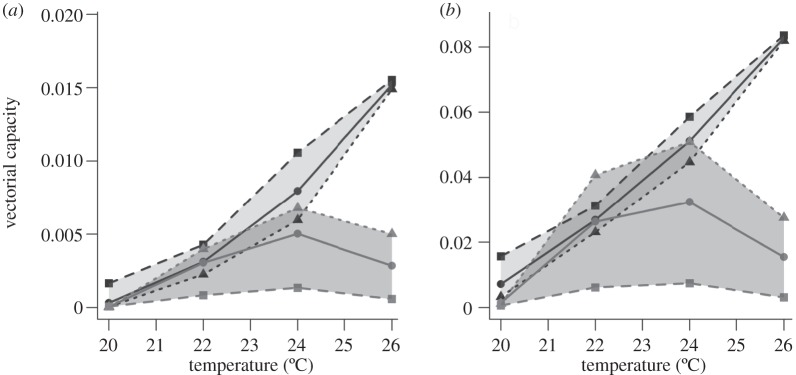
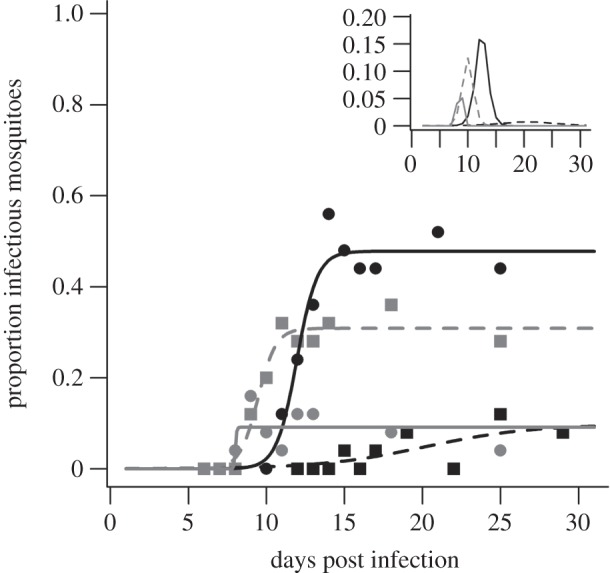
The development rate of parasites and pathogens within vectors typically increases with temperature. Accordingly, transmission intensity is generally assumed to be higher under warmer conditions. However, development is only one component of parasite/pathogen life history and there has been little research exploring the temperature sensitivity of other traits that contribute to transmission intensity. Here, using a rodent malaria, we show that vector competence (the maximum proportion of infectious mosquitoes, which implicitly includes parasite survival across the incubation period) tails off at higher temperatures, even though parasite development rate increases. We also show that the standard measure of the parasite incubation period (i.e. time until the first mosquitoes within a cohort become infectious following an infected blood-meal) is incomplete because parasite development follows a cumulative distribution, which itself varies with temperature. Including these effects in a simple model dramatically alters estimates of transmission intensity and reduces the optimum temperature for transmission. These results highlight the need to understand the interactive effects of environmental temperature on multiple host-disease life-history traits and challenge the assumptions of many current disease models that ignore this complexity.

摘要

寄生虫和病原体在媒介中的发育速度通常随温度升高而加快。因此,在较温暖的条件下,传播强度通常被认为更高。然而,发育只是寄生虫/病原体生活史的一个组成部分,很少有研究探索有助于传播强度的其他特征的温度敏感性。在这里,我们使用一种啮齿动物疟疾表明,即使寄生虫的发育速度增加,媒介能力(感染性蚊子的最大比例,这隐含地包括在潜伏期内寄生虫的生存)在较高温度下会下降。我们还表明,寄生虫潜伏期的标准衡量标准(即从受感染的血液餐中,一个群体中第一只感染蚊子出现的时间)是不完整的,因为寄生虫的发育遵循累积分布,而累积分布本身随温度而变化。在一个简单的模型中包含这些影响会极大地改变对传播强度的估计,并降低传播的最佳温度。这些结果强调了需要了解环境温度对多种宿主疾病生活史特征的相互作用影响,并挑战了许多当前忽视这种复杂性的疾病模型的假设。
https://cdn.ncbi.nlm.nih.gov/pmc/blobs/7280/3367745/416a4f097be8/rsbl20111075-g2.jpg
https://cdn.ncbi.nlm.nih.gov/pmc/blobs/7280/3367745/89034df645d7/rsbl20111075-g1.jpg
https://cdn.ncbi.nlm.nih.gov/pmc/blobs/7280/3367745/416a4f097be8/rsbl20111075-g2.jpg
https://cdn.ncbi.nlm.nih.gov/pmc/blobs/7280/3367745/89034df645d7/rsbl20111075-g1.jpg
https://cdn.ncbi.nlm.nih.gov/pmc/blobs/7280/3367745/416a4f097be8/rsbl20111075-g2.jpg

相似文献

1
Warmer temperatures reduce the vectorial capacity of malaria mosquitoes.高温降低疟疾蚊子的传播能力。
Biol Lett. 2012 Jun 23;8(3):465-8. doi: 10.1098/rsbl.2011.1075. Epub 2011 Dec 21.
2
Capacity of mosquitoes to transmit malaria depends on larval environment.蚊子传播疟疾的能力取决于幼虫的生存环境。
Parasit Vectors. 2014 Dec 14;7:593. doi: 10.1186/s13071-014-0593-4.
3
Climate, environment and transmission of malaria.气候、环境与疟疾传播
Infez Med. 2016 Jun 1;24(2):93-104.
4
Enhanced malaria parasite transmission from helminth co-infected mice.来自蠕虫共感染小鼠的疟原虫传播增强。
Am J Trop Med Hyg. 2007 Jun;76(6):1052-6.
5
Larval food quantity affects the capacity of adult mosquitoes to transmit human malaria.幼虫食物量会影响成年蚊子传播人类疟疾的能力。
Proc Biol Sci. 2016 Jul 13;283(1834). doi: 10.1098/rspb.2016.0298.
6
Temperature alters Plasmodium blocking by Wolbachia.温度改变沃尔巴克氏体对疟原虫的阻断作用。
Sci Rep. 2014 Feb 3;4:3932. doi: 10.1038/srep03932.
7
Effects of the antimalarial drugs ferroquine and artesunate on Plasmodium yoelii yoelii gametocytegenesis and vectorial transmission.抗疟药物非罗喹和青蒿琥酯对约氏疟原虫配子体生成及媒介传播的影响。
Sante. 2011 Jul-Sep;21(3):133-42. doi: 10.1684/san.2011.0261.
8
Enhanced transmission of malaria parasites to mosquitoes in a murine model of type 2 diabetes.在2型糖尿病小鼠模型中疟原虫向蚊子的传播增强。
Malar J. 2016 Apr 21;15:231. doi: 10.1186/s12936-016-1277-7.
9
The effects of Nosema algerae on the development of Plasmodium yoelii nigeriensis in Anopheles stephensi.阿尔及利亚微孢子虫对约氏疟原虫尼日尔亚种在斯氏按蚊体内发育的影响。
Parasitol Res. 1992;78(1):56-9. doi: 10.1007/BF00936182.
10
Temperature-dependent pre-bloodmeal period and temperature-driven asynchrony between parasite development and mosquito biting rate reduce malaria transmission intensity.温度依赖性的预吸血期和寄生虫发育与蚊子叮咬率之间的温度驱动的非同步性降低了疟疾传播强度。
PLoS One. 2013;8(1):e55777. doi: 10.1371/journal.pone.0055777. Epub 2013 Jan 31.

引用本文的文献

1
The dissemination potential of Microsporidia MB in Anopheles arabiensis mosquitoes is modulated by temperature.阿拉伯按蚊中微孢子虫MB的传播潜力受温度调节。
Sci Rep. 2025 Aug 7;15(1):28839. doi: 10.1038/s41598-025-07414-7.
2
Fluctuating Warm and Humid Conditions Differentially Impact Immunity and Development in the Malaria Vector Anopheles stephensi.波动的温暖和潮湿条件对疟疾媒介斯氏按蚊的免疫力和发育有不同影响。
Glob Chang Biol. 2025 Aug;31(8):e70382. doi: 10.1111/gcb.70382.
3
Effect of seasonal variability on the increased malaria positivity rate in drought-prone malaria endemic areas of Ethiopia.

本文引用的文献

1
Impact of daily temperature fluctuations on dengue virus transmission by Aedes aegypti.每日温度波动对埃及伊蚊传播登革热病毒的影响。
Proc Natl Acad Sci U S A. 2011 May 3;108(18):7460-5. doi: 10.1073/pnas.1101377108. Epub 2011 Apr 18.
2
A research agenda for malaria eradication: modeling.消除疟疾研究议程:建模。
PLoS Med. 2011 Jan 25;8(1):e1000403. doi: 10.1371/journal.pmed.1000403.
3
Ranking of elimination feasibility between malaria-endemic countries.疟疾流行国家消除可行性排名。
季节变化对埃塞俄比亚易旱疟疾流行地区疟疾阳性率上升的影响。
J Parasit Dis. 2024 Dec;48(4):860-871. doi: 10.1007/s12639-024-01720-z. Epub 2024 Aug 7.
4
Warmer environmental temperature accelerates aging in mosquitoes, decreasing longevity and worsening infection outcomes.环境温度升高会加速蚊子衰老,缩短寿命并使感染结果恶化。
Immun Ageing. 2024 Sep 11;21(1):61. doi: 10.1186/s12979-024-00465-w.
5
Bayesian spatio-temporal modelling of environmental, climatic, and socio-economic influences on malaria in Central Vietnam.越南中部疟疾的环境、气候和社会经济影响的贝叶斯时空建模。
Malar J. 2024 Aug 24;23(1):258. doi: 10.1186/s12936-024-05074-y.
6
Long-term effects of climate factors on dengue fever over a 40-year period.40 年来气候因素对登革热的长期影响。
BMC Public Health. 2024 May 30;24(1):1451. doi: 10.1186/s12889-024-18869-0.
7
Larval environment influences vector competence of the malaria mosquito .幼虫环境影响疟蚊的传病媒介能力。
Malariaworld J. 2016 Jun 29;7:8. doi: 10.5281/zenodo.10798340. eCollection 2016.
8
Temperature affects viral kinetics and vectorial capacity of Aedes aegypti mosquitoes co-infected with Mayaro and Dengue viruses.温度影响同时感染马亚罗病毒和登革病毒的埃及伊蚊的病毒动力学和传播能力。
Parasit Vectors. 2024 Feb 19;17(1):73. doi: 10.1186/s13071-023-06109-0.
9
Host Associations of Biting Midges in Northeastern Kansas, USA.美国堪萨斯州东北部咬蠓的宿主关联
Animals (Basel). 2023 Aug 3;13(15):2504. doi: 10.3390/ani13152504.
10
Humidity - The overlooked variable in the thermal biology of mosquito-borne disease.湿度——蚊媒传染病热生物学中被忽视的变量。
Ecol Lett. 2023 Jul;26(7):1029-1049. doi: 10.1111/ele.14228. Epub 2023 May 10.
Lancet. 2010 Nov 6;376(9752):1579-91. doi: 10.1016/S0140-6736(10)61301-3. Epub 2010 Oct 28.
4
Modeling the effects of weather and climate change on malaria transmission.建模研究天气和气候变化对疟疾传播的影响。
Environ Health Perspect. 2010 May;118(5):620-6. doi: 10.1289/ehp.0901256.
5
Mosquito immune responses and compatibility between Plasmodium parasites and anopheline mosquitoes.蚊子的免疫反应以及疟原虫与按蚊之间的相容性。
BMC Microbiol. 2009 Jul 30;9:154. doi: 10.1186/1471-2180-9-154.
6
The Arctic as a model for anticipating, preventing, and mitigating climate change impacts on host-parasite interactions.北极作为预测、预防和减轻气候变化对宿主-寄生虫相互作用影响的模型。
Vet Parasitol. 2009 Aug 7;163(3):217-28. doi: 10.1016/j.vetpar.2009.06.008. Epub 2009 Jun 13.
7
Climate and vectorborne diseases.气候与媒介传播疾病。
Am J Prev Med. 2008 Nov;35(5):436-50. doi: 10.1016/j.amepre.2008.08.030.
8
A physiological time analysis of the duration of the gonotrophic cycle of Anopheles pseudopunctipennis and its implications for malaria transmission in Bolivia.伪点按蚊生殖营养周期时长的生理学时间分析及其对玻利维亚疟疾传播的影响
Malar J. 2008 Jul 26;7:141. doi: 10.1186/1475-2875-7-141.
9
Temperature, viral genetics, and the transmission of West Nile virus by Culex pipiens mosquitoes.温度、病毒遗传学以及致倦库蚊传播西尼罗河病毒的研究
PLoS Pathog. 2008 Jun 27;4(6):e1000092. doi: 10.1371/journal.ppat.1000092.
10
Efficiency of salivary gland invasion by malaria sporozoites is controlled by rapid sporozoite destruction in the mosquito haemocoel.疟原虫子孢子侵入唾液腺的效率受蚊子血腔中快速的子孢子破坏控制。
Int J Parasitol. 2007 May;37(6):673-81. doi: 10.1016/j.ijpara.2006.12.007. Epub 2006 Dec 27.