Centro de Investigación Biomédica, Navarra, Spain.
BMC Med Res Methodol. 2011 Dec 21;11:172. doi: 10.1186/1471-2288-11-172.
Small area analysis is the most prevalent methodological approach in the study of unwarranted and systematic variation in medical practice at geographical level. Several of its limitations drive researchers to use disease mapping methods -deemed as a valuable alternative. This work aims at exploring these techniques using - as a case of study- the gender differences in rates of hospitalization in elderly patients with chronic diseases.
Design and study setting: An empirical study of 538,358 hospitalizations affecting individuals aged over 75, who were admitted due to a chronic condition in 2006, were used to compare Small Area Analysis (SAVA), the Besag-York-Mollie (BYM) modelling and the Shared Component Modelling (SCM). Main endpoint: Gender spatial variation was measured, as follows: SAVA estimated gender-specific utilization ratio; BYM estimated the fraction of variance attributable to spatial correlation in each gender; and, SCM estimated the fraction of variance shared by the two genders, and those specific for each one.
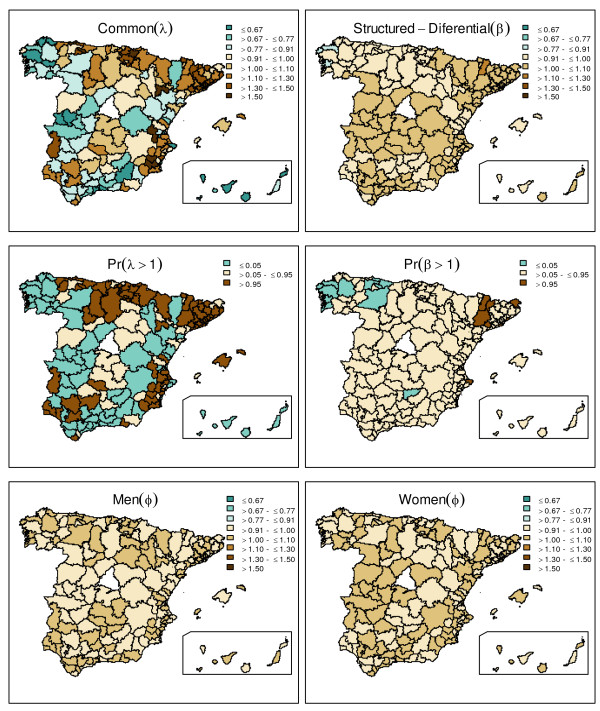
Hospitalization rates due to chronic diseases in the elderly were higher in men (median per area 21.4 per 100 inhabitants, interquartile range: 17.6 to 25.0) than in women (median per area 13.7 per 100, interquartile range: 10.8 to 16.6). Whereas Utilization Ratios showed a similar geographical pattern of variation in both genders, BYM found a high fraction of variation attributable to spatial correlation in both men (71%, CI95%: 50 to 94) and women (62%, CI95%: 45 to 77). In turn, SCM showed that the geographical admission pattern was mainly shared, with just 6% (CI95%: 4 to 8) of variation specific to the women component.
Whereas SAVA and BYM focused on the magnitude of variation and on allocating where variability cannot be due to chance, SCM signalled discrepant areas where latent factors would differently affect men and women.
小区域分析是研究医学实践在地理水平上的不合理和系统差异的最流行的方法学方法。其几个局限性促使研究人员使用疾病映射方法——被认为是一种有价值的替代方法。本工作旨在探索这些技术,使用——作为研究案例-慢性疾病老年患者住院率的性别差异。
设计和研究环境:使用 2006 年因慢性病住院的 538358 例患者的住院数据进行实证研究,比较小区域分析(SAVA)、Besag-York-Mollie(BYM)模型和共享成分模型(SCM)。主要终点:测量性别空间变化,如下所示:SAVA 估计性别特异性利用比;BYM 估计每个性别中归因于空间相关性的方差分数;以及,SCM 估计两性共享的方差分数,以及每个性别特有的方差分数。
老年慢性病患者的住院率男性(每个区域的中位数为 21.4 每 100 名居民,四分位距:17.6 至 25.0)高于女性(每个区域的中位数为 13.7 每 100 名,四分位距:10.8 至 16.6)。虽然利用比在两性中表现出相似的地理变化模式,但 BYM 发现两性中归因于空间相关性的变化比例都很高(男性为 71%,95%CI:50 至 94%;女性为 62%,95%CI:45 至 77%)。相反,SCM 表明地理入院模式主要是共享的,只有 6%(95%CI:4 至 8)的变化是女性组成部分特有的。
虽然 SAVA 和 BYM 侧重于变化的幅度以及分配变异不能归因于机会的地方,但 SCM 指出了不同的区域,潜在因素会以不同的方式影响男性和女性。