State Key Laboratory of Molecular Vaccinology and Molecular Diagnostics, School of Public Health, Xiamen University, Xiang'an Nan Road, Xiang'an District, Xiamen 361102, Fujian, China.
Key Laboratory of Health Technology Assessment of Fujian Province University, School of Public Health, Xiamen University, Xiang'an Nan Road, Xiang'an District, Xiamen 361102, Fujian, China.
Int J Environ Res Public Health. 2018 Jan 2;15(1):55. doi: 10.3390/ijerph15010055.
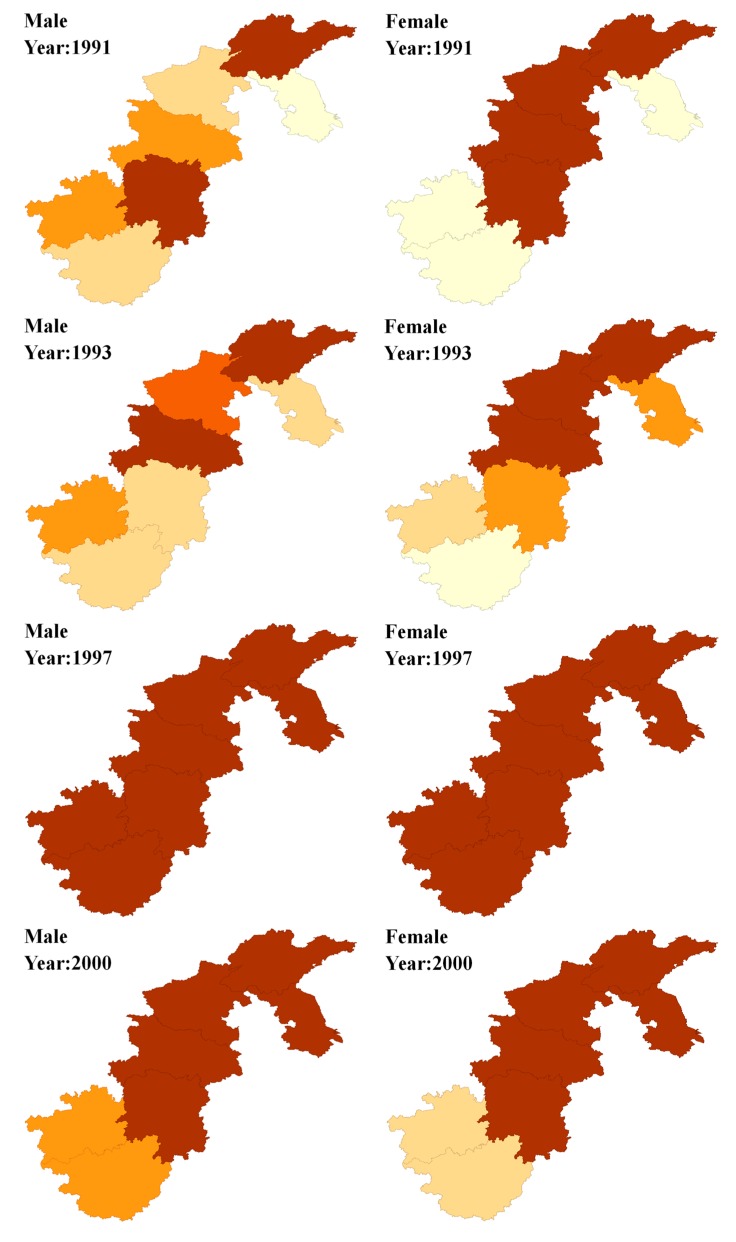
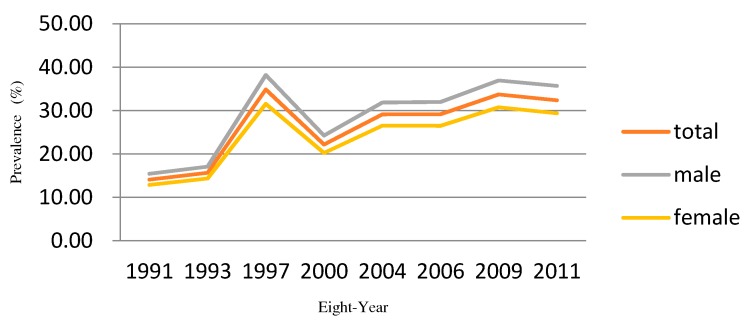
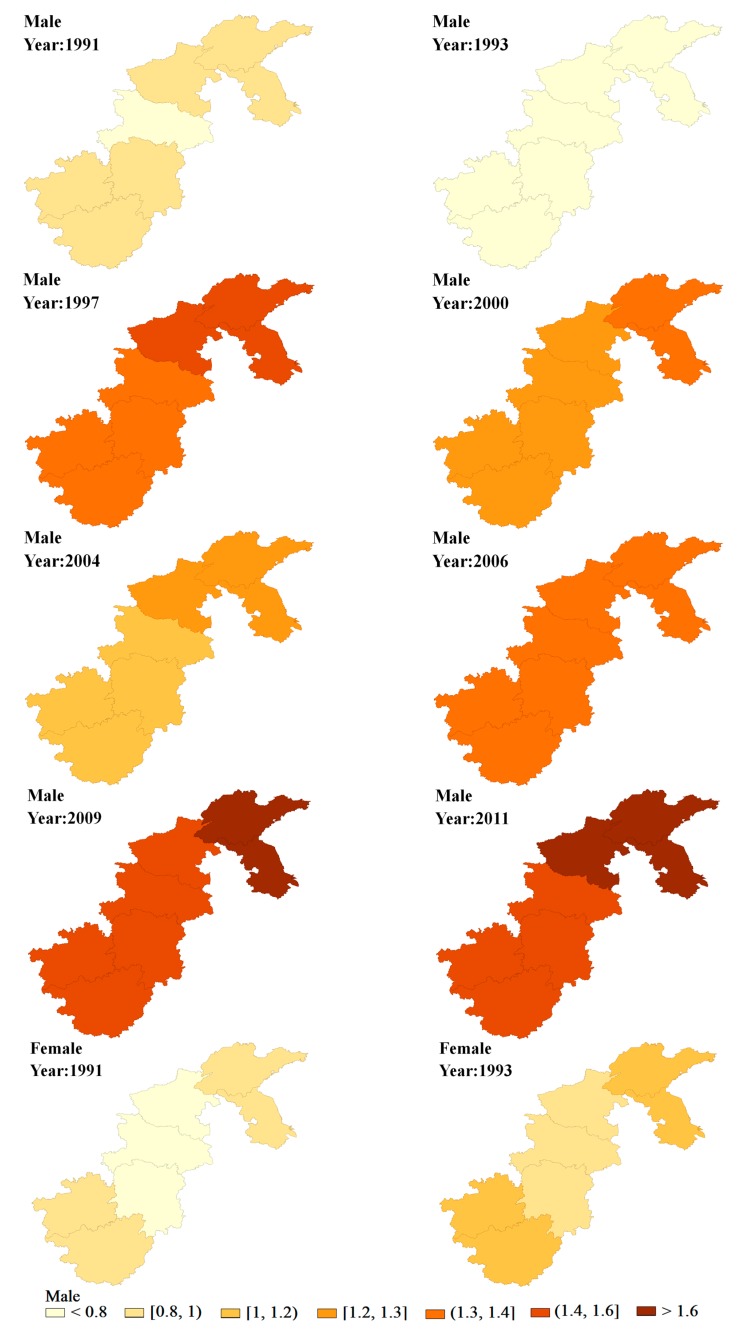
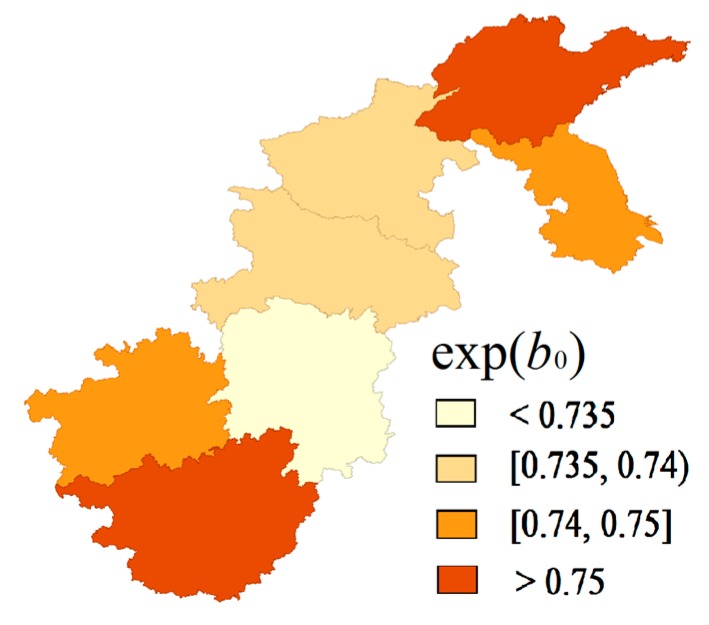
Most previous research on the disparities of hypertension risk has neither simultaneously explored the spatio-temporal disparities nor considered the spatial information contained in the samples, thus the estimated results may be unreliable. Our study was based on the China Health and Nutrition Survey (CHNS), including residents over 12 years old in seven provinces from 1991 to 2011. Bayesian B-spline was used in the extended shared component model (SCM) for fitting temporal-related variation to explore spatio-temporal distribution in the odds ratio (OR) of hypertension, reveal gender variation, and explore latent risk factors. Our results revealed that the prevalence of hypertension increased from 14.09% in 1991 to 32.37% in 2011, with men experiencing a more obvious change than women. From a spatial perspective, a standardized prevalence ratio (SPR) remaining at a high level was found in Henan and Shandong for both men and women. Meanwhile, before 1997, the temporal distribution of hypertension risk for both men and women remained low. After that, notably since 2004, the OR of hypertension in each province increased to a relatively high level, especially in Northern China. Notably, the OR of hypertension in Shandong and Jiangsu, which was over 1.2, continuously stood out after 2004 for males, while that in Shandong and Guangxi was relatively high for females. The findings suggested that obvious spatial-temporal patterns for hypertension exist in the regions under research and this pattern was quite different between men and women.
先前大多数关于高血压风险差异的研究既没有同时探索时空差异,也没有考虑样本中包含的空间信息,因此估计结果可能不可靠。我们的研究基于中国健康与营养调查(CHNS),包括 1991 年至 2011 年来自七个省份的 12 岁以上居民。我们使用扩展共享成分模型(SCM)中的贝叶斯 B 样条来拟合与时间相关的变化,以探索高血压比值比(OR)的时空分布,揭示性别差异,并探索潜在的风险因素。我们的研究结果表明,高血压的患病率从 1991 年的 14.09%增加到 2011 年的 32.37%,男性的变化比女性更为明显。从空间角度来看,我们发现男性和女性在河南和山东的标准化流行比(SPR)都保持在较高水平。同时,在 1997 年之前,男性和女性的高血压风险的时间分布仍然较低。此后,特别是自 2004 年以来,每个省份的高血压 OR 都增加到相对较高的水平,特别是在中国北方。值得注意的是,山东和江苏的男性高血压 OR 自 2004 年以来一直高于 1.2,而山东和广西的女性高血压 OR 相对较高。研究结果表明,在所研究的地区存在明显的高血压时空模式,且这种模式在男性和女性之间存在显著差异。