State Key Laboratory of Water Environment Simulation, School of Environment, Beijing Normal University, No. 19, Xin Jie Kou Wai St., Haidian District, Beijing, 100875, China.
Environ Manage. 2012 Feb;49(2):483-501. doi: 10.1007/s00267-011-9794-1. Epub 2011 Dec 22.
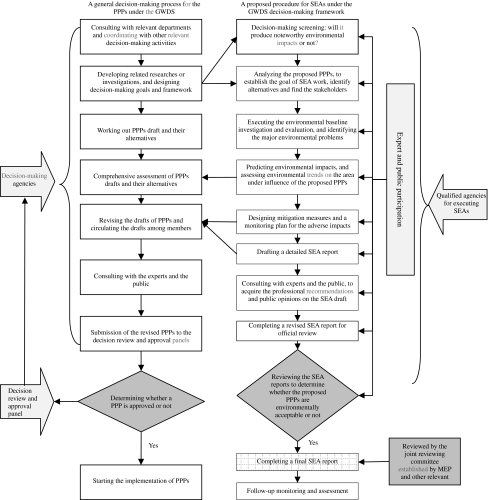
The Great Western Development Strategy (GWDS) is a long term national campaign aimed at boosting development of the western area of China and narrowing the economic gap between the western and the eastern parts of China. The Strategic Environmental Assessment (SEA) procedure was employed to assess the environmental challenges brought about by the western development plans. These plans include five key developmental domains (KDDs): water resource exploitation and use, land utilization, energy generation, tourism development, and ecological restoration and conservation. A combination of methods involving matrix assessment, incorporation of expert judgment and trend analysis was employed to analyze and predict the environmental impacts upon eight selected environmental indicators: water resource availability, soil erosion, soil salinization, forest destruction, land desertification, biological diversity, water quality and air quality. Based on the overall results of the assessment, countermeasures for environmental challenges that emerged were raised as key recommendations to ensure ecological security during the implementation of the GWDS. This paper is intended to introduce a consensus-based process for evaluating the complex, long term pressures on the ecological security of large areas, such as western China, that focuses on the use of combined methods applied at the strategic level.
西部大开发战略(GWDS)是一项旨在促进中国西部地区发展、缩小中国东西部经济差距的长期国家行动。本研究采用战略环境评价(SEA)程序来评估西部发展计划带来的环境挑战。这些计划包括五个关键发展领域(KDD):水资源开发利用、土地利用、能源发电、旅游发展以及生态恢复和保护。本研究采用矩阵评估、专家判断和趋势分析相结合的方法,分析和预测了八个选定的环境指标的环境影响:水资源可利用性、土壤侵蚀、土壤盐渍化、森林破坏、土地沙漠化、生物多样性、水质和空气质量。基于评估的总体结果,提出了应对环境挑战的对策,作为确保在实施 GWDS 期间生态安全的关键建议。本文旨在介绍一种基于共识的方法,用于评估中国西部等大面积地区生态安全的复杂、长期压力,重点是在战略层面应用综合方法。