Choi Alexander J S, Ryter Stefan W
College of Arts and Sciences, Boston College, 140 Commonwealth Avenue, Chestnut Hill, MA 02467, USA.
Int J Cell Biol. 2011;2011:732798. doi: 10.1155/2011/732798. Epub 2011 Nov 30.
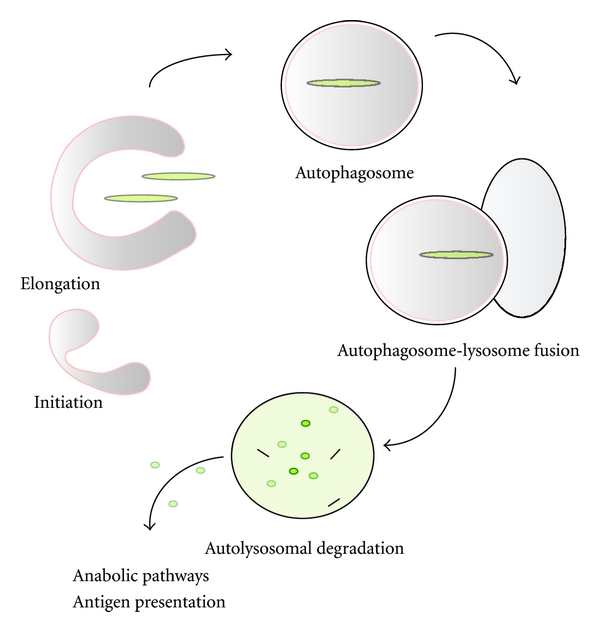
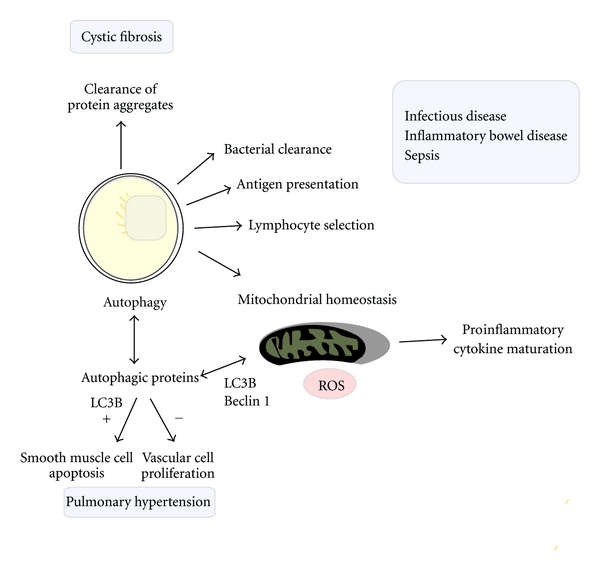
Autophagy provides a mechanism for the turnover of cellular organelles and proteins through a lysosome-dependent degradation pathway. During starvation, autophagy exerts a homeostatic function that promotes cell survival by recycling metabolic precursors. Additionally, autophagy can interact with other vital processes such as programmed cell death, inflammation, and adaptive immune mechanisms, and thereby potentially influence disease pathogenesis. Macrophages deficient in autophagic proteins display enhanced caspase-1-dependent proinflammatory cytokine production and the activation of the inflammasome. Autophagy provides a functional role in infectious diseases and sepsis by promoting intracellular bacterial clearance. Mutations in autophagy-related genes, leading to loss of autophagic function, have been implicated in the pathogenesis of Crohn's disease. Furthermore, autophagy-dependent mechanisms have been proposed in the pathogenesis of several pulmonary diseases that involve inflammation, including cystic fibrosis and pulmonary hypertension. Strategies aimed at modulating autophagy may lead to therapeutic interventions for diseases associated with inflammation.
自噬通过溶酶体依赖性降解途径为细胞器和蛋白质的周转提供了一种机制。在饥饿期间,自噬发挥稳态功能,通过回收代谢前体促进细胞存活。此外,自噬可与其他重要过程相互作用,如程序性细胞死亡、炎症和适应性免疫机制,从而可能影响疾病的发病机制。缺乏自噬蛋白的巨噬细胞表现出增强的半胱天冬酶-1依赖性促炎细胞因子产生和炎性小体的激活。自噬通过促进细胞内细菌清除在传染病和脓毒症中发挥功能性作用。自噬相关基因的突变导致自噬功能丧失,这与克罗恩病的发病机制有关。此外,在包括囊性纤维化和肺动脉高压在内的几种涉及炎症的肺部疾病的发病机制中,也提出了自噬依赖性机制。旨在调节自噬的策略可能会为与炎症相关的疾病带来治疗干预措施。