Department of Medical Informatics, Academic Medical Center, Amsterdam, The Netherlands.
PLoS One. 2011;6(12):e28631. doi: 10.1371/journal.pone.0028631. Epub 2011 Dec 16.
Care of the elderly is recognized as an increasingly important segment of health care. The Assessing Care Of Vulnerable Elderly (ACOVE) quality indicators (QIs) were developed to assess and improve the care of elderly patients.
The purpose of this review is to summarize studies that assess the quality of care using QIs from or based on ACOVE, in order to evaluate the state of quality of care for the reported conditions.
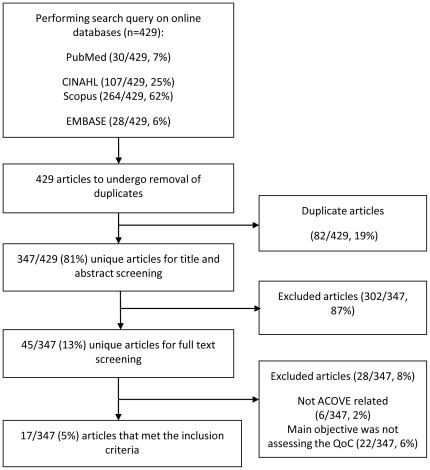
We systematically searched MEDLINE, EMBASE and CINAHL for English-language studies indexed by February 2010. Articles were included if they used any ACOVE QIs, or adaptations thereof, for assessing the quality of care. Included studies were analyzed and relevant information was extracted. We summarized the results of these studies, and when possible generated an overall conclusion about the quality of care as measured by ACOVE for each condition, in various settings, and for each QI.
Seventeen studies were included with 278 QIs (original, adapted or newly developed). The quality scores showed large variation between and within conditions. Only a few conditions showed a stable pass rate range over multiple studies. Overall, pass rates for dementia (interquartile range (IQR): 11%-35%), depression (IQR: 27%-41%), osteoporosis (IQR: 34%-43%) and osteoarthritis (IQR: 29-41%) were notably low. Medication management and use (range: 81%-90%), hearing loss (77%-79%) and continuity of care (76%-80%) scored higher than other conditions. Out of the 278 QIs, 141 (50%) had mean pass rates below 50% and 121 QIs (44%) had pass rates above 50%. Twenty-three percent of the QIs scored above 75%, and 16% scored below 25%.
Quality of care per condition varies markedly across studies. Although there has been much effort in improving the care for elderly patients in the last years, the reported quality of care according to the ACOVE indicators is still relatively low.
老年人的护理被认为是医疗保健中日益重要的一部分。评估易损老年人护理质量(ACOVE)质量指标(QIs)旨在评估和改善老年患者的护理质量。
本综述的目的是总结使用 ACOVE 的 QIs 或基于 ACOVE 的 QIs 评估护理质量的研究,以评估所报告的条件下的护理质量状况。
我们系统地检索了 MEDLINE、EMBASE 和 CINAHL 中截至 2010 年 2 月索引的英文研究。如果使用任何 ACOVE QIs 或其改编版来评估护理质量,则纳入研究。分析纳入的研究并提取相关信息。我们总结了这些研究的结果,并在可能的情况下,根据 ACOVE 为每种情况、各种环境和每个 QI 生成关于护理质量的总体结论。
共纳入 17 项研究,包含 278 个 QIs(原始、改编或新开发)。质量评分在不同条件之间和条件内存在很大差异。只有少数几种情况下的通过率在多项研究中保持稳定。总体而言,痴呆症(四分位间距(IQR):11%-35%)、抑郁症(IQR:27%-41%)、骨质疏松症(IQR:34%-43%)和骨关节炎(IQR:29%-41%)的通过率明显较低。药物管理和使用(范围:81%-90%)、听力损失(77%-79%)和连续性护理(76%-80%)的评分高于其他条件。278 个 QIs 中,有 141 个(50%)的平均通过率低于 50%,有 121 个 QIs(44%)的通过率高于 50%。23%的 QIs 得分超过 75%,16%的 QIs 得分低于 25%。
按条件划分,护理质量在研究之间差异很大。尽管近年来在改善老年患者护理方面做出了很多努力,但根据 ACOVE 指标报告的护理质量仍然相对较低。