Drug Discovery Division, Department of Biochemistry and Molecular Biology, Southern Research Institute, Birmingham, Alabama, United States of America.
PLoS One. 2011;6(12):e29290. doi: 10.1371/journal.pone.0029290. Epub 2011 Dec 16.
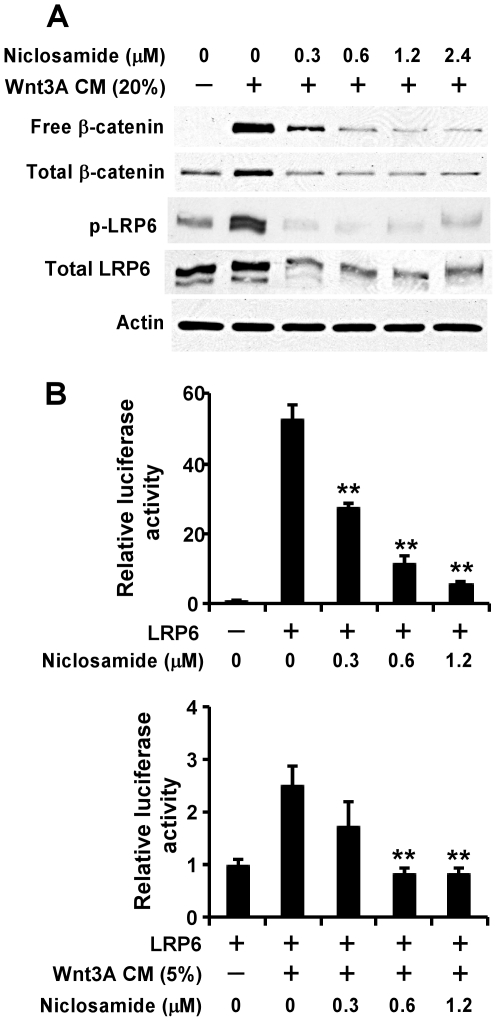
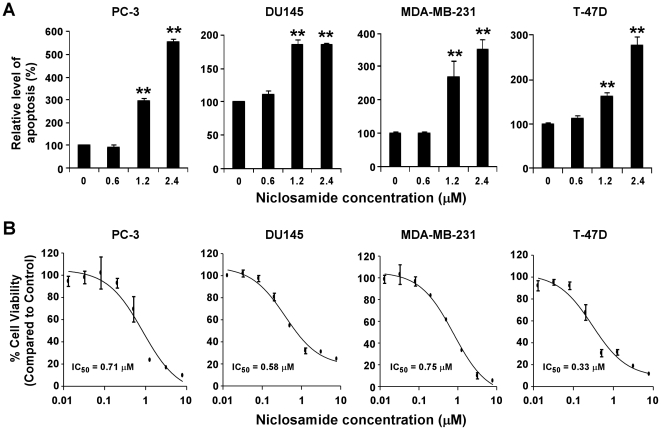
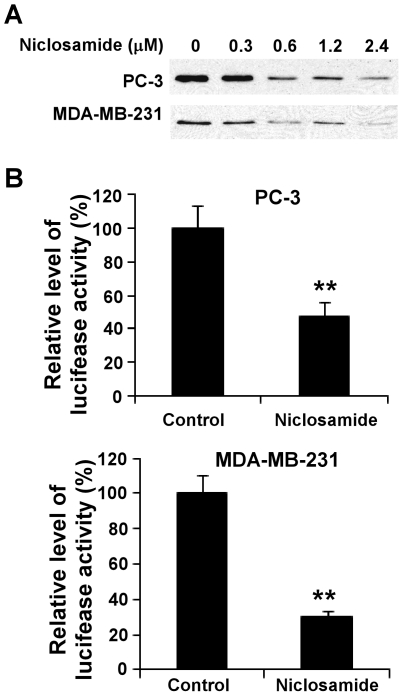
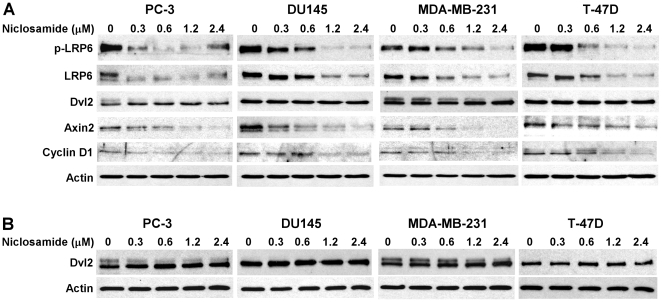
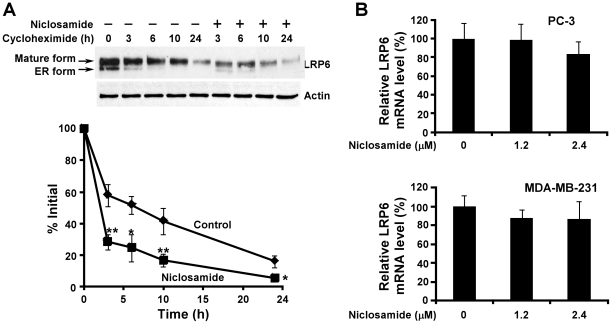
The Wnt/β-catenin signaling pathway is important for tumor initiation and progression. The low density lipoprotein receptor-related protein-6 (LRP6) is an essential Wnt co-receptor for Wnt/β-catenin signaling and represents a promising anticancer target. Recently, the antihelminthic drug, niclosamide was found to inhibit Wnt/β-catenin signaling, although the mechanism was not well defined. We found that niclosamide was able to suppress LRP6 expression and phosphorylation, block Wnt3A-induced β-catenin accumulation, and inhibit Wnt/β-catenin signaling in HEK293 cells. Furthermore, the inhibitory effects of niclosamide on LRP6 expression/phosphorylation and Wnt/β-catenin signaling were conformed in human prostate PC-3 and DU145 and breast MDA-MB-231 and T-47D cancer cells. Moreover, we showed that the mechanism by which niclosamide suppressed LRP6 resulted from increased degradation as evident by a shorter half-life. Finally, we demonstrated that niclosamide was able to induce cancer cell apoptosis, and displayed excellent anticancer activity with IC(50) values less than 1 µM for prostate PC-3 and DU145 and breast MDA-MB-231 and T-47D cancer cells. The IC(50) values are comparable to those shown to suppress the activities of Wnt/β-catenin signaling in prostate and breast cancer cells. Our data indicate that niclosamide is a unique small molecule Wnt/β-catenin signaling inhibitor targeting the Wnt co-receptor LRP6 on the cell surface, and that niclosamide has a potential to be developed a novel chemopreventive or therapeutic agent for human prostate and breast cancer.
Wnt/β-连环蛋白信号通路对于肿瘤的发生和发展至关重要。低密度脂蛋白受体相关蛋白-6(LRP6)是 Wnt/β-连环蛋白信号的必需共受体,是一种有前途的抗癌靶标。最近,抗蠕虫药物尼氯硝唑被发现能够抑制 Wnt/β-连环蛋白信号,尽管其机制尚不清楚。我们发现尼氯硝唑能够抑制 LRP6 的表达和磷酸化,阻断 Wnt3A 诱导的β-连环蛋白积累,并抑制 HEK293 细胞中的 Wnt/β-连环蛋白信号。此外,尼氯硝唑对 LRP6 表达/磷酸化和 Wnt/β-连环蛋白信号的抑制作用在人前列腺 PC-3 和 DU145 以及乳腺癌 MDA-MB-231 和 T-47D 癌细胞中得到了证实。此外,我们表明,尼氯硝唑抑制 LRP6 的机制是由于半衰期缩短导致的降解增加。最后,我们证明尼氯硝唑能够诱导癌细胞凋亡,并显示出优异的抗癌活性,对前列腺 PC-3 和 DU145 以及乳腺癌 MDA-MB-231 和 T-47D 癌细胞的 IC50 值均小于 1µM。这些 IC50 值与抑制前列腺癌和乳腺癌细胞中 Wnt/β-连环蛋白信号活性的那些值相当。我们的数据表明,尼氯硝唑是一种独特的小分子 Wnt/β-连环蛋白信号抑制剂,靶向细胞表面的 Wnt 共受体 LRP6,尼氯硝唑有可能被开发为预防和治疗人类前列腺癌和乳腺癌的新型化学预防剂或治疗剂。