Key Laboratory of Zoological Systematics and Evolution, Institute of Zoology, Chinese Academy of Sciences, Beijing, China.
PLoS One. 2011;6(12):e29329. doi: 10.1371/journal.pone.0029329. Epub 2011 Dec 16.
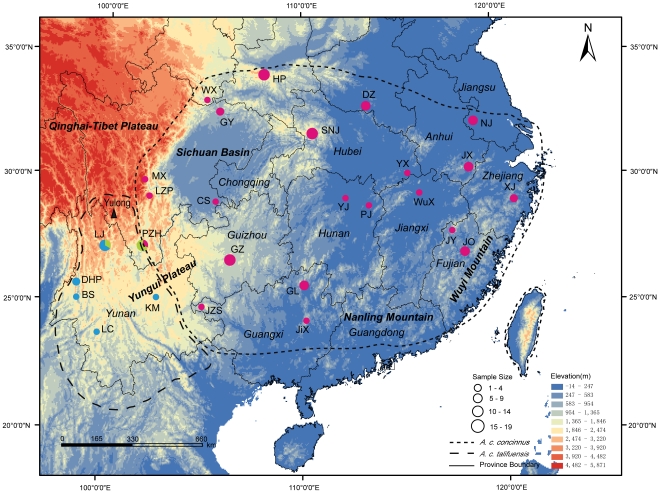
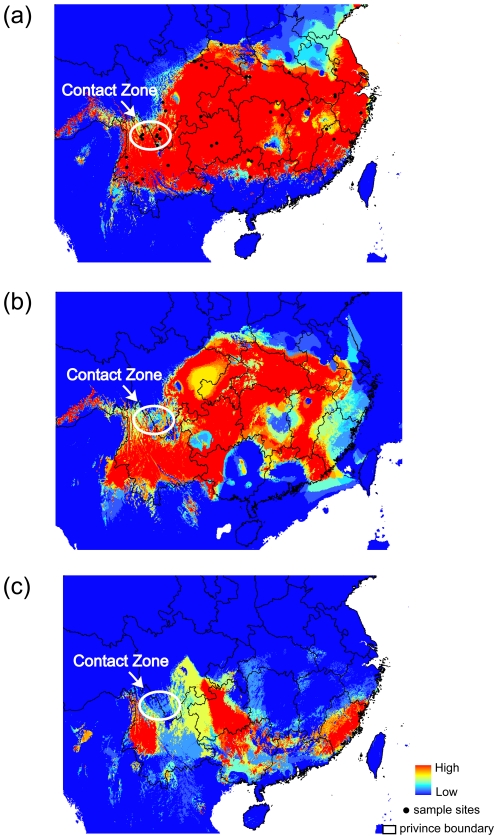
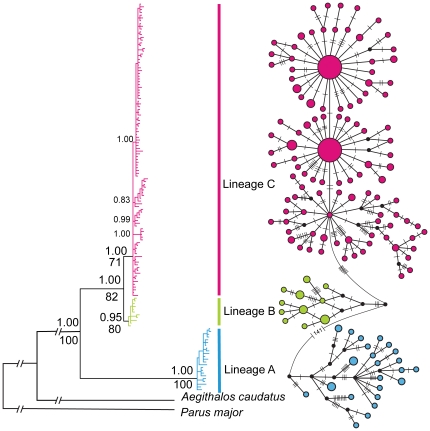
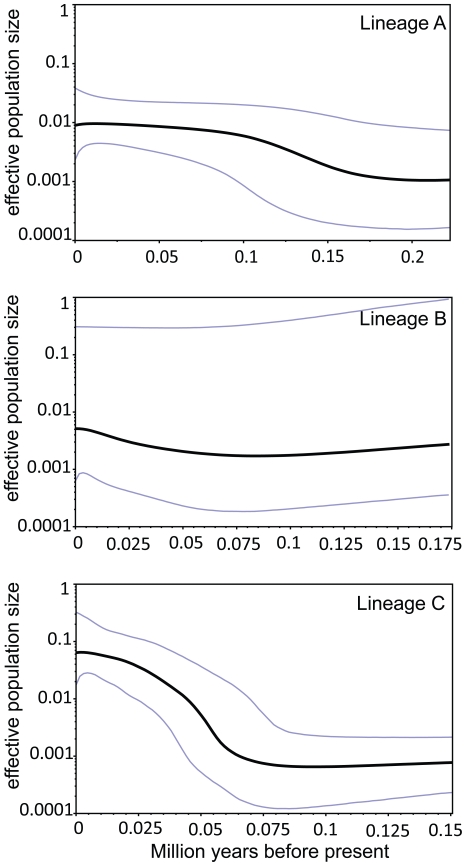
Although a number of studies have assessed the effects of geological and climatic changes on species distributions in East Asian, we still have limited knowledge of how these changes have impacted avian species in south-western and southern China. Here, we aim to study paleo-climatic effects on an East Asian bird, two subspecies of black-throated tit (A. c. talifuensis-concinnus) with the combined analysis of phylogeography and Ecological Niche Models (ENMs). We sequenced three mitochondrial DNA markers from 32 populations (203 individuals) and used phylogenetic inferences to reconstruct the intra-specific relationships among haplotypes. Population genetic analyses were undertaken to gain insight into the demographic history of these populations. We used ENMs to predict the distribution of target species during three periods; last inter-glacial (LIG), last glacial maximum (LGM) and present. We found three highly supported, monophyletic MtDNA lineages and different historical demography among lineages in A. c. talifuensis-concinnus. These lineages formed a narrowly circumscribed intra-specific contact zone. The estimated times of lineage divergences were about 2.4 Ma and 0.32 Ma respectively. ENMs predictions were similar between present and LGM but substantially reduced during LIG. ENMs reconstructions and molecular dating suggest that Pleistocene climate changes had triggered and shaped the genetic structure of black-throated tit. Interestingly, in contrast to profound impacts of other glacial cycles, ENMs and phylogeographic analysis suggest that LGM had limited effect on these two subspecies. ENMs also suggest that Pleistocene climatic oscillations enabled the formation of the contact zone and thus support the refuge theory.
尽管已有多项研究评估了地质和气候变化对东亚物种分布的影响,但我们对这些变化如何影响中国西南和南部地区鸟类物种的了解仍然有限。在这里,我们旨在通过综合分析系统地理学和生态位模型(ENM)来研究古气候对东亚鸟类黑喉山雀(A. c. talifuensis-concinnus)两个亚种的影响。我们从 32 个种群(203 个个体)中提取了三个线粒体 DNA 标记,并使用系统发育推断来重建种内单倍型之间的种内关系。种群遗传分析用于深入了解这些种群的种群历史。我们使用 ENM 在三个时期预测目标物种的分布:末次间冰期(LIG)、末次冰期最大值(LGM)和现在。我们发现了三个高度支持的、单系的线粒体 DNA 谱系,并且在 A. c. talifuensis-concinnus 中,谱系之间存在不同的历史种群动态。这些谱系形成了一个狭窄的种内接触区。谱系分歧的估计时间分别约为 240 万年前和 32 万年前。ENM 预测在现在和 LGM 之间相似,但在 LIG 期间大幅减少。ENM 重建和分子年代测定表明,更新世气候变化引发并塑造了黑喉山雀的遗传结构。有趣的是,与其他冰期循环的深远影响形成对比的是,ENM 和系统地理学分析表明,LGM 对这两个亚种的影响有限。ENM 还表明,更新世气候波动使接触区得以形成,从而支持避难所理论。