Burnett School of Biomedical Sciences, University of Central Florida College of Medicine, 4000 Central Florida Blvd, Orlando, FL 32816, USA.
J Neuroinflammation. 2011 Dec 24;8:182. doi: 10.1186/1742-2094-8-182.
Lipopolysaccharide (LPS) preconditioning-induced neuroprotection is known to be related to suppression of the inflammatory response in the ischemic area. This study seeks to determine if monocyte chemotactic protein-induced protein 1 (MCPIP1), a recently identified CCCH Zn finger-containing protein, plays a role in focal brain ischemia and to elucidate the mechanisms of LPS-induced ischemic brain tolerance.
Transcription and expression of MCPIP1 gene was monitored by qRT-PCR and Western blot. Mouse microglia was prepared from cortices of C57BL/6 mouse brain and primary human microglia was acquired from Clonexpress, Inc. Wild type and MCPIP1 knockout mice were treated with LPS (0.2 mg/kg) 24 hours before brain ischemia induced by transient middle cerebral artery occlusion (MCAO). The infarct was measured by 2,3,5-triphenyltetrazolium chloride (TTC) staining.
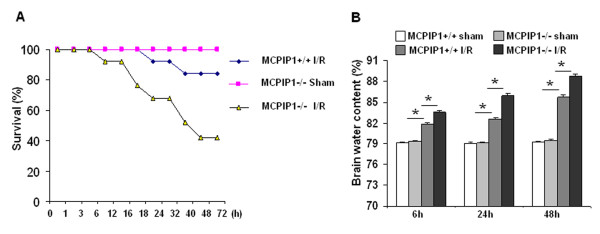
MCPIP1 protein and mRNA levels significantly increased in both mouse and human microglia and mouse brain undergoing LPS preconditioning. MCPIP1 mRNA level significantly increased in mice ipsilateral brain than that of contralateral side after MCAO. The mortality of MCPIP1 knockout mice was significantly higher than that of wild-type after MCAO. MCPIP1 deficiency caused significant increase in the infarct volume compared with wild type mice undergoing LPS preconditioning. MCPIP1 deficiency caused significant upregulation of proinflammatory cytokines in mouse brain. Furthermore, MCPIP1 deficiency increased c-Jun N terminal kinase (JNK) activation substantially. Inhibition of JNK signaling decreased the production of proinflammatory cytokines in MCPIP1 knock out mice after MCAO.
Our data indicate that absence of MCPIP1 exacerbates ischemic brain damage by upregulation of proinflammatory cytokines and that MCPIP1 participates in LPS-induced ischemic stroke tolerance.
脂多糖 (LPS) 预处理诱导的神经保护作用与缺血区炎症反应的抑制有关。本研究旨在确定单核细胞趋化蛋白诱导蛋白 1 (MCPIP1) 是否在局灶性脑缺血中发挥作用,并阐明 LPS 诱导的缺血性脑耐受的机制。
通过 qRT-PCR 和 Western blot 监测 MCPIP1 基因的转录和表达。从小鼠大脑皮质中制备小鼠小胶质细胞,并从 Clonexpress,Inc. 获得原代人小胶质细胞。用 LPS(0.2mg/kg)预处理野生型和 MCPIP1 敲除小鼠 24 小时,然后用短暂性大脑中动脉闭塞 (MCAO) 诱导脑缺血。用 2,3,5-三苯基氯化四氮唑 (TTC) 染色测量梗死。
在 LPS 预处理的小鼠和人小胶质细胞以及小鼠脑内,MCPIP1 蛋白和 mRNA 水平显著增加。MCAO 后,小鼠对侧脑 MCPIP1 mRNA 水平明显高于同侧脑。MCAO 后,MCPIP1 敲除小鼠的死亡率明显高于野生型小鼠。与野生型小鼠相比,MCPIP1 缺陷小鼠在 LPS 预处理后梗死体积明显增加。MCPIP1 缺陷导致炎性细胞因子的表达明显上调。此外,MCPIP1 缺陷导致 JNK 激活显著增加。抑制 JNK 信号通路可减少 MCAO 后 MCPIP1 敲除小鼠炎性细胞因子的产生。
我们的数据表明,MCPIP1 缺失通过上调促炎细胞因子加重缺血性脑损伤,并且 MCPIP1 参与 LPS 诱导的缺血性中风耐受。