Anthropology Department, Brunel University, United Kingdom; Department of Epidemiology and Population Health, London School of Hygiene and Tropical Medicine, United Kingdom.
Departamento de Medicina Social, Universidade Federal de Pelotas, Pelotas, Brazil.
Soc Sci Med. 2012 Feb;74(3):434-443. doi: 10.1016/j.socscimed.2011.10.014. Epub 2011 Nov 27.
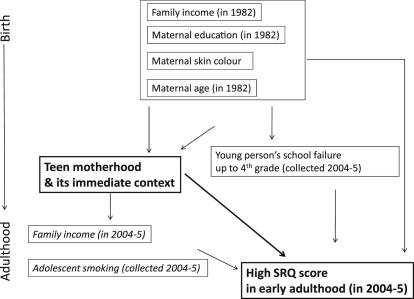
Explanations for the association between teen-childbearing and subsequent mental morbidity vary considerably, from those based on neurological theories of development to those investigating underlying social and economic determinants. Based on longitudinal epidemiological and ethnographic sub-studies of the 1982 Pelotas birth cohort study, this paper explores the hypothesis that teen childbearing and subsequent mental morbidity have become associated through the interplay of culture, society, and biology in situations where teen pregnancy has become a stigmatised object of scientific and public health attention. Results show that the effect of teen childbearing on subsequent mental morbidity remained significant in the multivariate analysis. Ethnographic analysis, together with epidemiological effect modification analyses, suggest that this association is partially accounted for by the fact that it is more pronounced amongst a specific subgroup of women of low socio-economic status who, being more politicised about societal injustice, were also more critically engaged with - and thus troubled by - the inequitable institutionalisation of life-cycle transitions. With time, these women became highly critical of the institutionalised identification of early childbearing as a key violation of life-cycle norms and the differential class-based application of scientific knowledge on its causes and consequences. Public health campaigns should consider how the age-based institutionalisation of developmental norms has enabled the stigmatisation of those identified as transgressors.
青少年生育与随后的精神健康之间的关联的解释差异很大,从基于发展的神经科学理论到调查潜在的社会和经济决定因素的理论都有。本文基于对 1982 年佩洛塔斯出生队列研究的纵向流行病学和民族志子研究,探讨了这样一种假设,即青少年生育与随后的精神健康之间的关联是通过文化、社会和生物学的相互作用形成的,在这种情况下,青少年怀孕已经成为科学和公共卫生关注的一个被污名化的对象。研究结果表明,青少年生育对随后的精神健康的影响在多变量分析中仍然显著。民族志分析以及流行病学的效应修正分析表明,这种关联部分归因于这样一个事实,即在社会经济地位较低的特定亚组妇女中,这种关联更为明显,这些妇女对社会不公正更加关注,也更加关注和因此受到困扰于生命周期转变的不平等制度化。随着时间的推移,这些妇女对将早期生育确定为违反生命周期规范的主要行为以及对其原因和后果的科学知识的基于阶级的差异化应用的制度化提出了强烈批评。公共卫生运动应该考虑到基于年龄的发展规范的制度化如何使那些被认定为违规者的人受到污名化。