Kasperczyk A, DiMartino N A, Krontiris T G
Department of Medicine (Hematology/Oncology), New England Medical Center Hospitals, Boston, MA 02111.
Am J Hum Genet. 1990 Nov;47(5):854-9.
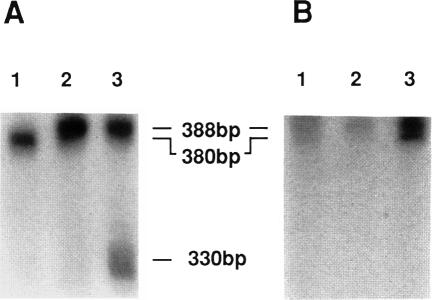
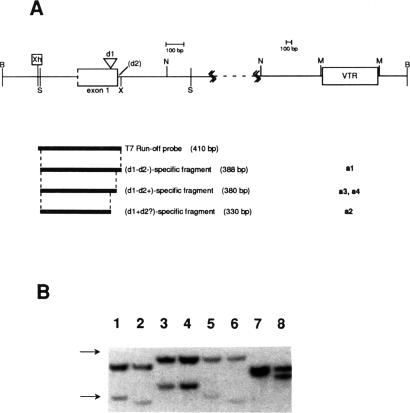
Three genetic markers within the promoter-exon 1 region of the HRAS1 locus have been employed to investigate lineage relationships among alleles of the highly polymorphic variable tandem repeat (VTR) immediately downstream of the HRAS1 gene. These markers were in absolute linkage disequilibrium with the HRAS1 VTR, allowing the assignment of unique upstream haplotypes to each of the four common VTR alleles. Analysis of 17 rare alleles revealed a stratification of allele fragment size and upstream haplotype in which each rare VTR allele possessed the markers characteristic of the common allele nearest in size. Therefore, hyperallelism emanated from the four common alleles in a defined fashion, the size of a rare allele specifying its origin. As discussed below, this result implies that unequal crossing-over between homologues is unlikely to be the predominant mechanism for generating new VTR alleles at this minisatellite locus.
HRAS1基因座启动子-外显子1区域内的三个遗传标记已被用于研究HRAS1基因下游高度多态性可变串联重复序列(VTR)等位基因之间的谱系关系。这些标记与HRAS1 VTR处于完全连锁不平衡状态,从而能够为四种常见VTR等位基因中的每一个分配独特的上游单倍型。对17个罕见等位基因的分析揭示了等位基因片段大小和上游单倍型的分层情况,其中每个罕见VTR等位基因都具有大小最接近的常见等位基因的特征性标记。因此,高度多态性以一种明确的方式源自四种常见等位基因,罕见等位基因的大小决定了其起源。如下所述,这一结果意味着同源染色体之间的不等交换不太可能是在这个小卫星基因座产生新VTR等位基因的主要机制。