Institute of Human Genetics, University of Freiburg, Freiburg, Germany.
PLoS One. 2011;6(12):e29311. doi: 10.1371/journal.pone.0029311. Epub 2011 Dec 27.
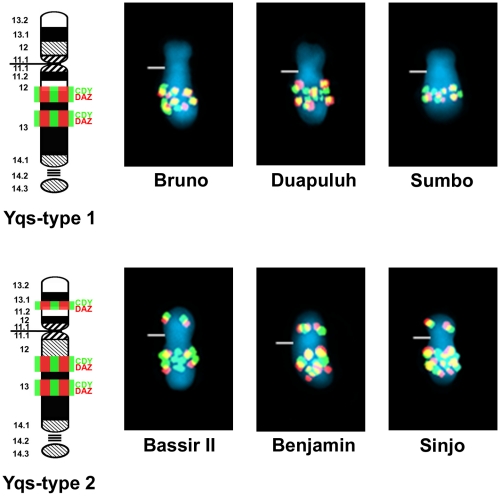
We have previously demonstrated that the Y-specific ampliconic fertility genes DAZ (deleted in azoospermia) and CDY (chromodomain protein Y) varied with respect to copy number and position among chimpanzees (Pan troglodytes). In comparison, seven Y-chromosomal lineages of the bonobo (Pan paniscus), the chimpanzee's closest living relative, showed no variation. We extend our earlier comparative investigation to include an analysis of the intraspecific variation of these genes in gorillas (Gorilla gorilla) and orangutans (Pongo pygmaeus), and examine the resulting patterns in the light of the species' markedly different social and mating behaviors.
METHODOLOGY/PRINCIPAL FINDINGS: Fluorescence in situ hybridization analysis (FISH) of DAZ and CDY in 12 Y-chromosomal lineages of western lowland gorilla (G. gorilla gorilla) and a single lineage of the eastern lowland gorilla (G. beringei graueri) showed no variation among lineages. Similar findings were noted for the 10 Y-chromosomal lineages examined in the Bornean orangutan (Pongo pygmaeus), and 11 Y-chromosomal lineages of the Sumatran orangutan (P. abelii). We validated the contrasting DAZ and CDY patterns using quantitative real-time polymerase chain reaction (qPCR) in chimpanzee and bonobo.
CONCLUSION/SIGNIFICANCE: High intraspecific variation in copy number and position of the DAZ and CDY genes is seen only in the chimpanzee. We hypothesize that this is best explained by sperm competition that results in the variant DAZ and CDY haplotypes detected in this species. In contrast, bonobos, gorillas and orangutans-species that are not subject to sperm competition-showed no intraspecific variation in DAZ and CDY suggesting that monoandry in gorillas, and preferential female mate choice in bonobos and orangutans, probably permitted the fixation of a single Y variant in each taxon. These data support the notion that the evolutionary history of a primate Y chromosome is not simply encrypted in its DNA sequences, but is also shaped by the social and behavioral circumstances under which the specific species has evolved.
我们之前已经证明,在黑猩猩(Pan troglodytes)中,Y 染色体特异性扩增基因 DAZ(无精子症缺失)和 CDY(色氨酸蛋白 Y)在数量和位置上存在差异。相比之下,黑猩猩亲缘关系最近的物种——倭黑猩猩(Pan paniscus)的七个 Y 染色体谱系没有发生变化。我们将之前的比较研究扩展到对大猩猩(Gorilla gorilla)和猩猩(Pongo pygmaeus)的这些基因的种内变异进行分析,并根据这些物种明显不同的社会和交配行为来检查由此产生的模式。
方法/主要发现:通过对 12 条西部低地大猩猩(G. gorilla gorilla)和 1 条东部低地大猩猩(G. beringei graueri)的 Y 染色体谱系以及 10 条婆罗洲猩猩(Pongo pygmaeus)和 11 条苏门答腊猩猩(P. abelii)的 Y 染色体谱系进行荧光原位杂交分析(FISH),发现这些谱系之间没有变异。在黑猩猩和倭黑猩猩中,我们使用定量实时聚合酶链反应(qPCR)验证了 DAZ 和 CDY 模式的对比。
结论/意义:在黑猩猩中,仅观察到 DAZ 和 CDY 基因数量和位置的高度种内变异。我们假设,这最好用精子竞争来解释,这种竞争导致了在该物种中检测到的变异 DAZ 和 CDY 单倍型。相比之下,不会受到精子竞争影响的倭黑猩猩、大猩猩和猩猩没有在 DAZ 和 CDY 中表现出种内变异,这表明大猩猩的单配偶制,以及倭黑猩猩和猩猩中雌性的优先择偶,可能使每个分类单元的单一 Y 变体得以固定。这些数据支持这样一种观点,即灵长类动物 Y 染色体的进化历史不仅仅被其 DNA 序列所编码,还受到该特定物种进化过程中社会和行为环境的影响。