Vaccine and Infectious Disease Organization, University of Saskatchewan, Saskatoon, Canada.
PLoS One. 2011;6(12):e29787. doi: 10.1371/journal.pone.0029787. Epub 2011 Dec 27.
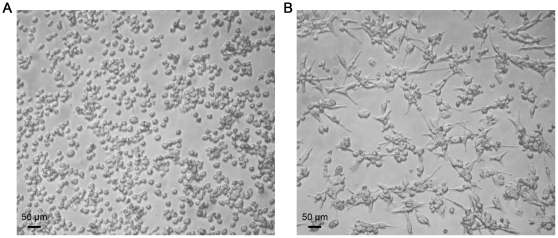
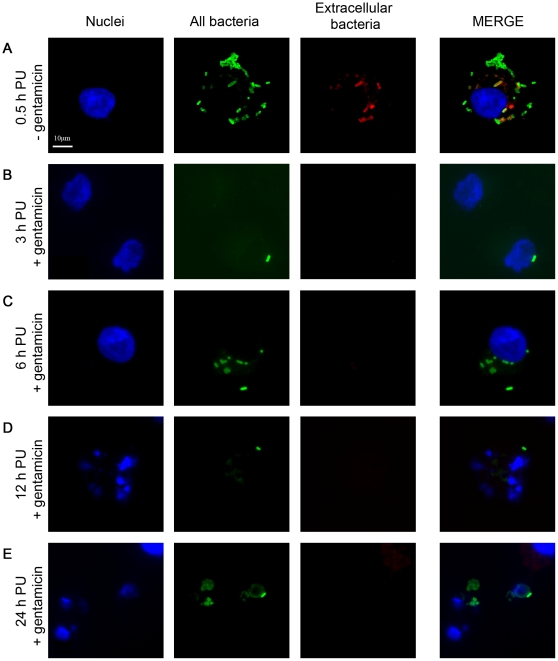
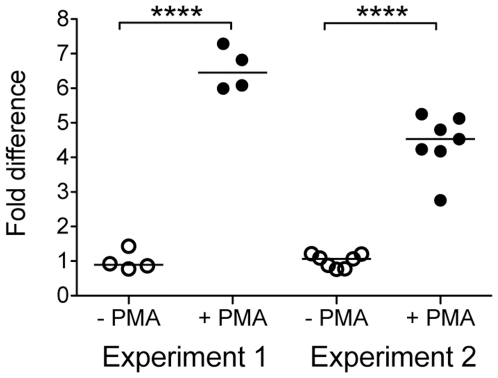
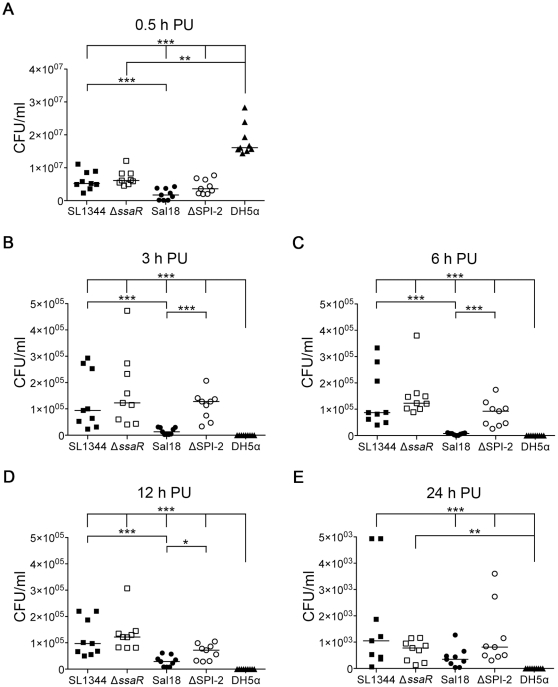
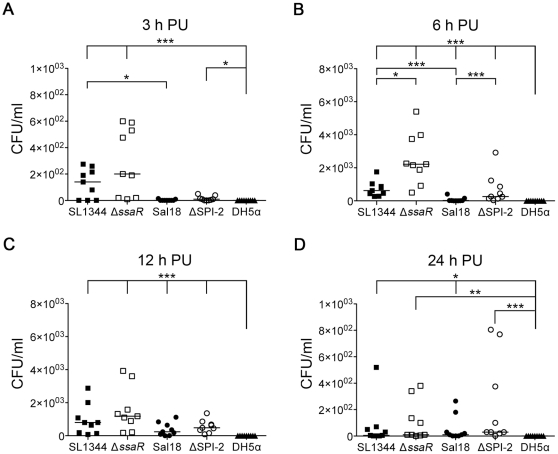
In order to better identify the role of the Salmonella pathogenicity island 2 (SPI-2) type III secretion system (T3SS) in chickens, we used the well-known gentamicin protection assay with activated HD11 cells. HD11 cells are a macrophage-like chicken cell line that can be stimulated with phorbol 12-myristate 13-acetate (PMA) to exhibit more macrophage-like morphology and greater production of reactive oxygen species (ROS). Activated HD11 cells were infected with a wild-type Salmonella enterica subspecies enterica serovar Typhimurium (S. Typhimurium) strain, a SPI-2 mutant S. Typhimurium strain, a wild-type Salmonella enterica subspecies enterica serovar Enteritidis (S. Enteritidis) strain, a SPI-2 mutant S. Enteritidis strain, or a non-pathogenic Escherichia coli (E. coli) strain. SPI-2 mutant strains were found to survive as well as their parent strain at all time points post-uptake (PU) by the HD11 cells, up to 24 h PU, while the E. coli strain was no longer recoverable by 3 h PU. We can conclude from these observations that the SPI-2 T3SS of S. Typhimurium and S. Enteritidis is not important for survival of Salmonella in the activated macrophage-like HD11 cell line, and that Salmonella must employ other mechanisms for survival in this environment, as E. coli is effectively eliminated.
为了更好地确定沙门氏菌致病岛 2(SPI-2)型 III 型分泌系统(T3SS)在鸡中的作用,我们使用了著名的激活 HD11 细胞的庆大霉素保护试验。HD11 细胞是一种类似于巨噬细胞的鸡细胞系,可用佛波醇 12-肉豆蔻酸 13-乙酸酯(PMA)刺激,表现出更类似于巨噬细胞的形态和更多的活性氧物质(ROS)产生。激活的 HD11 细胞被野生型沙门氏菌肠亚种肠炎沙门氏菌(S. Typhimurium)菌株、SPI-2 突变 S. Typhimurium 菌株、野生型沙门氏菌肠亚种肠炎沙门氏菌(S. Enteritidis)菌株、SPI-2 突变 S. Enteritidis 菌株或非致病性大肠杆菌(E. coli)菌株感染。SPI-2 突变菌株在被 HD11 细胞摄取后(PU)的所有时间点都能像其亲本菌株一样存活,直到 24 h PU,而大肠杆菌菌株在 3 h PU 时已无法恢复。从这些观察结果可以得出结论,SPI-2 T3SS 沙门氏菌和 S. Enteritidis 对沙门氏菌在激活的类似于巨噬细胞的 HD11 细胞系中的存活不重要,沙门氏菌必须采用其他机制在这种环境中存活,因为大肠杆菌已被有效消除。