Bielicki J, Freeman C, Clements P R, Hopwood J J
Department of Chemical Pathology, Adelaide Medical Centre for Women and Children, South Australia.
Biochem J. 1990 Oct 1;271(1):75-86. doi: 10.1042/bj2710075.
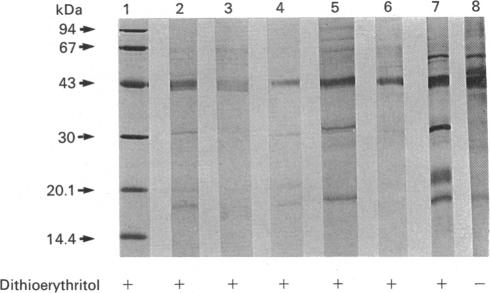
Human iduronate-2-sulphatase (EC 3.1.6.13), which is involved in the lysosomal degradation of the glycosaminoglycans heparan sulphate and dermatan sulphate, was purified more than 500,000-fold in 5% yield from liver with a six-step column procedure, which consisted of a concanavalin A-Sepharose-Blue A-agarose coupled step, chromatofocusing, gel filtration on TSK HW 50S-Fractogel, hydrophobic separation on phenyl-Sepharose CL-4B and size separation on TSK G3000SW Ultrapac. Two major forms were identified. Form A and form B, with pI values of 4.5 and less than 4.0 respectively, separated at the chromatofocusing step in approximately equal amounts of recovered enzyme activity. By gel-filtration methods form A had a native molecular mass in the range 42-65 kDa. When analysed by SDS/PAGE, dithioerythritol-reduced and non-reduced form A and form B consistently contained polypeptides of molecular masses 42 kDa and 14 kDa. Iduronate-2-sulphatase was purified from human kidney, placenta and lung, and form A was shown to have similar native molecular mass and subunit components to those observed for liver enzyme. Both forms of liver iduronate-2-sulphatase were active towards a variety of substrates derived from heparin and dermatan sulphate. Kinetic parameters (Km and Kcat) of form A were determined with a variety of substrates matching structural aspects of the physiological substrates in vivo, namely heparan sulphate, heparin and dermatan sulphate. Substrate with 6-sulphate esters on the aglycone residue adjacent to the iduronic acid 2-sulphate residue being attack were hydrolysed with catalytic efficiencies up to 200 times above that observed for the simplest disaccharide substrate without a 6-sulphated aglycone residue. The effect of incubation pH on enzyme activity towards the variety of substrates evaluated was complex and dependent on substrate aglycone structure, substrate concentration, buffer type and the presence of other proteins. Sulphate and phosphate ions and a number of substrate and product analogues were potent inhibitor of form A and form B enzyme activities.
人艾杜糖醛酸 -2-硫酸酯酶(EC 3.1.6.13)参与硫酸乙酰肝素和硫酸皮肤素这两种糖胺聚糖的溶酶体降解过程。采用六步柱层析法从肝脏中纯化该酶,纯化倍数超过500,000倍,产率为5%。该六步柱层析法包括伴刀豆球蛋白A - 琼脂糖 - 蓝色A - 琼脂糖偶联步骤、色谱聚焦、TSK HW 50S - Fractogel凝胶过滤、苯基 - 琼脂糖CL - 4B疏水分离以及TSK G3000SW Ultrapac尺寸分离。鉴定出两种主要形式,即A形式和B形式,其pI值分别为4.5和小于4.0,在色谱聚焦步骤中以大致等量的回收酶活性分离。通过凝胶过滤法,A形式的天然分子质量在42 - 65 kDa范围内。通过SDS/PAGE分析,二硫苏糖醇还原型和非还原型的A形式和B形式始终含有分子质量分别为42 kDa和14 kDa的多肽。从人肾、胎盘和肺中纯化出艾杜糖醛酸 -2-硫酸酯酶,结果表明A形式的天然分子质量和亚基组成与肝脏酶相似。肝脏中的两种形式的艾杜糖醛酸 -2-硫酸酯酶对多种源自肝素和硫酸皮肤素的底物均有活性。用多种与体内生理底物结构方面相匹配的底物,即硫酸乙酰肝素、肝素和硫酸皮肤素,测定了A形式的动力学参数(Km和Kcat)。在艾杜糖醛酸2 - 硫酸酯残基相邻的糖苷配基残基上带有6 - 硫酸酯的底物被水解,其催化效率比没有6 - 硫酸化糖苷配基残基的最简单二糖底物高出200倍。孵育pH对所评估的多种底物的酶活性的影响较为复杂,且取决于底物糖苷配基结构、底物浓度、缓冲液类型以及其他蛋白质的存在。硫酸根离子、磷酸根离子以及许多底物和产物类似物是A形式和B形式酶活性的强效抑制剂。