Department of Chemistry, Texas A&M University, P.O. Box 30012, College Station, Texas 77842, USA.
J Am Chem Soc. 2012 Feb 1;134(4):1914-7. doi: 10.1021/ja208779k. Epub 2012 Jan 18.
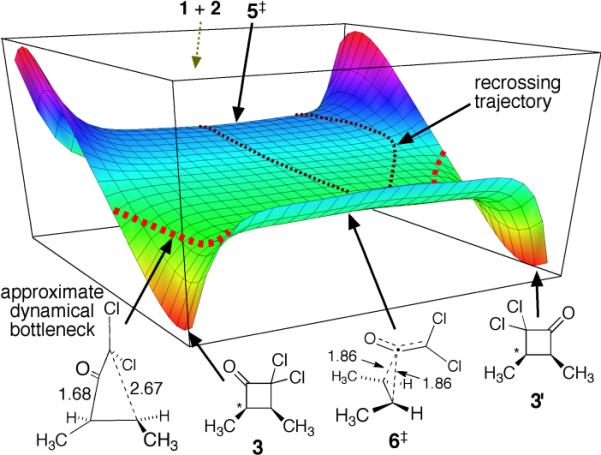
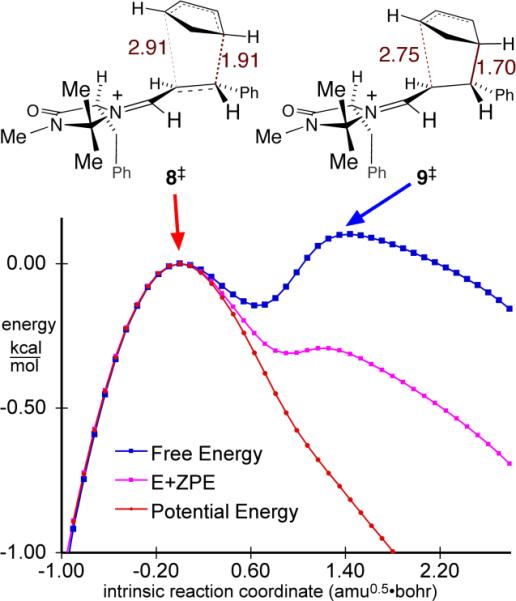
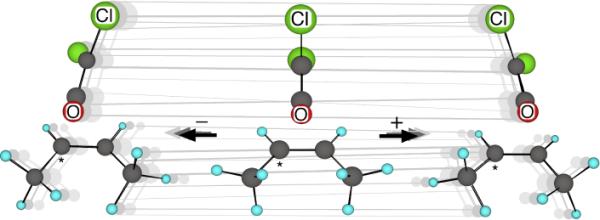
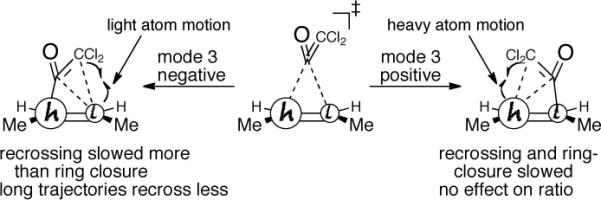
An unusual intramolecular kinetic isotope effect (KIE) in the reaction of dichloroketene with cis-2-butene does not fit with a simple asynchronous cycloaddition transition state, but it can be predicted from trajectory studies on a bifurcating energy surface. The origin of the KIE is related to a high propensity for transition state recrossing in this system, with heavier masses recrossing less. The KIE can also be predicted by a statistical model that treats the cycloaddition as a stepwise mechanism, the rate-limiting second step being associated with an entropic barrier for formation of the second carbon-carbon bond. The relevance of this stepwise mechanism to other asynchronous but seemingly concerted cycloadditions is suggested by examination of organocatalytic Diels-Alder reactions.
二氯亚乙烯与顺-2-丁烯反应中出现了一种不寻常的分子内动力学同位素效应(KIE),这与简单的非同步环加成过渡态不相符,但可以通过分叉能面上的轨迹研究来预测。KIE 的起源与该体系中过渡态重交叉的高倾向有关,较重的质量重交叉较少。KIE 也可以通过一个统计模型来预测,该模型将环加成视为逐步机制,限速的第二步与第二个碳-碳键形成的熵垒有关。通过对有机催化 Diels-Alder 反应的考察,表明这种逐步机制与其他看似协同的异步环加成反应有关。