Molecular Physiology Group, Department of Exercise and Sport Sciences, University of Copenhagen, Copenhagen, Denmark.
PLoS One. 2012;7(1):e29391. doi: 10.1371/journal.pone.0029391. Epub 2012 Jan 3.
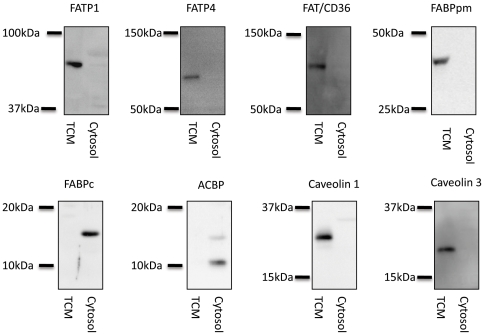
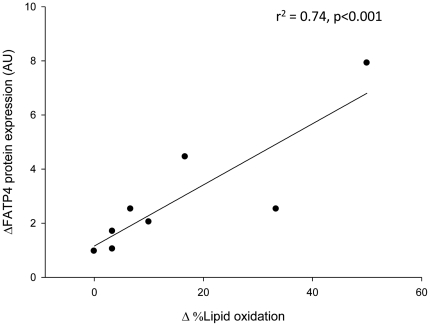
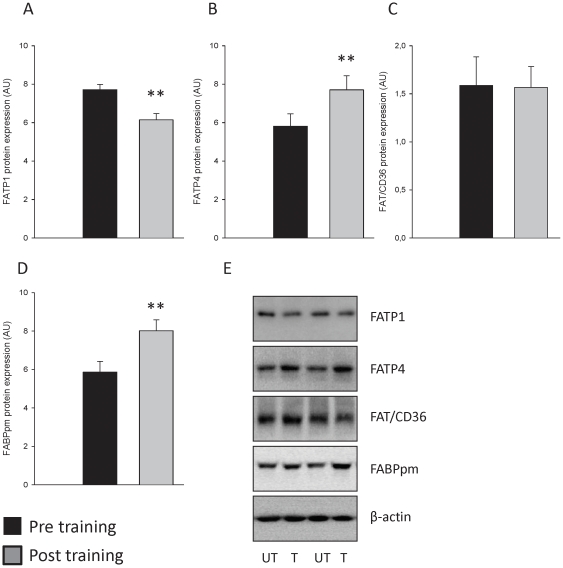
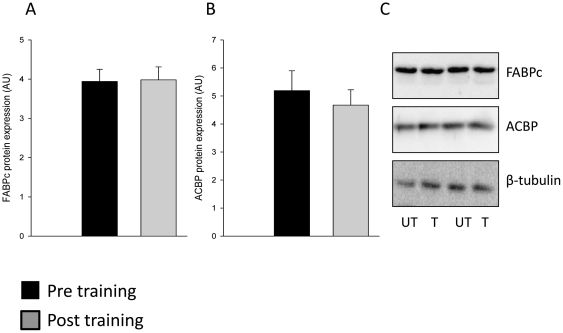
FATP1 and FATP4 appear to be important for the cellular uptake and handling of long chain fatty acids (LCFA). These findings were obtained from loss- or gain of function models. However, reports on FATP1 and FATP4 in human skeletal muscle are limited. Aerobic training enhances lipid oxidation; however, it is not known whether this involves up-regulation of FATP1 and FATP4 protein. Therefore, the aim of this project was to investigate FATP1 and FATP4 protein expression in the vastus lateralis muscle from healthy human individuals and to what extent FATP1 and FATP4 protein expression were affected by an increased fuel demand induced by exercise training. Eight young healthy males were recruited to the study. All subjects were non smokers and did not participate in regular physical activity (<1 time per week for the past 6 months, VO(2peak) 3.4±0.1 l O₂ min⁻¹). Subjects underwent an 8 week supervised aerobic training program. Training induced an increase in VO(2peak) from 3.4±0.1 to 3.9±0.1 l min⁻¹ and citrate synthase activity was increased from 53.7±2.5 to 80.8±3.7 µmol g⁻¹ min⁻¹. The protein content of FATP4 was increased by 33%, whereas FATP1 protein content was reduced by 20%. Interestingly, at the end of the training intervention a significant association (r² = 0.74) between the observed increase in skeletal muscle FATP4 protein expression and lipid oxidation during a 120 min endurance exercise test was observed. In conclusion, based on the present findings it is suggested that FATP1 and FATP4 proteins perform different functional roles in handling LCFA in skeletal muscle with FATP4 apparently more important as a lipid transport protein directing lipids for lipid oxidation.
FATP1 和 FATP4 似乎对长链脂肪酸 (LCFA) 的细胞摄取和处理很重要。这些发现来自于功能丧失或获得的模型。然而,关于人类骨骼肌中 FATP1 和 FATP4 的报道有限。有氧运动训练可增强脂类氧化;然而,尚不清楚这是否涉及 FATP1 和 FATP4 蛋白的上调。因此,本项目的目的是研究健康个体股外侧肌中 FATP1 和 FATP4 蛋白的表达,并探讨运动训练引起的燃料需求增加对 FATP1 和 FATP4 蛋白表达的影响程度。8 名年轻健康男性被招募参与本研究。所有受试者均不吸烟,且过去 6 个月每周运动次数不超过 1 次(VO₂peak 为 3.4±0.1 l O₂ min⁻¹)。受试者接受了 8 周的监督有氧运动训练计划。训练使 VO₂peak 从 3.4±0.1 增加到 3.9±0.1 l min⁻¹,柠檬酸合酶活性从 53.7±2.5 增加到 80.8±3.7 µmol g⁻¹ min⁻¹。FATP4 的蛋白含量增加了 33%,而 FATP1 蛋白含量减少了 20%。有趣的是,在训练干预结束时,观察到骨骼肌 FATP4 蛋白表达的增加与 120 分钟耐力运动测试中的脂类氧化之间存在显著相关性(r²=0.74)。总之,根据目前的发现,FATP1 和 FATP4 蛋白在处理骨骼肌中的 LCFA 时可能具有不同的功能作用,而 FATP4 显然作为一种脂质转运蛋白,将脂质导向脂质氧化,起着更为重要的作用。