Department of Plant Pathology, College of Plant Protection, Nanjing Agricultural University, and Key Laboratory of Integrated Management of Crop Diseases and Pests, Ministry of Education, Nanjing, China.
PLoS Pathog. 2011 Dec;7(12):e1002450. doi: 10.1371/journal.ppat.1002450. Epub 2011 Dec 29.
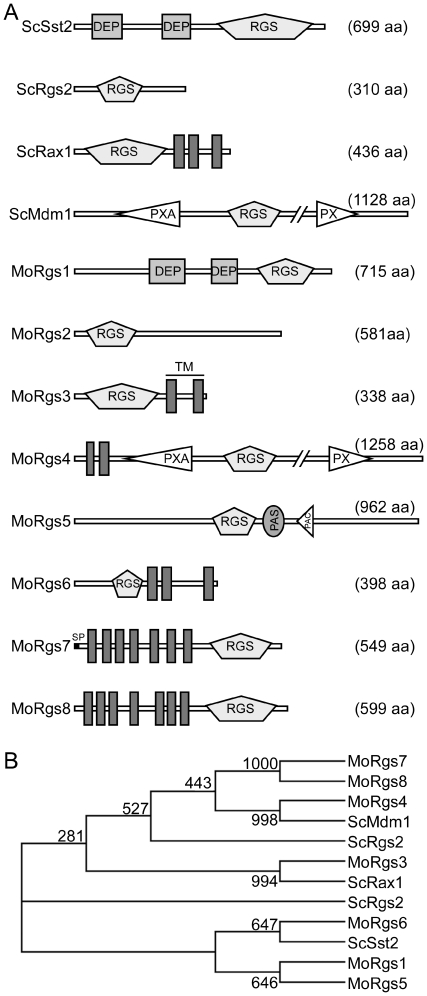
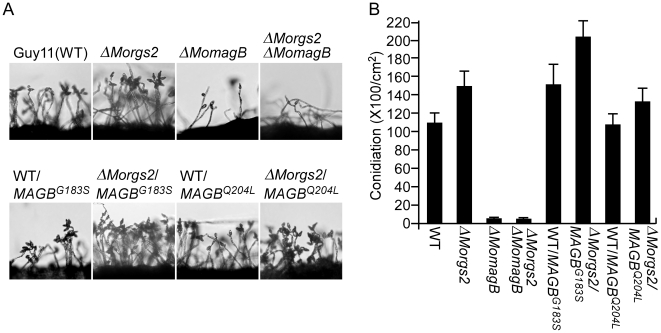
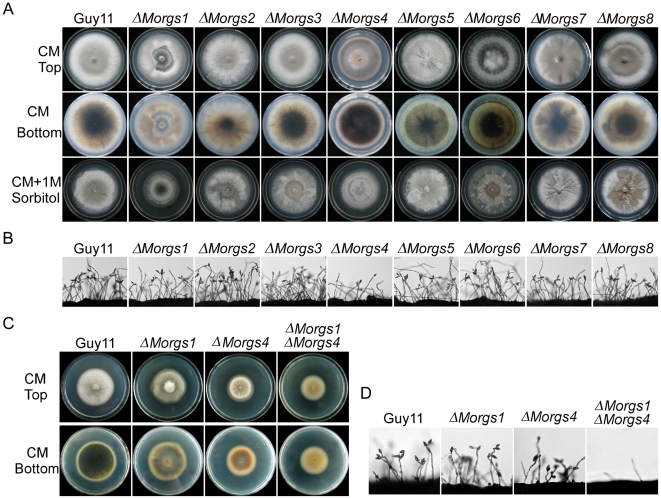
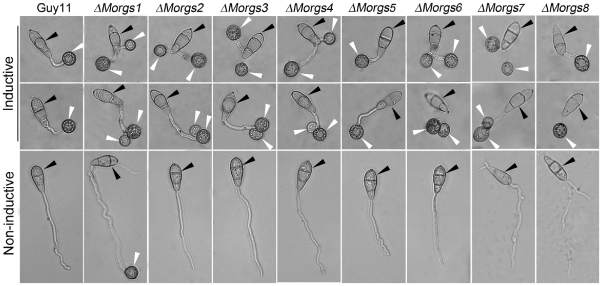
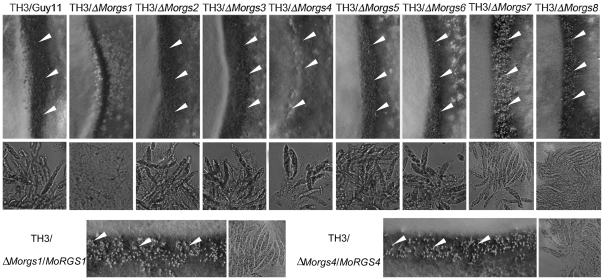
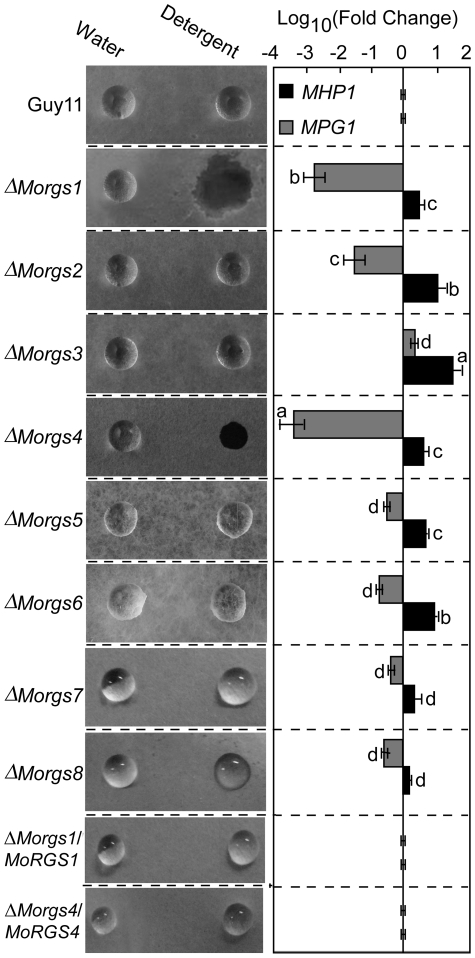
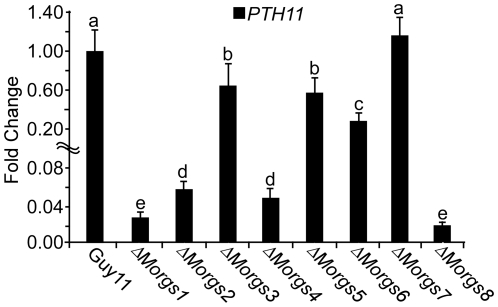
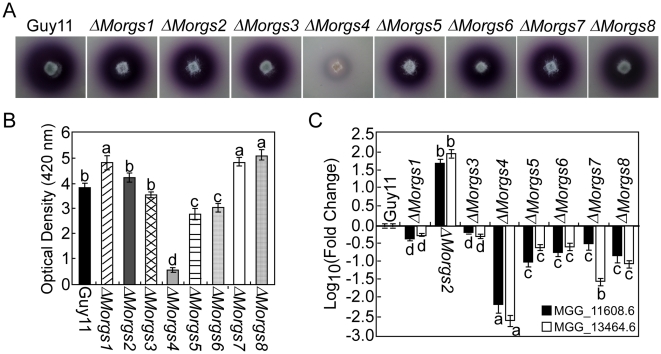
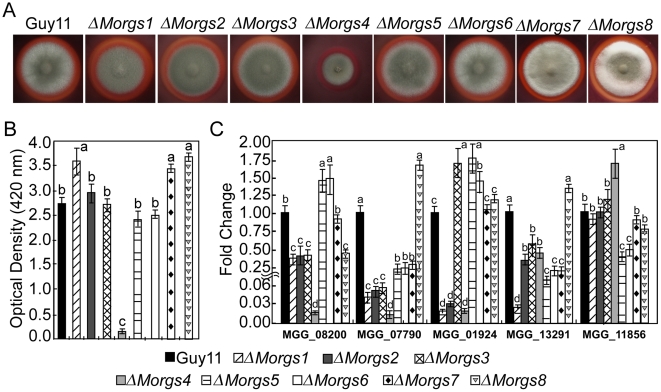
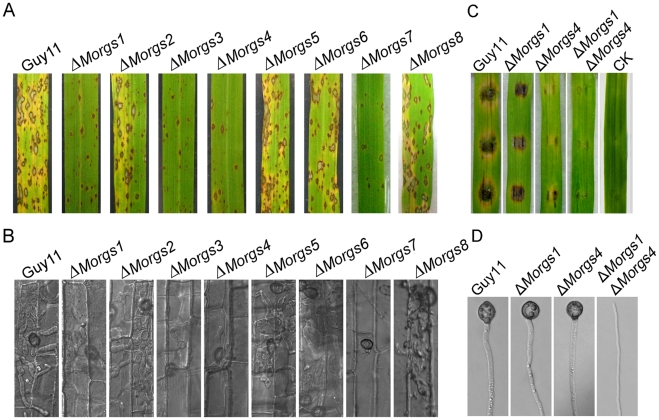
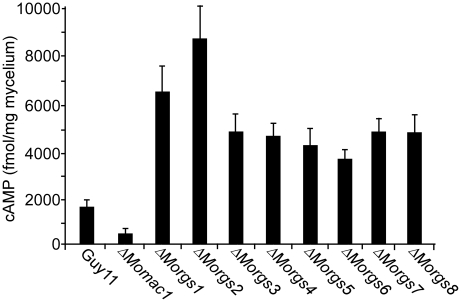
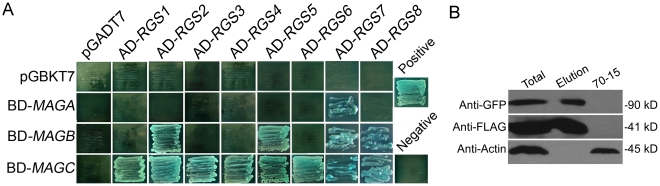
A previous study identified MoRgs1 as an RGS protein that negative regulates G-protein signaling to control developmental processes such as conidiation and appressorium formation in Magnaporthe oryzae. Here, we characterized additional seven RGS and RGS-like proteins (MoRgs2 through MoRgs8). We found that MoRgs1 and MoRgs4 positively regulate surface hydrophobicity, conidiation, and mating. Indifference to MoRgs1, MoRgs4 has a role in regulating laccase and peroxidase activities. MoRgs1, MoRgs2, MoRgs3, MoRgs4, MoRgs6, and MoRgs7 are important for germ tube growth and appressorium formation. Interestingly, MoRgs7 and MoRgs8 exhibit a unique domain structure in which the RGS domain is linked to a seven-transmembrane motif, a hallmark of G-protein coupled receptors (GPCRs). We have also shown that MoRgs1 regulates mating through negative regulation of Gα MoMagB and is involved in the maintenance of cell wall integrity. While all proteins appear to be involved in the control of intracellular cAMP levels, only MoRgs1, MoRgs3, MoRgs4, and MoRgs7 are required for full virulence. Taking together, in addition to MoRgs1 functions as a prominent RGS protein in M. oryzae, MoRgs4 and other RGS and RGS-like proteins are also involved in a complex process governing asexual/sexual development, appressorium formation, and pathogenicity.
先前的研究确定 MoRgs1 是一种 RGS 蛋白,可负向调节 G 蛋白信号转导,以控制发育过程,如稻瘟病菌中的分生孢子形成和附着胞形成。在这里,我们鉴定了另外七种 RGS 和 RGS 样蛋白(MoRgs2 到 MoRgs8)。我们发现 MoRgs1 和 MoRgs4 正向调节表面疏水性、分生孢子形成和交配。MoRgs1 对表面疏水性和交配没有影响,但对漆酶和过氧化物酶活性的调节有作用。MoRgs1、MoRgs2、MoRgs3、MoRgs4、MoRgs6 和 MoRgs7 对芽管生长和附着胞形成很重要。有趣的是,MoRgs7 和 MoRgs8 表现出独特的结构域结构,其中 RGS 结构域与七次跨膜基序相连,这是 G 蛋白偶联受体(GPCR)的标志。我们还表明,MoRgs1 通过负向调节 Gα MoMagB 来调节交配,并参与维持细胞壁完整性。虽然所有蛋白似乎都参与了细胞内 cAMP 水平的调控,但只有 MoRgs1、MoRgs3、MoRgs4 和 MoRgs7 是完全毒力所必需的。综上所述,除了 MoRgs1 作为稻瘟病菌中一种重要的 RGS 蛋白的功能外,MoRgs4 和其他 RGS 和 RGS 样蛋白还参与了调控无性/有性发育、附着胞形成和致病性的复杂过程。