Department of Epidemiology and Biostatistics, Peking University Health Science Center, Beijing 100191, China.
BMC Public Health. 2012 Jan 16;12:34. doi: 10.1186/1471-2458-12-34.
Cardiovascular disease (CVD) is the leading cause of global disease burden. Although stroke was thought to be more prevalent than coronary heart disease (CHD) in Chinese, the epidemic pattern might have been changed in some rural areas nowadays. This study was to estimate up-to-date prevalence of CVD and its risk factors in rural communities of Fangshan District, Beijing, China.
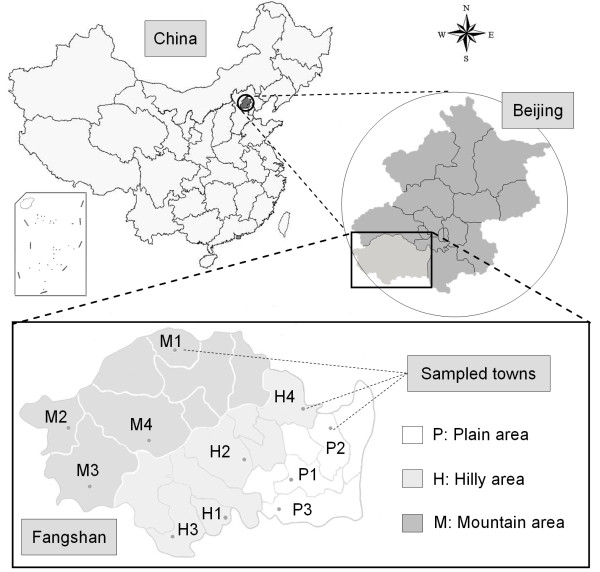
A cross-sectional population survey was carried out by stratified cluster sampling. A total of 58,308 rural residents aged over 40 years were surveyed by face-to-face interview and physical examination during 2008 and 2010. The standardized prevalence was calculated according to adult sample data of China's 5th Population Census in 2000, and the adjusted prevalence odds ratio (POR) was calculated for the association of CHD/stroke with its cardiovascular risk factors in multivariate logistic regression models.
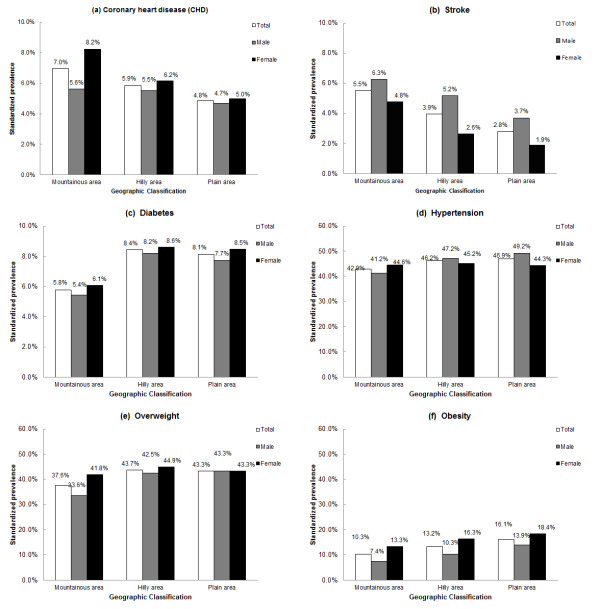
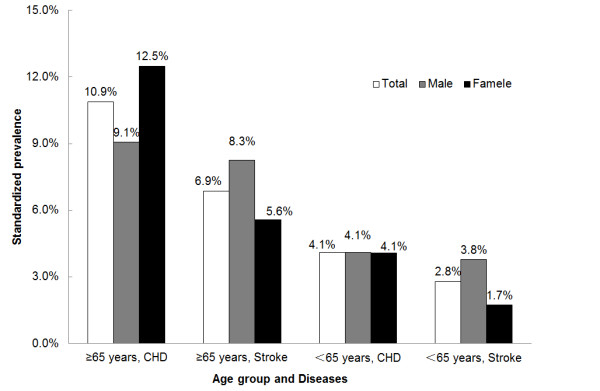
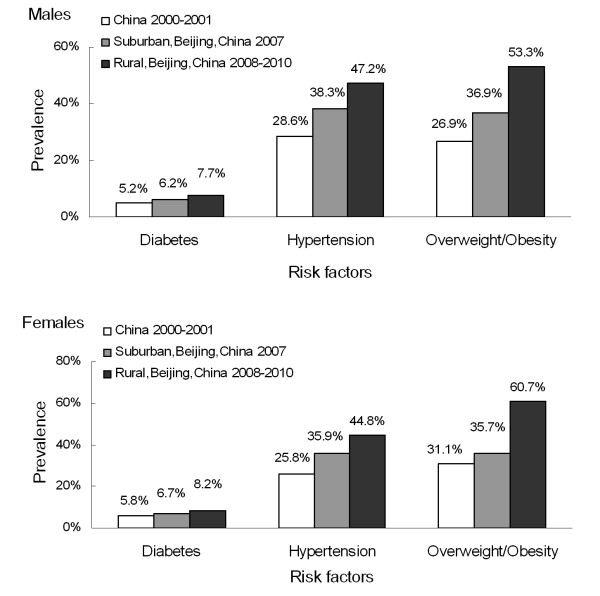
Age- and sex-standardized prevalence was 5.6% for CHD (5.2% in males and 5.9% in females), higher than the counterpart of 3.7% (4.7% in males and 2.6% in females) for stroke. Compared with previous studies, higher prevalence of 7.7%, 47.2%, 53.3% in males and 8.2%, 44.8%, 60.7% in females for diabetes, hypertension and overweight/obesity were presented accordingly. Moreover, adjusted POR (95% confidence interval) of diabetes, obesity, stage 1 and stage 2 hypertension for CHD as 2.51 (2.29 to 2.75), 1.53 (1.38 to 1.70), 1.13 (1.02 to 1.26) and 1.35 (1.20 to 1.52), and for stroke as 2.24 (1.98 to 2.52), 1.25 (1.09 to 1.44), 1.44 (1.25 to 1.66) and 1.70 (1.46 to 1.98) were shown respectively in the multivariate logistic regression models.
High prevalence of CVD and probably changed epidemic pattern in rural communities of Beijing, together with the prevalent cardiovascular risk factors and population aging, might cause public health challenges in rural Chinese population.
心血管疾病(CVD)是全球疾病负担的主要原因。尽管在中国人中,中风被认为比冠心病(CHD)更为普遍,但如今在某些农村地区,这种流行模式可能已经发生了变化。本研究旨在评估北京市房山区农村社区最新的 CVD 患病率及其危险因素。
采用分层聚类抽样进行横断面人群调查。2008 年至 2010 年,通过面对面访谈和体格检查对 58308 名 40 岁以上的农村居民进行了调查。根据 2000 年中国第五次人口普查的成人样本数据计算了标准化患病率,并在多变量逻辑回归模型中计算了 CHD/中风与心血管危险因素的关联的调整比值比(POR)。
年龄和性别标准化患病率为 CHD5.6%(男性为 5.2%,女性为 5.9%),高于中风 3.7%(男性为 4.7%,女性为 2.6%)。与以往研究相比,男性糖尿病、高血压和超重/肥胖的患病率分别升高了 7.7%、47.2%和 53.3%,女性分别升高了 8.2%、44.8%和 60.7%。此外,糖尿病、肥胖、1 期和 2 期高血压与 CHD 的调整 POR(95%置信区间)分别为 2.51(2.29 至 2.75)、1.53(1.38 至 1.70)、1.13(1.02 至 1.26)和 1.35(1.20 至 1.52),与中风的调整 POR 分别为 2.24(1.98 至 2.52)、1.25(1.09 至 1.44)、1.44(1.25 至 1.66)和 1.70(1.46 至 1.98)。
北京市农村社区 CVD 患病率高,流行模式可能发生变化,再加上普遍存在的心血管危险因素和人口老龄化,可能给农村中国人口带来公共卫生挑战。