Intellectual Disability Medicine/Department of General Practice, Erasmus University Medical Centre, PO Box 2040, 3000, CA, Rotterdam, The Netherlands.
Pediatr Radiol. 2012 May;42(5):574-83. doi: 10.1007/s00247-011-2307-9. Epub 2012 Jan 18.
Children with severe neurological impairment and intellectual disability (ID) are susceptible for developing low bone mineral density (BMD) and fractures. BMD is generally measured with dual-energy X-ray absorptiometry (DXA).
To describe the occurrence of factors that may influence the feasibility of DXA and the accuracy of DXA outcome in children with severe neurological impairment and ID.
Based on literature and expert opinion, a list of disrupting factors was developed. Occurrence of these factors was assessed in 27 children who underwent DXA measurement.
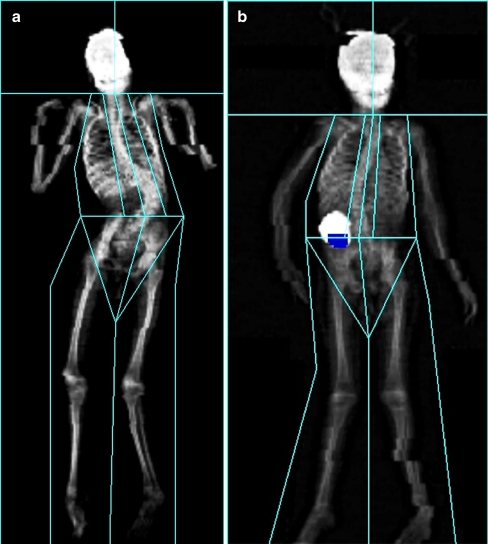
Disrupting factors that occurred most frequently were movement during measurement (82%), aberrant body composition (67%), small length for age (56%) and scoliosis (37%). The number of disrupting factors per child was mean 5.3 (range 1-8). No correlation was found between DXA outcomes and the number of disrupting factors.
Factors that may negatively influence the accuracy of DXA outcome are frequently present in children with severe neurological impairment and ID. No systematic deviation of DXA outcome in coherence with the amount of disrupting factors was found, but physicians should be aware of the possible influence of disrupting factors on the accuracy of DXA.
严重神经功能障碍和智力残疾(ID)的儿童易发生骨矿物质密度(BMD)降低和骨折。BMD 通常使用双能 X 射线吸收法(DXA)进行测量。
描述可能影响严重神经功能障碍和 ID 儿童 DXA 可行性和 DXA 结果准确性的因素。
根据文献和专家意见,制定了一个可能干扰因素列表。对 27 名接受 DXA 测量的儿童进行了这些因素的出现评估。
最常发生的干扰因素是测量期间的运动(82%)、异常身体成分(67%)、身高与年龄不匹配(56%)和脊柱侧凸(37%)。每个儿童的干扰因素数平均为 5.3(范围 1-8)。未发现 DXA 结果与干扰因素数量之间存在相关性。
可能对 DXA 结果准确性产生负面影响的因素在严重神经功能障碍和 ID 儿童中经常出现。未发现 DXA 结果与干扰因素数量之间存在系统偏差,但医生应注意干扰因素对 DXA 准确性的可能影响。