Reuss Heiko, Pohl Carsten, Kiesel Andrea, Kunde Wilfried
Department of Psychology, Julius-Maximilians-Universität Würzburg, Germany.
Adv Cogn Psychol. 2011;7:82-91. doi: 10.2478/v10053-008-0091-3. Epub 2011 Dec 1.
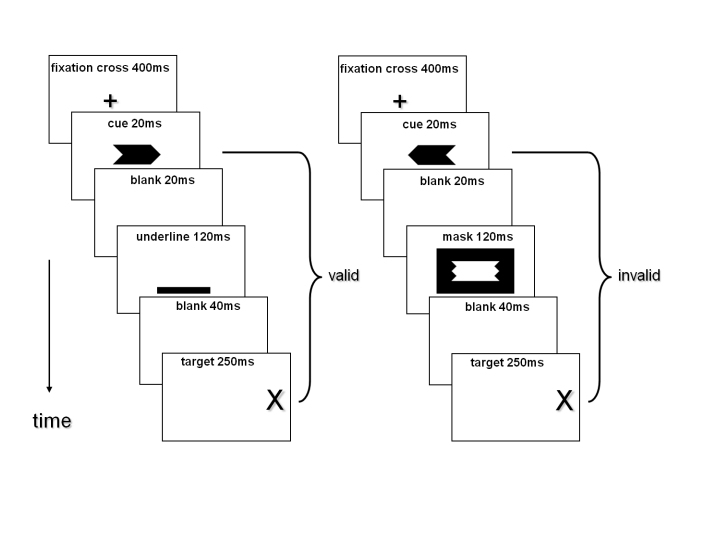
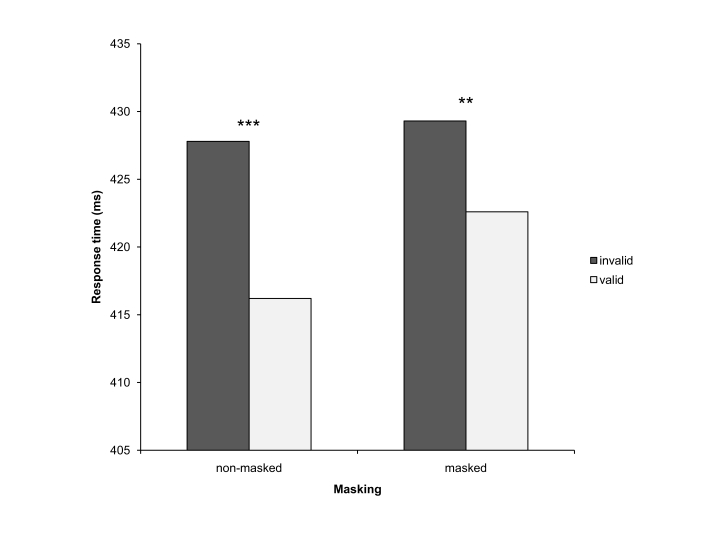
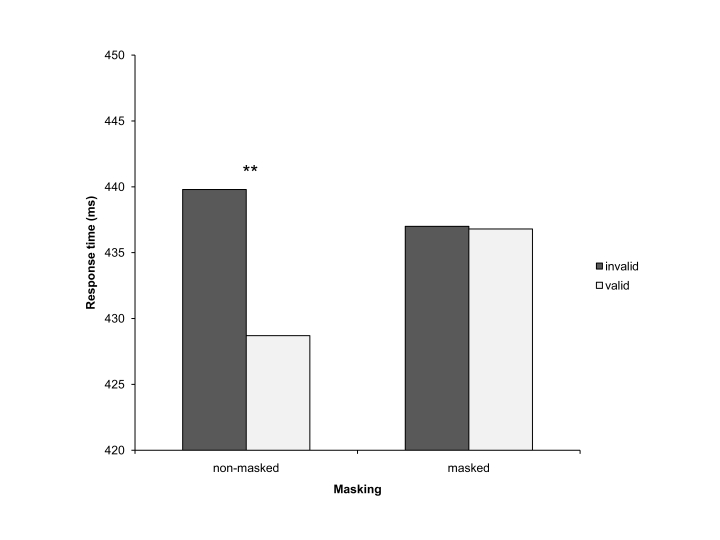
Arrow cues and other overlearned spatial symbols automatically orient attention according to their spatial meaning. This renders them similar to exogenous cues that occur at stimulus location. Exogenous cues trigger shifts of attention even when they are presented subliminally. Here, we investigate to what extent the mechanisms underlying the orienting of attention by exogenous cues and by arrow cues are comparable by analyzing the effects of visible and masked arrow cues on attention. In Experiment 1, we presented arrow cues with overall 50% validity. Visible cues, but not masked cues, lead to shifts of attention. In Experiment 2, the arrow cues had an overall validity of 80%. Now both visible and masked arrows lead to shifts of attention. This is in line with findings that subliminal exogenous cues capture attention only in a top-down contingent manner, that is, when the cues fit the observer's intentions.
箭头线索和其他过度学习的空间符号会根据其空间意义自动引导注意力。这使得它们类似于出现在刺激位置的外源性线索。即使外源性线索以阈下方式呈现,也会引发注意力的转移。在此,我们通过分析可见和掩蔽箭头线索对注意力的影响,来研究外源性线索和箭头线索引导注意力的机制在多大程度上具有可比性。在实验1中,我们呈现的箭头线索总体有效性为50%。可见线索而非掩蔽线索会导致注意力转移。在实验2中,箭头线索的总体有效性为80%。现在可见和掩蔽箭头都会导致注意力转移。这与以下发现一致,即阈下外源性线索仅以自上而下的偶然方式捕获注意力,也就是说,当线索符合观察者的意图时。