Department of Head and Neck Surgery, University of Texas MD Anderson Cancer Center, Houston, Texas 77030, USA.
Clin Cancer Res. 2012 Mar 1;18(5):1435-46. doi: 10.1158/1078-0432.CCR-11-1951. Epub 2012 Jan 18.
To determine the disease control rate and toxicity of treating patients with aggressive cutaneous squamous cell carcinoma (CSCC) with neoadjuvant gefitinib.
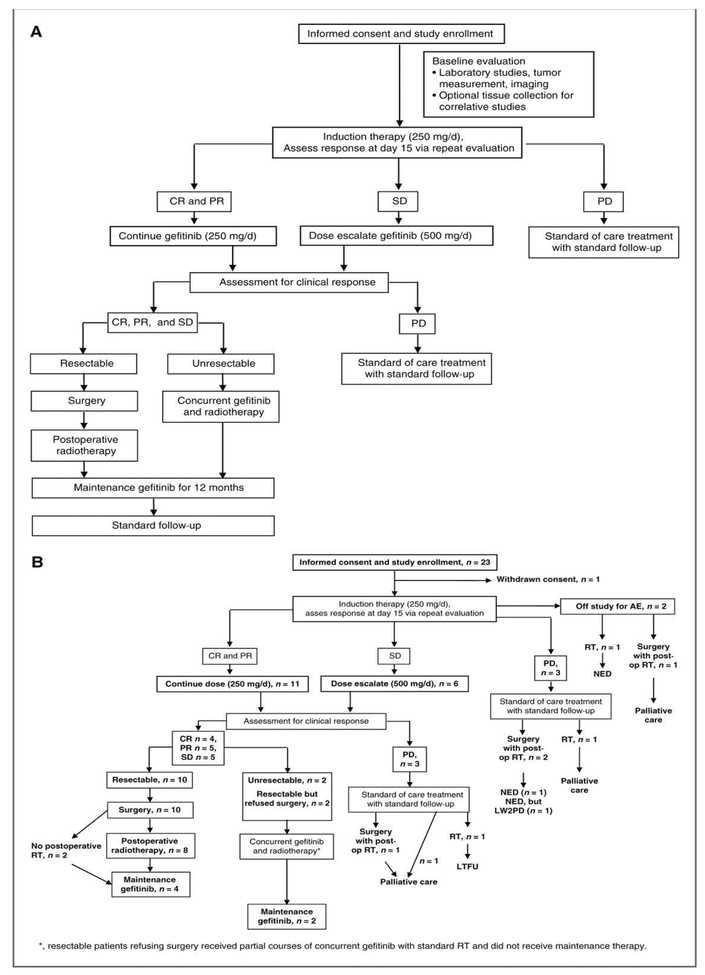
A prospective phase II clinical trial evaluating neoadjuvant gefitinib given prior to standard treatment with surgery and/or radiotherapy. Patients with stable disease after one cycle received escalated doses. Patients who responded were given gefitinib during radiation therapy, as well as maintenance therapy after definitive treatment. We analyzed the correlation between epidermal growth factor receptor (EGFR) expression, mutation status, and gene copy number on available tissue samples and clinical response.
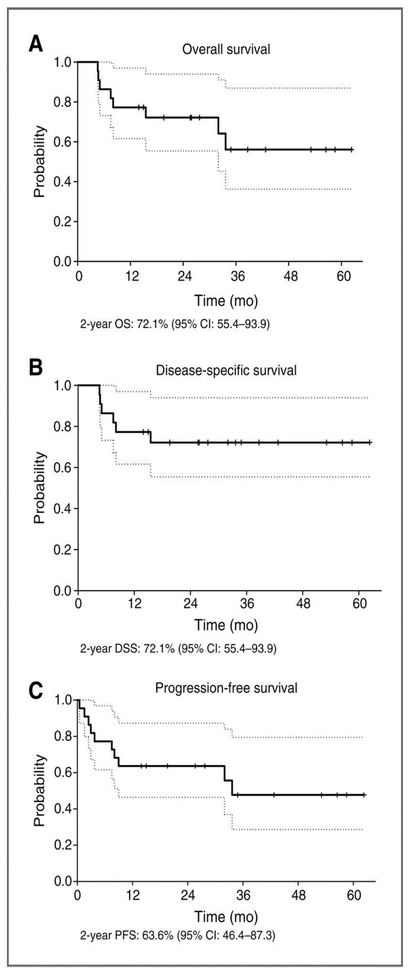
Twenty-three patients were accrued and 22 patients were evaluable for response prior to definitive local treatment; complete responses were attained by 18.2% of patients and partial responses by 27.3%. Grades 2 to 3 toxicities were observed in 59.1% of patients experiencing class-specific effects during induction therapy. After induction, 11.8% underwent surgery alone, 17.6% had definitive radiation, 11.8% were treated with radiation and concurrent gefitinib, and 47% had surgery with postoperative radiation and concurrent gefitinib. Median follow-up for the censored observations was 32 months. Two-year overall, disease-specific, and progression-free survival rates were 72.1%, 72.1%, and 63.6%, respectively. No EGFR-activating mutations were identified in tumor samples available from 10 patients. No associations between EGFR correlative studies and patient outcomes were identified.
Gefitinib, in the neoadjuvant setting, was active and well tolerated in patients with aggressive CSCC and did not interfere with definitive treatment. In view of the 18% complete response rate we observed, EGFR tyrosine kinase inhibitors should be further explored in the treatment of aggressive CSCC.
确定新辅助吉非替尼治疗侵袭性皮肤鳞状细胞癌(CSCC)患者的疾病控制率和毒性。
一项评估新辅助吉非替尼治疗的前瞻性 II 期临床试验,在手术和/或放疗前给予标准治疗。一个周期后疾病稳定的患者接受递增剂量。对有反应的患者在放疗期间以及根治性治疗后给予吉非替尼维持治疗。我们分析了可用组织样本中表皮生长因子受体(EGFR)表达、突变状态和基因拷贝数与临床反应之间的相关性。
共入组 23 例患者,22 例患者在接受确定性局部治疗前可评估疗效;完全缓解率为 18.2%,部分缓解率为 27.3%。59.1%接受诱导治疗的患者出现 2-3 级毒性。诱导后,11.8%患者单独接受手术,17.6%患者接受根治性放疗,11.8%患者接受放疗联合吉非替尼治疗,47%患者接受手术联合术后放疗和吉非替尼治疗。截止观察的中位随访时间为 32 个月。2 年总生存率、疾病特异性生存率和无进展生存率分别为 72.1%、72.1%和 63.6%。在可获得 10 例肿瘤样本中未发现 EGFR 激活突变。未发现 EGFR 相关性研究与患者结局之间存在关联。
吉非替尼在新辅助治疗中对侵袭性 CSCC 患者具有活性且耐受性良好,并不影响确定性治疗。鉴于我们观察到的 18%完全缓解率,EGFR 酪氨酸激酶抑制剂应进一步探索用于治疗侵袭性 CSCC。