Centre for Infectious Disease Control Netherlands, RIVM, Bilthoven, The Netherlands.
BMC Public Health. 2012 Jan 20;12:57. doi: 10.1186/1471-2458-12-57.
Knowledge about the determinants of participation and attitude towards the National Immunisation Program (NIP) may be helpful in tailoring information campaigns for this program. Our aim was to determine which factors were associated with nonparticipation in the NIP and which ones were associated with parents' intention to accept remaining vaccinations. Further, we analyzed possible changes in opinion on vaccination over a 10 year period.
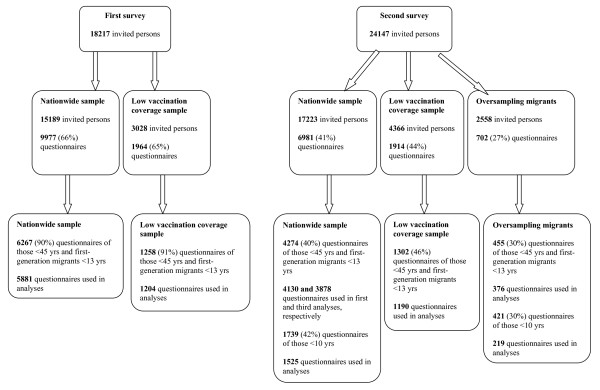
We used questionnaire data from two independent, population-based, cross-sectional surveys performed in 1995-96 and 2006-07. For the 2006-07 survey, logistic regression modelling was used to evaluate what factors were associated with nonparticipation and with parents' intention to accept remaining vaccinations. We used multivariate multinomial logistic regression modelling to compare the results between the two surveys.
Ninety-five percent of parents reported that they or their child (had) participated in the NIP. Similarly, 95% reported they intended to accept remaining vaccinations. Ethnicity, religion, income, educational level and anthroposophic beliefs were important determinants of nonparticipation in the NIP. Parental concerns that played a role in whether or not they would accept remaining vaccinations included safety of vaccinations, maximum number of injections, whether vaccinations protect the health of one's child and whether vaccinating healthy children is necessary. Although about 90% reported their opinion towards vaccination had not changed, a larger proportion of participants reported to be less inclined to accept vaccination in 2006-07 than in 1995-96.
Most participants had a positive attitude towards vaccination, although some had doubts. Groups with a lower income or educational level or of non-Western descent participated less in the NIP than those with a high income or educational level or indigenous Dutch and have been less well identified previously. Particular attention ought to be given to these groups as they contribute in large measure to the rate of nonparticipation in the NIP, i.e., to a greater extent than well-known vaccine refusers such as specific religious groups and anthroposophics. Our finding that the proportion of the population inclined to accept vaccinations is smaller than it was 10 years ago highlights the need to increase knowledge about attitudes and beliefs regarding the NIP.
了解参与国家免疫计划(NIP)的决定因素和对该计划的态度可能有助于为该计划量身定制信息宣传活动。我们的目的是确定哪些因素与不参与 NIP 有关,哪些因素与父母接受剩余疫苗接种的意愿有关。此外,我们还分析了在 10 年内对疫苗接种的看法可能发生的变化。
我们使用了 1995-96 年和 2006-07 年两次独立的、基于人群的、横断面调查的问卷数据。对于 2006-07 年的调查,我们使用逻辑回归模型来评估哪些因素与不参与和父母接受剩余疫苗接种的意愿有关。我们使用多元多项逻辑回归模型来比较两次调查的结果。
95%的家长报告说他们或他们的孩子(已经)参与了 NIP。同样,95%的家长报告说他们打算接受剩余的疫苗接种。种族、宗教、收入、教育水平和人智学信仰是不参与 NIP 的重要决定因素。父母是否接受剩余疫苗接种的考虑因素包括疫苗接种的安全性、最大注射次数、疫苗接种是否能保护孩子的健康以及是否有必要给健康的孩子接种疫苗。尽管约 90%的人报告说他们对疫苗接种的看法没有改变,但在 2006-07 年,比 1995-96 年,有更多的参与者报告说他们不太倾向于接受疫苗接种。
大多数参与者对疫苗接种持积极态度,尽管有些人存在疑虑。收入或教育水平较低或非西方血统的群体参与 NIP 的比例低于收入或教育水平较高或土生土长的荷兰人,以前也没有被很好地识别。应该特别关注这些群体,因为他们在很大程度上导致了 NIP 的参与率较低,即比众所周知的疫苗抵制者,如特定的宗教团体和人智学团体,更大程度地导致了 NIP 的参与率较低。我们发现,愿意接受疫苗接种的人口比例比 10 年前更小,这突出表明需要增加对 NIP 的态度和信仰的了解。