Strauss Mirian, Rada Alegna, Tejero Félix, Hermoso Tomás
J Toxicol Pathol. 2010 Dec;23(4):235-43. doi: 10.1293/tox.23.235. Epub 2010 Dec 16.
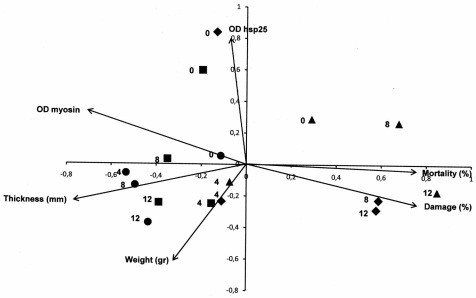
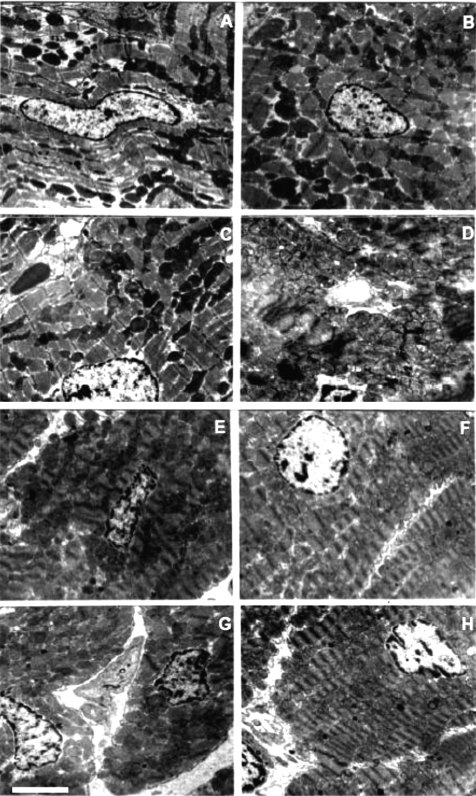
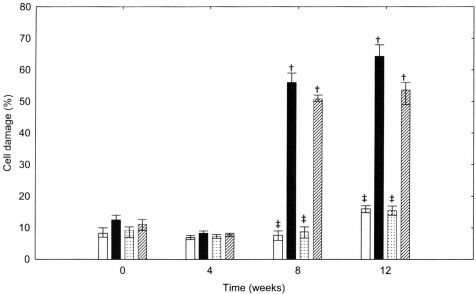
In order to evaluate the effects of hyperthermia on adriamycin cardiomyopathy and its relationship with heat shock protein induction and myosin accumulation, female Sprague-Dawley rats (21-24 days) were randomized into four groups: the control, adriamycin, temperature and temperature-adriamycin groups. Adriamycin was injected i.v. at a dose of 27 mg/Kg (0.1 ml). The rats were exposed to a temperature of 45ºC for 35 min, followed by a recovery (1 h) at room temperature prior to adriamycin treatment. Body weight was recorded weekly. The thickness of the ventricular wall and percentage of cellular damage were biometrically and ultrastructurally evaluated, respectively. Heat shock protein 25 and myosin accumulation were determined through Western blot analysis. The determinations were carried out monthly until the third month after treatment. At eight and twelve weeks after treatment, the thickness of the ventricular wall seemed to decrease in the adriamycin-treated rats in relation to the other groups. An electron microscopic analysis of the adriamycin group's left ventricular wall samples, showed more sarcomeric changes and loss of myofibrils than the control, temperature and temperature-adriamycin groups. At 24 hours after treatment with adriamycin, higher levels of heat shock protein 25 and myosin were observed (week 0) in the temperature-adriamycin group than in the control and adriamycin groups (4, 8 and 12 weeks). Hyperthermia was confirmed by a multivariate approach to induce heat shock protein 25 and myosin, which would strengthen cardiac-sarcomeric myosin arrangement.
为了评估热疗对阿霉素性心肌病的影响及其与热休克蛋白诱导和肌球蛋白积累的关系,将21 - 24日龄的雌性Sprague-Dawley大鼠随机分为四组:对照组、阿霉素组、温度组和温度-阿霉素组。以27 mg/Kg(0.1 ml)的剂量静脉注射阿霉素。在阿霉素治疗前,将大鼠暴露于45ºC温度下35分钟,然后在室温下恢复1小时。每周记录体重。分别通过生物测量和超微结构评估心室壁厚度和细胞损伤百分比。通过蛋白质免疫印迹分析测定热休克蛋白25和肌球蛋白积累。每月进行测定,直至治疗后第三个月。在治疗后八周和十二周时,与其他组相比,阿霉素治疗的大鼠心室壁厚度似乎有所减小。对阿霉素组左心室壁样本的电子显微镜分析显示,与对照组、温度组和温度-阿霉素组相比,肌节变化更多,肌原纤维损失更多。在用阿霉素治疗24小时后(第0周),温度-阿霉素组中热休克蛋白25和肌球蛋白的水平高于对照组和阿霉素组(第4、8和12周)。通过多变量方法证实热疗可诱导热休克蛋白25和肌球蛋白,这将加强心肌肌节肌球蛋白排列。