Willard Abbott L, Herman Ira M
Graduate Program in Cellular and Molecular Physiology, Sackler School of Graduate Biomedical Sciences, Tufts University, Boston, MA 02111, USA.
J Ophthalmol. 2012;2012:209538. doi: 10.1155/2012/209538. Epub 2012 Jan 9.
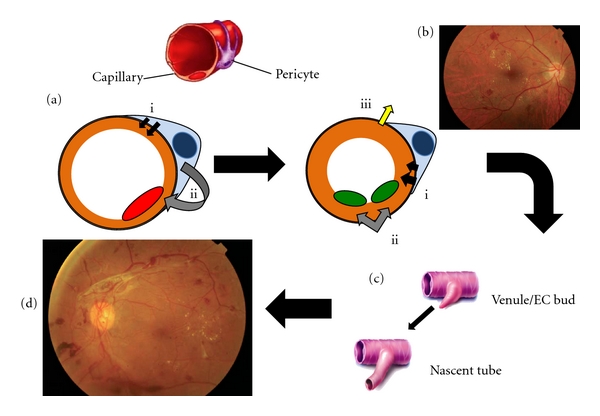
Diabetic retinal complications, including macular edema (DME) and proliferative diabetic retinopathy (PDR), are the leading cause of new cases of blindness among adults aged 20-74. Chronic hyperglycemia, considered the underlying cause of diabetic retinopathy, is thought to act first through violation of the pericyte-endothelial coupling. Disruption of microvascular integrity leads to pathologic consequences including hypoxia-induced imbalance in vascular endothelial growth factor (VEGF) signaling. Several anti-VEGF medications are in clinical trials for use in arresting retinal angiogenesis arising from DME and PDR. Although a review of current clinical trials shows promising results, the lack of large prospective studies, head-to-head therapeutic comparisons, and potential long-term and systemic adverse events give cause for optimistic caution. Alternative therapies including targeting pathogenic specific angiogenesis and mural-cell-based therapeutics may offer innovative solutions for currently intractable clinical problems. This paper describes the mechanisms behind diabetic retinal complications, current research supporting anti-VEGF medications, and future therapeutic directions.
糖尿病视网膜并发症,包括黄斑水肿(DME)和增殖性糖尿病视网膜病变(PDR),是20至74岁成年人失明新病例的主要原因。慢性高血糖被认为是糖尿病视网膜病变的根本原因,最初被认为是通过破坏周细胞 - 内皮细胞耦合起作用。微血管完整性的破坏会导致包括缺氧诱导的血管内皮生长因子(VEGF)信号失衡在内的病理后果。几种抗VEGF药物正在进行临床试验,用于阻止由DME和PDR引起的视网膜血管生成。尽管对当前临床试验的综述显示出有希望的结果,但缺乏大型前瞻性研究、直接的治疗比较以及潜在的长期和全身不良事件,仍需谨慎乐观。包括靶向致病性特异性血管生成和基于壁细胞的治疗方法在内的替代疗法,可能为目前难以解决的临床问题提供创新解决方案。本文描述了糖尿病视网膜并发症背后的机制、支持抗VEGF药物的当前研究以及未来的治疗方向。