Department of Biology, University of Massachusetts Dartmouth, North Dartmouth, MA 02747, USA.
J Eukaryot Microbiol. 2012 Mar-Apr;59(2):101-4. doi: 10.1111/j.1550-7408.2011.00604.x. Epub 2012 Jan 24.
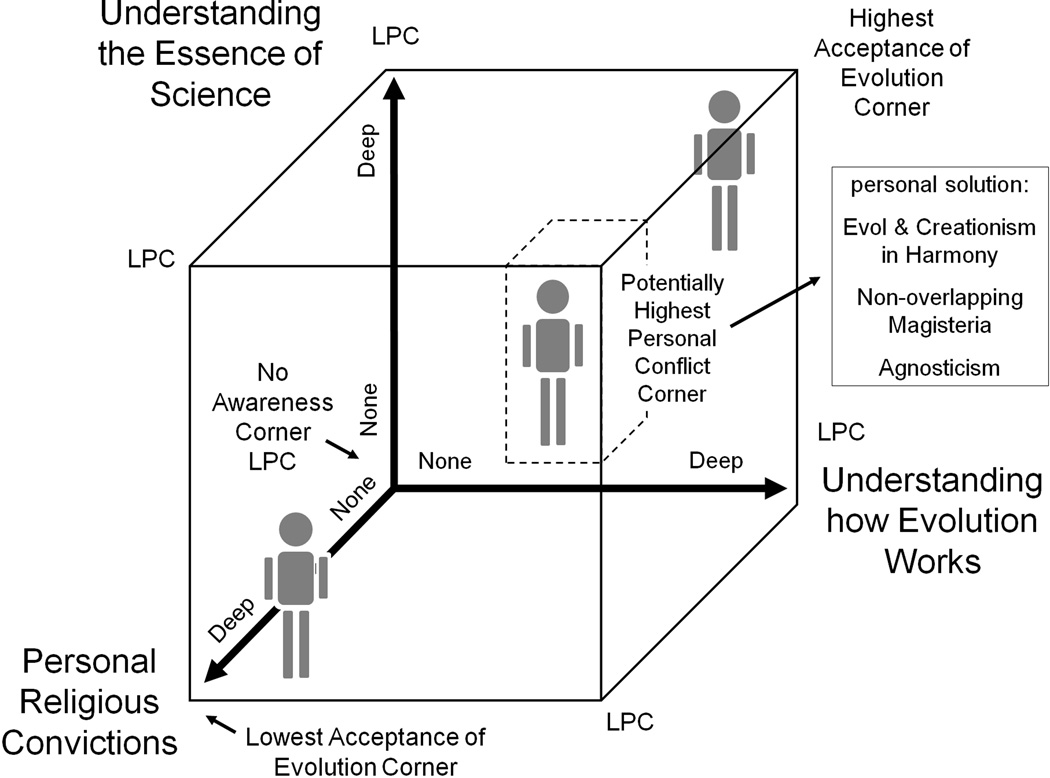
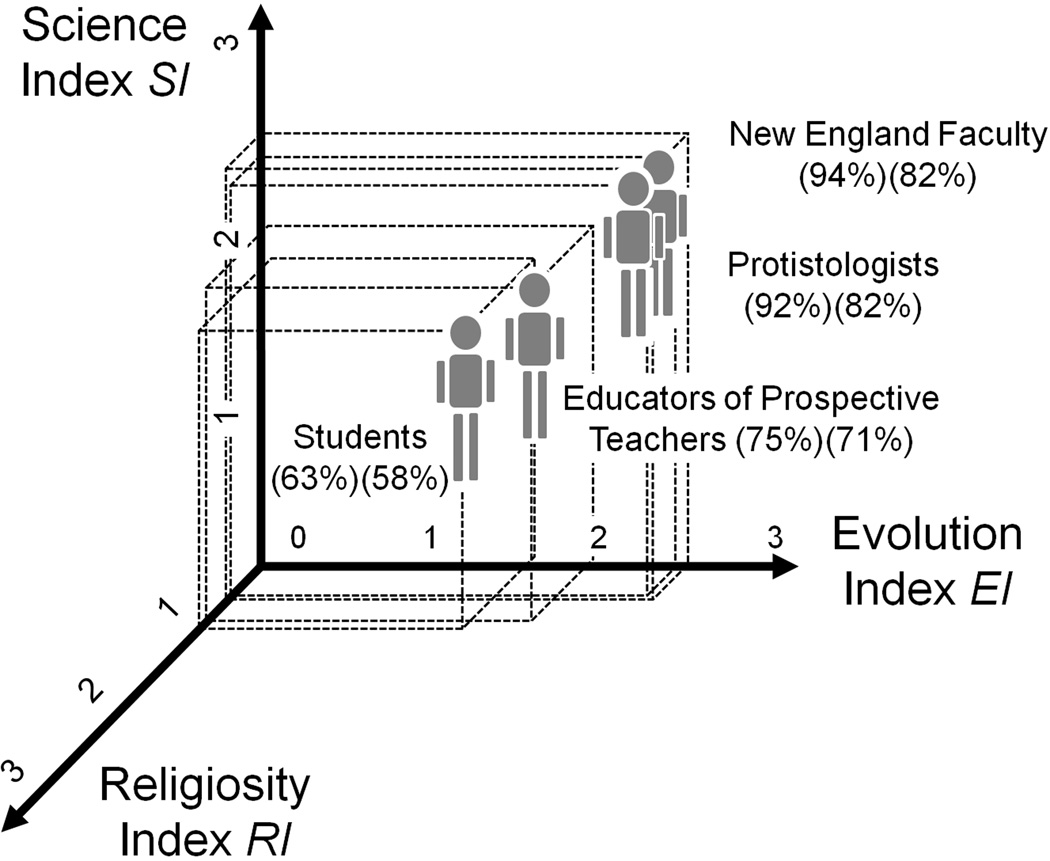
The controversy evolution vs. creationism is inherent to the incompatibility between scientific rationalism/empiricism and the belief in supernatural causation. To test this hypothesis, we conceptualized a Cartesian landscape where the dependent variable acceptance of evolution was plotted as function of three factors, each represented by an index (value range 0 to 3): Religiosity Index (RI), Science Index (SI), and Evolution Index (EI). The indexes summarized an individual's personal religious convictions, familiarity with the processes and forces of change in organisms (= concept of evolution), and understanding the essence of science (= method to explore reality). We compared and contrasted acceptance of evolution among four populations of variable educational attainment: 244 professors of New England, United States (93% Ph.D./doctorate holders), 50 protistologists from 25 countries (70% Ph.D./doctorate holders), 62 educators of prospective teachers (83% Ph.D./doctorate holders), and 827 college students. The New England faculty held the highest acceptance of evolution position (RI = 0.49; SI = 2.49; EI = 2.49), followed by the protistologists (RI = 0.46; SI = 2.30; EI = 2.48), the educators of prospective teachers (RI = 0.83; SI = 1.96; EI = 1.96), and the students (RI = 0.89; SI = 1.80; EI = 1.60); therefore, the data supported our hypothesis. Proper science education, public outreach and robust debate over the controversy "evolution versus creationism" should suffice to improve society's evolution literacy, and qualified scholars ought to lead this mission.
进化与创造论的争议源自于科学理性主义/经验主义与超自然因果信仰之间的固有冲突。为了验证这一假说,我们构建了一个笛卡尔式的景观,其中进化的接受程度作为因变量,由三个因素的指数(取值范围为 0 到 3)表示:宗教指数(RI)、科学指数(SI)和进化指数(EI)。这些指数综合了个体的个人宗教信仰、对生物体变化过程和力量的熟悉程度(即进化概念)以及对科学本质的理解(即探索现实的方法)。我们比较了四个不同教育程度群体对进化的接受程度:来自美国新英格兰的 244 名教授(93%拥有博士/博士学位)、来自 25 个国家的 50 名原生生物学家(70%拥有博士/博士学位)、62 名未来教师教育工作者(83%拥有博士/博士学位)和 827 名大学生。新英格兰的教职员工对进化的接受程度最高(RI=0.49;SI=2.49;EI=2.49),其次是原生生物学家(RI=0.46;SI=2.30;EI=2.48)、未来教师教育工作者(RI=0.83;SI=1.96;EI=1.96)和学生(RI=0.89;SI=1.80;EI=1.60);因此,数据支持我们的假设。适当的科学教育、公众宣传和对“进化与创造论”争议的有力辩论应该足以提高社会的进化素养,而合格的学者应该领导这项使命。