Department of Pharmacy, Taihe Hospital, Hubei University of Medicine, Shiyan City, Hubei Province, People's Republic of China.
Int J Nanomedicine. 2012;7:271-80. doi: 10.2147/IJN.S26935. Epub 2012 Jan 16.
Quercetin has been shown to induce apoptosis in a number of cancer cell lines, but a quercetin-loaded nanoliposomal formulation with enhanced antitumor activity in C6 glioma cells and its effect on cancer cell death has not been well studied. The aim of this study was to examine if quercetin-loaded liposomes (QUE-NL) has enhanced cytotoxic effects and if such effects involve type III programmed cell death in C6 glioma cells.
C6 glioma cells were treated with QUE-NL and assayed for cell survival, apoptosis, and necrosis. Levels of reactive oxygen species production and loss of mitochondrial membrane potential (ΔΨm) were also determined by flow cytometry assay to assess the effects of QUE-NL. ATP levels and lactate dehydrogenase activity were measured, and Western blotting was used to assay cytochrome C release and caspase expression.
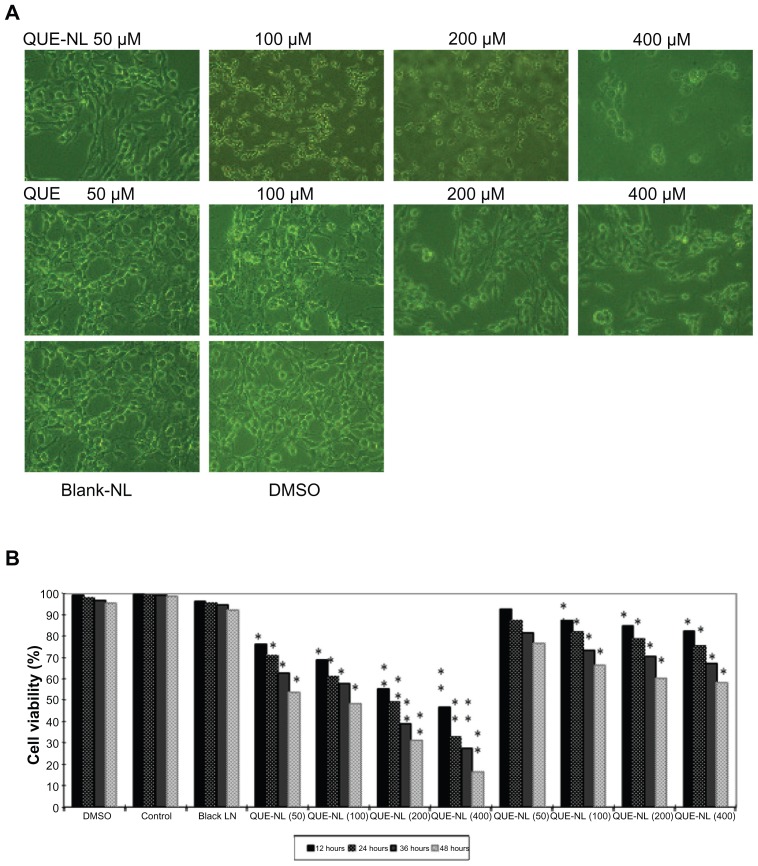
QUE-NL induced type III (necrotic) programmed cell death in C6 glioma cells in a dose-dependent and time-dependent manner. High concentrations of QUE-NL induced cell necrosis, which is distinct from apoptosis and autophagy, whereas liposomes administered alone induced neither significant apoptosis nor necrosis in C6 glioma cells. QUE-NL-induced ΔΨm loss and cytochrome C release had no effect on caspase activation, but decreased ATP levels and increased lactate dehydrogenase activity indicated that QUE-NL stimulated necrotic cell death.
C6 glioma cells treated with QUE-NL showed a cellular pattern associated with necrosis without apoptosis and was independent of caspase activity. Nonapoptotic cell death induced by high concentrations of QUE-NL for controlling caspase-independent type III programmed cell death may provide the basis for novel therapeutic approaches to overcome avoidance of apoptosis by malignant cells.
槲皮素已被证明可诱导多种癌细胞系凋亡,但具有增强抗肿瘤活性的载槲皮素纳米脂质体制剂在 C6 神经胶质瘤细胞中的作用及其对癌细胞死亡的影响尚未得到很好的研究。本研究旨在探讨载槲皮素脂质体(QUE-NL)是否具有增强的细胞毒性作用,以及这种作用是否涉及 C6 神经胶质瘤细胞中的 III 型程序性细胞死亡。
用 QUE-NL 处理 C6 神经胶质瘤细胞,检测细胞存活、凋亡和坏死。还通过流式细胞术检测活性氧(ROS)产生水平和线粒体膜电位(ΔΨm)丧失,以评估 QUE-NL 的作用。测量 ATP 水平和乳酸脱氢酶(LDH)活性,并通过 Western blot 检测细胞色素 C 释放和半胱天冬酶表达。
QUE-NL 以剂量和时间依赖性方式诱导 C6 神经胶质瘤细胞发生 III 型(坏死性)程序性细胞死亡。高浓度的 QUE-NL 诱导细胞坏死,这与凋亡和自噬不同,而单独给予脂质体则不会在 C6 神经胶质瘤细胞中引起明显的凋亡或坏死。QUE-NL 诱导的 ΔΨm 丧失和细胞色素 C 释放对半胱天冬酶激活没有影响,但降低的 ATP 水平和增加的 LDH 活性表明 QUE-NL 刺激了坏死性细胞死亡。
用 QUE-NL 处理的 C6 神经胶质瘤细胞显示出与凋亡无关的与坏死相关的细胞模式,并且不依赖于半胱天冬酶活性。高浓度 QUE-NL 诱导的非凋亡性细胞死亡可能为控制恶性细胞逃避凋亡的新型治疗方法提供基础。