Department of Aquatic Ecology and Water Quality Management, Wageningen University, Wageningen, The Netherlands.
Ecotoxicology. 2012 May;21(4):1024-38. doi: 10.1007/s10646-012-0856-9. Epub 2012 Jan 26.
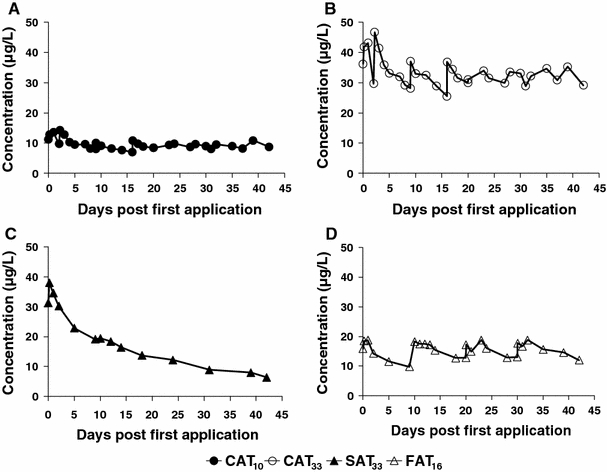
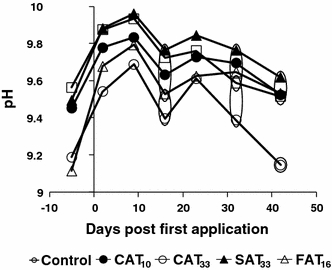
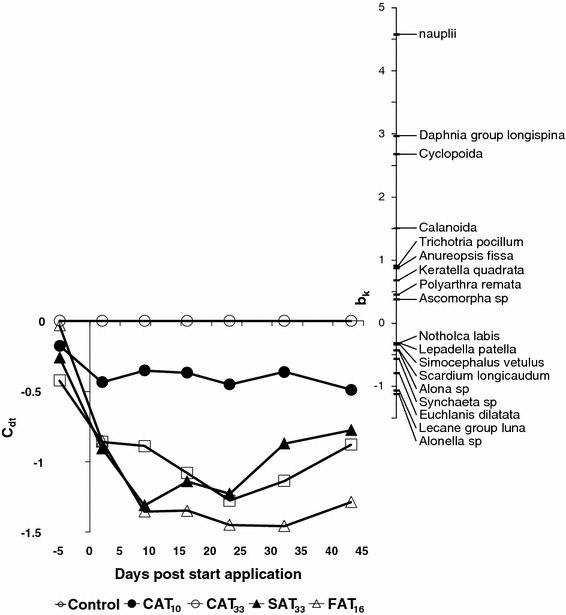
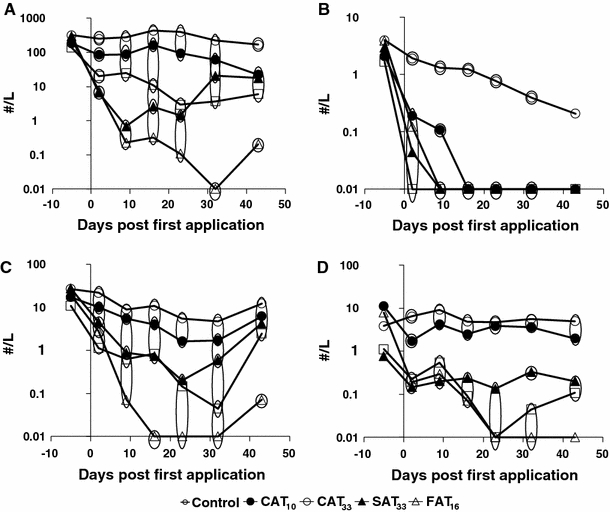
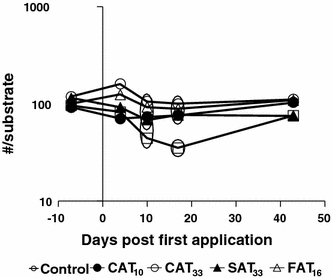
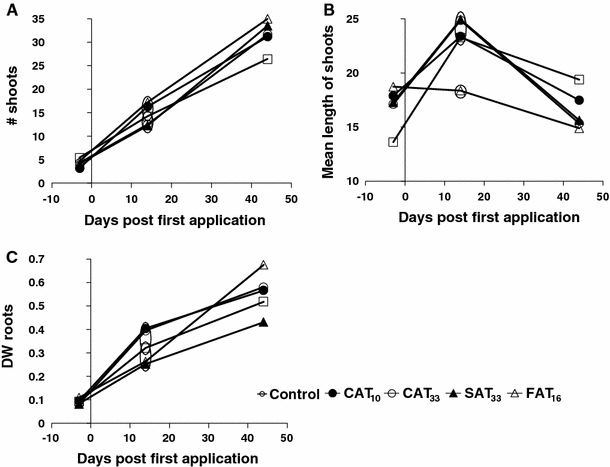
This paper evaluates the effects of different time-varying exposure patterns of the strobilurin fungicide azoxystrobin on freshwater microsocosm communities. These exposure patterns included two treatments with a similar peak but different time-weighted average (TWA) concentrations, and two treatments with similar TWA but different peak concentrations. The experiment was carried out in outdoor microcosms under four different exposure regimes; (1) a continuous application treatment of 10 μg/L (CAT(10)) for 42 days (2), a continuous application treatment of 33 μg/L (CAT(33)) for 42 days (3), a single application treatment of 33 μg/L (SAT(33)) and (4) a four application treatment of 16 μg/L (FAT(16)), with a time interval of 10 days. Mean measured 42-d TWA concentrations in the different treatments were 9.4 μg/L (CAT(10)), 32.8 μg/L (CAT(33)), 14.9 μg/L (SAT(33)) and 14.7 μg/L (FAT(16)). Multivariate analyses demonstrated significant changes in zooplankton community structure in all but the CAT(10) treated microcosms relative to that of controls. The largest adverse effects were reported for zooplankton taxa belonging to Copepoda and Cladocera. By the end of the experimental period (day 42 after treatment), community effects were of similar magnitude for the pulsed treatment regimes, although the magnitude of the initial effect was larger in the SAT(33) treatment. This indicates that for long-term effects the TWA is more important for most zooplankton species in the test system than the peak concentration. Azoxystrobin only slightly affected some species of the macroinvertebrate, phytoplankton and macrophyte assemblages. The overall no observed ecologically adverse effect concentrations (NOEAEC) in this study was 10 µg/L.
本文评估了不同时间变化的唑菌胺酯杀菌剂暴露模式对淡水微宇宙群落的影响。这些暴露模式包括两种处理方式,它们的峰值相似,但时间加权平均值(TWA)浓度不同;以及两种 TWA 相似但峰值浓度不同的处理方式。该实验在四个不同的暴露条件下于户外微宇宙中进行;(1)持续应用 10μg/L(CAT(10))42 天,(2)持续应用 33μg/L(CAT(33))42 天,(3)单次应用 33μg/L(SAT(33)),(4)四次应用 16μg/L(FAT(16)),间隔 10 天。不同处理方式下的 42 天 TWA 浓度分别为 9.4μg/L(CAT(10))、32.8μg/L(CAT(33))、14.9μg/L(SAT(33))和 14.7μg/L(FAT(16))。多变量分析表明,除 CAT(10)处理的微宇宙外,所有处理方式的浮游动物群落结构均发生了显著变化。受影响最大的是属于桡足类和枝角类的浮游动物类群。在实验结束时(处理后第 42 天),脉冲处理方式对浮游动物的影响相似,但 SAT(33)处理的初始影响较大。这表明,对于长期影响,TWA 比峰值浓度对测试系统中的大多数浮游动物物种更为重要。唑菌胺酯仅对某些大型无脊椎动物、浮游植物和大型植物群落的物种略有影响。本研究的无观察到生态不良效应浓度(NOEAEC)总体为 10μg/L。