IBB--Institute for Biotechnology and Bioengineering, Centre of Biological Engineering, Universidade do Minho, Campus de Gualtar, 4700-057 Braga, Portugal.
Virol J. 2012 Jan 27;9:35. doi: 10.1186/1743-422X-9-35.
Campylobacter is the leading cause of foodborne diseases worldwide. Bacteriophages (phages) are naturally occurring predators of bacteria, ubiquitous in the environment, with high host specificity and thus considered an appealing option to control bacterial pathogens. Nevertheless for an effective use of phages as antimicrobial agents, it is important to understand phage biology which renders crucial the analysis of phage genomes and proteomes. The lack of sequence data from Campylobacter phages adds further importance to these studies.
vB_CcoM-IBB_35 is a broad lytic spectrum Myoviridae Campylobacter phage with high potential for therapeutic use. The genome of this phage was obtained by pyrosequencing and the sequence data was further analyzed. The proteomic analysis was performed by SDS-PAGE and Mass spectrometry.
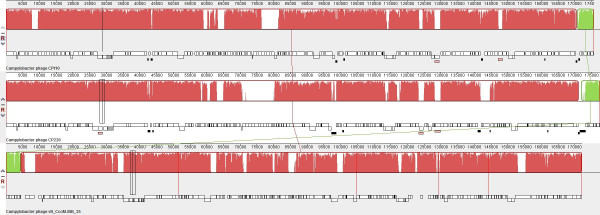
The DNA sequence data of vB_CcoM-IBB_35 consists of five contigs for a total of 172,065 bp with an average GC content of 27%. Attempts to close the gaps between contigs were unsuccessful since the DNA preparations appear to contain substances that inhibited Taq and ϕ29 polymerases. From the 210 identified ORFs, around 60% represent proteins that were not functionally assigned. Homology exists with members of the Teequatrovirinae namely for T4 proteins involved in morphogenesis, nucleotide metabolism, transcription, DNA replication and recombination. Tandem mass spectrometric analysis revealed 38 structural proteins as part of the mature phage particle.
Genes encoding proteins involved in the carbohydrate metabolism along with several incidences of gene duplications, split genes with inteins and introns have been rarely found in other phage genomes yet are found in this phage. We identified the genes encoding for tail fibres and for the lytic cassette, this later, expressing enzymes for bacterial capsular polysaccharides (CPS) degradation, which has not been reported before for Campylobacter phages.
弯曲菌是全球食源性疾病的主要原因。噬菌体(phages)是细菌的天然捕食者,广泛存在于环境中,具有高度的宿主特异性,因此被认为是控制细菌病原体的一种有吸引力的选择。然而,为了有效地将噬菌体用作抗菌剂,了解噬菌体的生物学特性至关重要,这使得分析噬菌体的基因组和蛋白质组变得至关重要。弯曲菌噬菌体缺乏序列数据,这使得这些研究更加重要。
vB_CcoM-IBB_35 是一种广泛裂解谱的肌尾噬菌体,具有很高的治疗应用潜力。该噬菌体的基因组通过焦磷酸测序获得,进一步分析了序列数据。蛋白质组分析通过 SDS-PAGE 和质谱法进行。
vB_CcoM-IBB_35 的 DNA 序列数据由五个连续体组成,总共有 172065bp,平均 GC 含量为 27%。由于 DNA 制剂似乎含有抑制 Taq 和 ϕ29 聚合酶的物质,因此无法成功缩小连续体之间的差距。在鉴定的 210 个 ORF 中,约 60%代表未被功能赋予的蛋白质。与 Teequatrovirinae 的成员存在同源性,例如参与形态发生、核苷酸代谢、转录、DNA 复制和重组的 T4 蛋白。串联质谱分析显示 38 种结构蛋白是成熟噬菌体颗粒的一部分。
编码参与碳水化合物代谢的蛋白质的基因以及几个基因重复、带有内含子的分裂基因和内含子在其他噬菌体基因组中很少发现,但在这种噬菌体中发现了。我们鉴定了编码尾部纤维和裂解盒的基因,后者表达用于细菌荚膜多糖 (CPS) 降解的酶,这在以前的弯曲菌噬菌体中没有报道过。