Duke-NUS Graduate Medical School, Singapore, Singapore.
Heart. 2012 Mar;98(6):443-9. doi: 10.1136/heartjnl-2011-301317. Epub 2012 Jan 27.
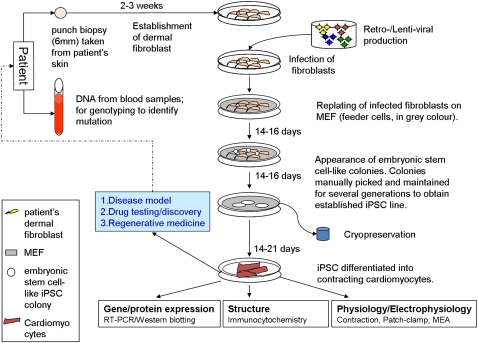
The emergence of induced pluripotent stem cell (iPSC) technology has had a great impact on the field of medicine ever since the ground-breaking discovery in 2006 that overexpression of four specific transcription factors was able to turn back the developmental clock of somatic cells into an embryonic-like state. The resulting iPSCs carry the developmental potential of human embryonic stem cells (hESC) without the embryo and have been heralded as a powerful tool to study development and disease. This technology has made it possible for the first time for researchers to transform end-differentiated cells from a particular individual into another cell type that remains specific to that individual, paving the way for novel methods of in vitro disease modelling and therapeutic applications. This paper reviews some of the key areas in cardiovascular medicine in which iPSC technology has been applied and discusses the future directions and ongoing challenges ahead in this exciting field.
诱导多能干细胞(iPSC)技术自 2006 年开创性发现以来,对医学领域产生了重大影响。该发现表明,过度表达四种特定转录因子能够使体细胞的发育时钟倒回到胚胎样状态。由此产生的 iPSC 具有人类胚胎干细胞(hESC)的发育潜力,而无需胚胎,被誉为研究发育和疾病的强大工具。该技术首次使研究人员能够将特定个体的终末分化细胞转化为另一种仍然特定于该个体的细胞类型,为体外疾病建模和治疗应用的新方法铺平了道路。本文综述了 iPSC 技术在心血管医学中的一些关键领域,并讨论了这一令人兴奋的领域未来的发展方向和持续挑战。