Iwata Human Receptor Crystallography Project, ERATO, Japan Science and Technology Agency, Yoshidakonoe-cho, Sakyo-ku, Kyoto 606-8501, Japan.
Nature. 2012 Jan 29;482(7384):237-40. doi: 10.1038/nature10750.
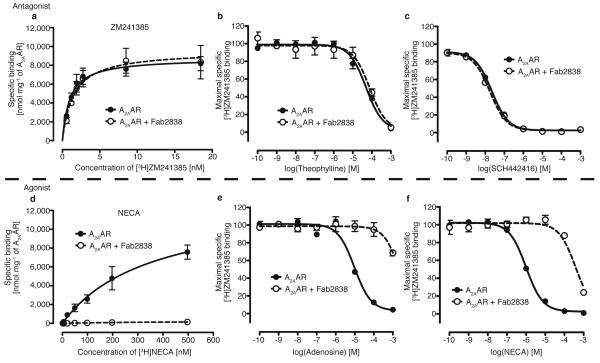
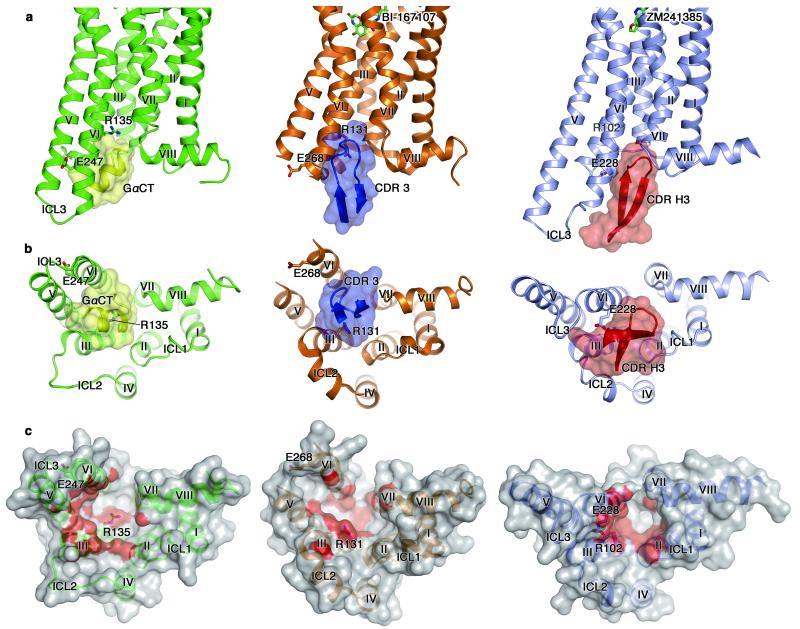
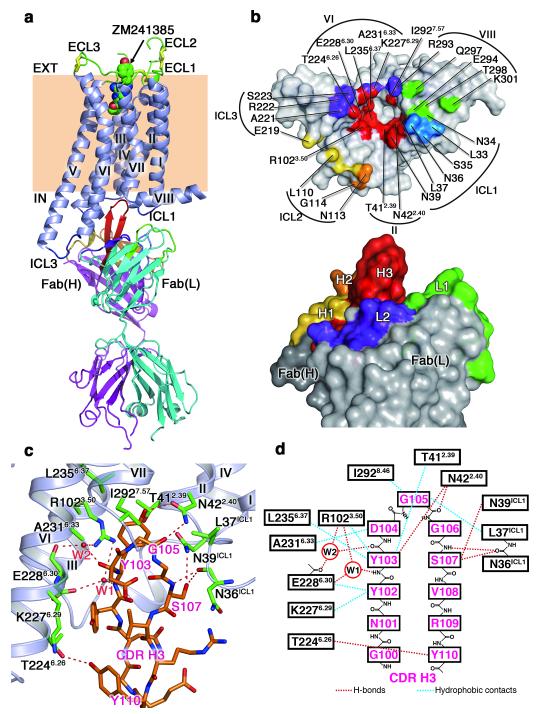
G-protein-coupled receptors are the largest class of cell-surface receptors, and these membrane proteins exist in equilibrium between inactive and active states. Conformational changes induced by extracellular ligands binding to G-protein-coupled receptors result in a cellular response through the activation of G proteins. The A(2A) adenosine receptor (A(2A)AR) is responsible for regulating blood flow to the cardiac muscle and is important in the regulation of glutamate and dopamine release in the brain. Here we report the raising of a mouse monoclonal antibody against human A(2A)AR that prevents agonist but not antagonist binding to the extracellular ligand-binding pocket, and describe the structure of A(2A)AR in complex with the antibody Fab fragment (Fab2838). This structure reveals that Fab2838 recognizes the intracellular surface of A(2A)AR and that its complementarity-determining region, CDR-H3, penetrates into the receptor. CDR-H3 is located in a similar position to the G-protein carboxy-terminal fragment in the active opsin structure and to CDR-3 of the nanobody in the active β(2)-adrenergic receptor structure, but locks A(2A)AR in an inactive conformation. These results suggest a new strategy to modulate the activity of G-protein-coupled receptors.
G 蛋白偶联受体是细胞表面受体中最大的一类,这些膜蛋白在非活性和活性状态之间处于平衡状态。细胞外配体与 G 蛋白偶联受体结合诱导的构象变化通过激活 G 蛋白导致细胞反应。A(2A) 腺苷受体 (A(2A)AR) 负责调节心肌的血流量,并且在大脑中调节谷氨酸和多巴胺的释放中很重要。在这里,我们报告了一种针对人 A(2A)AR 的小鼠单克隆抗体的产生,该抗体可防止激动剂但不阻止拮抗剂与细胞外配体结合口袋结合,并描述了 A(2A)AR 与抗体 Fab 片段 (Fab2838) 复合物的结构。该结构表明 Fab2838 识别 A(2A)AR 的细胞内表面,并且其互补决定区 CDR-H3 穿透到受体中。CDR-H3 位于与活性视蛋白结构中的 G 蛋白羧基末端片段和活性β(2)-肾上腺素能受体结构中的纳米体 CDR-3 相似的位置,但将 A(2A)AR 锁定在非活性构象中。这些结果表明了一种调节 G 蛋白偶联受体活性的新策略。