Department of Chemistry, Pohang University of Science & Technology, Pohang 790-784, Korea; E-Mail:
Sensors (Basel). 2009;9(12):9513-32. doi: 10.3390/s91209513. Epub 2009 Nov 26.
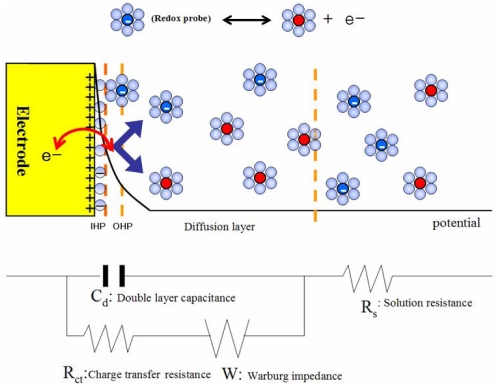
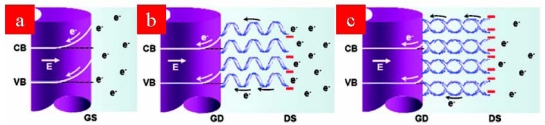
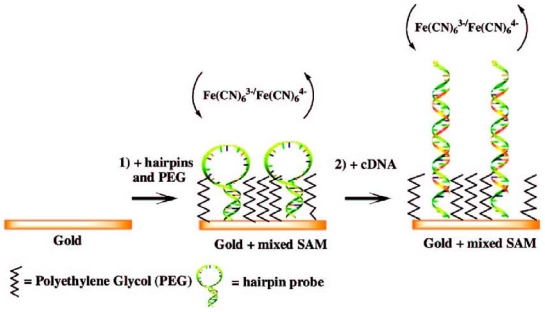
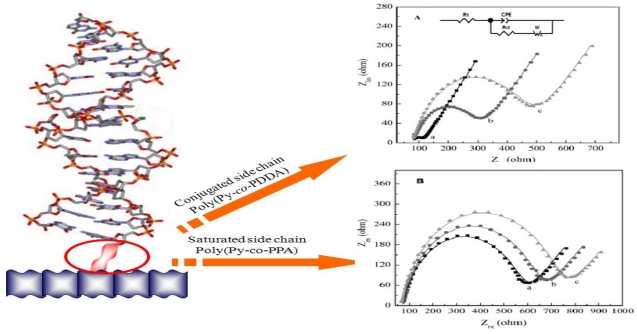
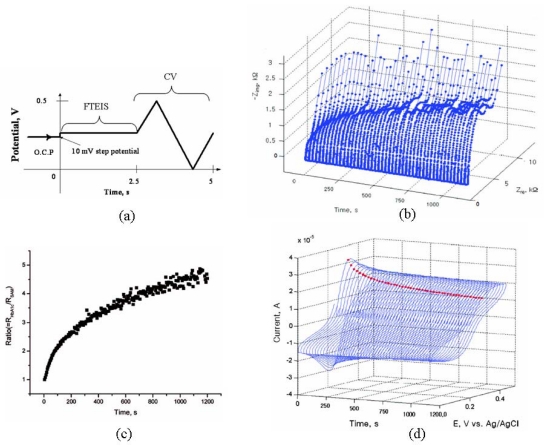
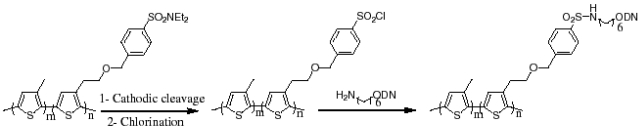
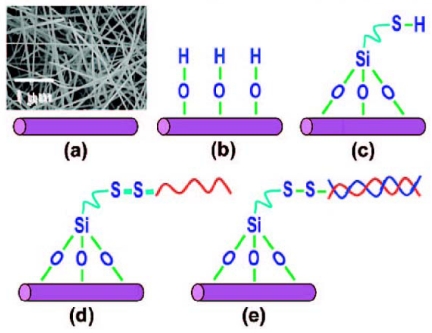
Recent advances in label free DNA hybridization sensors employing electrochemical impedance spectroscopy (EIS) as a detection tool are reviewed. These sensors are based on the modulation of the blocking ability of an electrode modified with a probe DNA by an analyte, i.e., target DNA. The probe DNA is immobilized on a self-assembled monolayer, a conducting polymer film, or a layer of nanostructures on the electrode such that desired probe DNA would selectively hybridize with target DNA. The rate of charge transfer from the electrode thus modified to a redox indicator, e.g., Fe(CN)(6), which is measured by EIS in the form of charge transfer resistance (R(ct)), is modulated by whether or not, as well as how much, the intended target DNA is selectively hybridized. Efforts made to enhance the selectivity as well as the sensitivity of DNA sensors and to reduce the EIS measurement time are briefly described along with brief future perspectives in developing DNA sensors.
综述了无标记 DNA 杂交传感器的最新进展,这些传感器采用电化学阻抗谱 (EIS) 作为检测工具。这些传感器基于通过分析物(即靶 DNA)调制用探针 DNA 修饰的电极的阻断能力。探针 DNA 固定在自组装单层、导电聚合物膜或电极上的纳米结构层上,使得所需的探针 DNA能够与靶 DNA选择性杂交。通过 EIS 以电荷转移电阻 (R(ct)) 的形式测量从修饰后的电极到氧化还原指示剂(例如 Fe(CN)(6))的电荷转移速率,这取决于是否以及多少,目标 DNA 被选择性杂交。简要描述了提高 DNA 传感器的选择性和灵敏度以及缩短 EIS 测量时间的努力,并简要介绍了开发 DNA 传感器的未来展望。